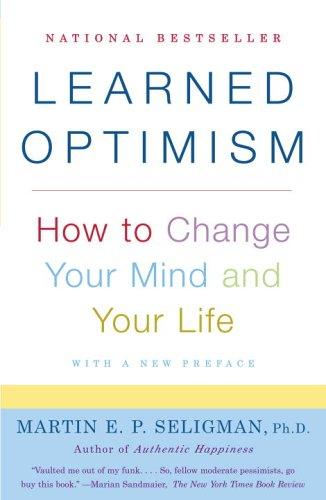
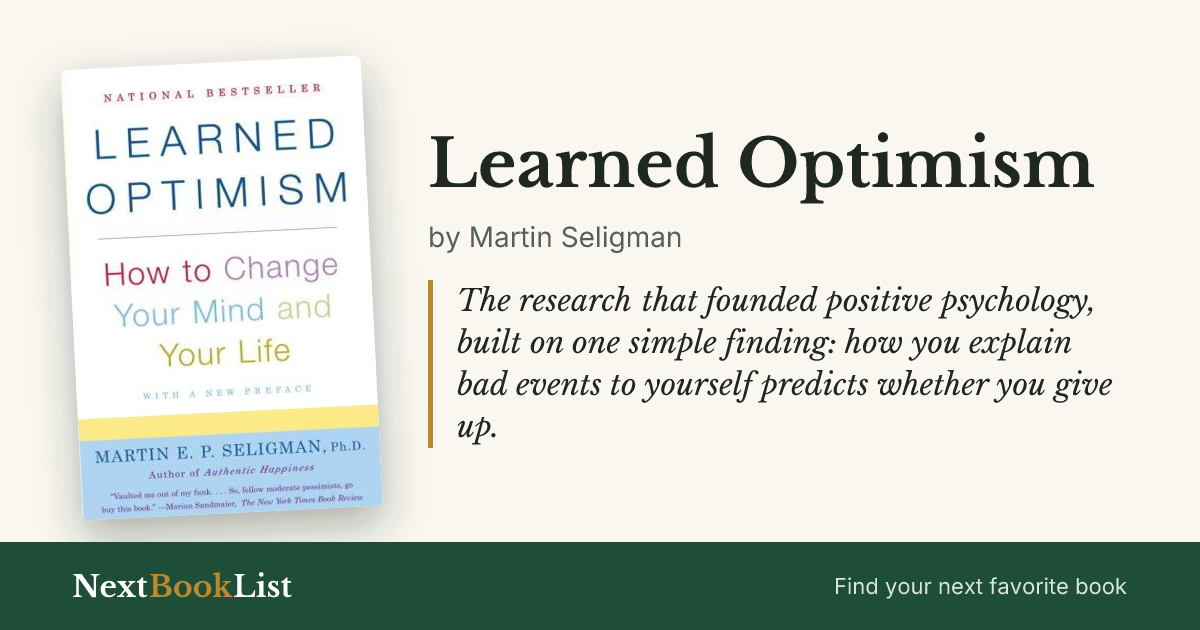
Learned Optimism
by Martin Seligman · 1991
The research that founded positive psychology, built on one simple finding: how you explain bad events to yourself predicts whether you give up.
Worth reading? Learned Optimism is the book that gave positive psychology its scientific footing, and the core finding still holds up: people who explain setbacks as permanent, pervasive, and personal ('I always fail, at everything, because of me') give up faster than people who explain the same setback as temporary, specific, and external. It's denser and more academic than Feeling Good, but it's also more rigorously evidenced -- read it if you want the why behind the technique, not just the technique.
| Full Title | Learned Optimism: How to Change Your Mind and Your Life |
|---|---|
| Author | Martin Seligman |
| Published | 1991 |
| Category | Self-Improvement & Psychology |
| Favorite quote | “Learned helplessness is the giving-up reaction, the quitting response that follows from the belief that whatever you do doesn't matter.” |
The Verdict
Seligman writes as a research psychologist, and the book carries the weight of decades of studies rather than anecdote, which makes it slower going than most books on this list but more convincing. The three-dimension framework (permanence, pervasiveness, personalization) is genuinely one of the more useful diagnostic tools in the whole self-improvement genre.
you want the research-backed case for why explanatory style shapes resilience, with a real test to diagnose your own
you want a quick motivational read, this is a research book first, with a self-help layer on top, and it reads accordingly
Book Summary
Seligman's explanatory style framework breaks down how people interpret bad events along three dimensions: permanence (is this forever or temporary?), pervasiveness (does this ruin everything or just this one thing?), and personalization (is this my fault entirely, or partly circumstance?). Pessimists default to permanent, pervasive, personal explanations for setbacks; optimists default to the opposite, and that difference predicts persistence, achievement, and even physical health outcomes.
Crucially, Seligman frames this as learned, not fixed -- explanatory style is a habit built through disputation, a CBT-adjacent technique where you actively argue against your own pessimistic explanation the way you'd argue against an unfair accusation from someone else. The book grew directly out of his earlier research on "learned helplessness," discovering the flip side: helplessness could be unlearned.
Top 7 Lessons from Learned Optimism
- Explanatory style (how you narrate setbacks to yourself) predicts resilience more than raw talent or circumstance.
- Check setbacks against three dimensions: is it permanent, pervasive, and personal, or temporary, specific, and situational?
- Pessimistic explanatory style correlates with higher rates of depression and even worse physical health outcomes.
- Dispute pessimistic explanations the way you'd argue against an unfair accusation from someone else.
- Learned helplessness (giving up after repeated uncontrollable failure) can be unlearned with deliberate practice.
- Optimism isn't about denying bad events -- it's about how you explain their cause and scope.
- Take the book's explanatory style test to diagnose your own default pattern before trying to change it.
Top 3 Quotes from Learned Optimism
"Learned helplessness is the giving-up reaction, the quitting response that follows from the belief that whatever you do doesn't matter."
Martin Seligman, Learned Optimism
"Pessimists give up more easily and get depressed more often."
Martin Seligman, Learned Optimism
"The defining characteristic of pessimists is that they tend to believe bad events will last a long time, will undermine everything they do, and are their own fault."
Martin Seligman, Learned Optimism
Frequently Asked Questions
Is Learned Optimism worth reading?
Yes, especially if you want the research behind resilience rather than just motivational advice. It's the foundational book of positive psychology and is more rigorously evidenced than most self-help on the shelf next to it.
What is the main idea of Learned Optimism?
How you explain setbacks to yourself along three dimensions -- permanence, pervasiveness, and personalization -- predicts your resilience, and pessimistic explanatory style can be changed through deliberate disputation.
Is Learned Optimism the same as positive thinking?
No. Seligman explicitly distinguishes it from blind positive thinking -- it's about accurately narrowing the scope and duration of a setback, not denying that it happened or pretending everything's fine.
How is Learned Optimism different from Feeling Good?
Feeling Good is a broader CBT workbook covering many cognitive distortions. Learned Optimism focuses specifically on explanatory style and is more research-heavy, growing out of Seligman's original studies on learned helplessness.
Ready to read it?
Get Learned Optimism on Amazon