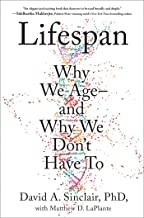
Lifespan
by David Sinclair · 2019
A Harvard genetics professor makes the case that aging isn't an inevitable fact of biology, it's a treatable disease, and argues we're closer to treating it than most people realize.
Worth reading? Sinclair's core reframe, that aging is a disease and therefore treatable rather than an unavoidable fact of existence, is the most useful idea in the book, whether or not you buy every specific mechanism he proposes. Read it for the argument and the practical hormesis-based habits (fasting, cold exposure, certain exercise); read outside sources too before you accept his more speculative claims as settled.
| Full Title | Lifespan: Why We Age -- and Why We Don't Have To |
|---|---|
| Author | David Sinclair |
| Published | 2019 |
| Publisher | Atria Books |
| Category | Science & Nature |
| Favorite quote | “Aging is a disease, and that disease is treatable.” |
The Verdict
Sinclair’s reframe, that aging is a disease and therefore a legitimate target for treatment rather than something to simply accept, is the idea worth taking from this book even if you’re skeptical of every specific mechanism he proposes. It changes the question from “how do I feel better while getting older” to “why are we treating this as inevitable at all.”
Where it gets shakier is in the more speculative territory – his own Information Theory of Aging, and some of the compounds and interventions his companies have a stake in. That doesn’t make the science wrong, but it’s a reason to read the more aggressive claims with real scrutiny rather than taking them as settled.
Read it if you want the actual argument behind the longevity movement from someone doing the research, not selling you a supplement. Skip the specific product recommendations, or at least verify them elsewhere, before treating them as proven.
you want the actual scientific argument behind the longevity movement, from a researcher who runs his own lab on it, not a supplement company's marketing
you want settled, consensus science -- Sinclair's central claims (aging as a treatable disease, his own theory of why we age) are genuinely contested within the scientific community, not universally accepted
Book Summary
Sinclair's central argument reframes aging itself as a disease rather than an inevitable natural process, built on his "Information Theory of Aging" -- the idea that aging results from a gradual loss of epigenetic information (which genes get turned on or off) rather than accumulated genetic damage alone, and that restoring that information could, in principle, reverse aging rather than just slow it.
The book argues certain mild, controlled stressors -- intermittent fasting, cold and heat exposure, specific types of exercise -- activate ancient "longevity genes" (sirtuins) that evolved to help organisms survive scarcity, a process called hormesis, and that deliberately invoking this stress response is one of the more evidence-backed practical levers available today, alongside more speculative interventions like NAD+ boosters that Sinclair's own lab studies.
Sinclair draws a hard distinction between lifespan and healthspan, arguing that extending how long people live without also extending how long they stay healthy would be a moral failure, not a win -- and that his research program's actual goal is compressing the period of age-related decline at the end of life, not just adding years at any cost.
Top 8 Lessons from Lifespan
- Aging can be reframed as a disease process with identifiable mechanisms, rather than an unavoidable fact of biology -- a framing that changes what counts as a legitimate research and treatment goal.
- Extending lifespan without also extending healthspan (years lived in good health) would be a moral failure, not a success, and shouldn't be the actual goal of longevity research.
- Mild, controlled stressors -- intermittent fasting, cold and heat exposure, certain intensities of exercise -- activate longevity genes (sirtuins) through a process called hormesis, more reliably than comfort ever does.
- The Information Theory of Aging proposes that aging results from a loss of epigenetic information (which genes are turned on or off), not just accumulated DNA damage -- a distinction that matters because information loss may, in principle, be reversible.
- Comfort and constant abundance may work against long-term health by never triggering the stress-response pathways the body evolved to survive scarcity.
- Some longevity interventions Sinclair studies (NAD+ boosters, specific gene therapies) remain genuinely speculative and unproven in humans, distinct from the better-evidenced lifestyle levers like fasting and exercise.
- A researcher's own financial and reputational stake in a field (Sinclair holds patents and runs companies in longevity science) is worth weighing alongside the science when evaluating specific product claims.
- Treating aging as treatable rather than inevitable changes healthcare's entire framing, from managing individual diseases of old age toward addressing their common root cause.
Top 4 Quotes from Lifespan
"Aging is a disease, and that disease is treatable."
David Sinclair, Lifespan
"Aging, quite simply, is a loss of information."
David Sinclair, Lifespan
"It does not matter if we can extend lifespans if we cannot extend healthspans to an equal extent."
David Sinclair, Lifespan
"We are analog, therefore we age."
David Sinclair, Lifespan
Frequently Asked Questions
Is Lifespan worth reading?
Yes -- it's the clearest, most direct case for treating aging as a disease rather than an inevitability, from a researcher actively working on it, though some of the more speculative claims deserve outside scrutiny before you act on them.
What is the main idea of Lifespan?
Aging results from a loss of epigenetic information rather than being an unavoidable natural process, and specific interventions (fasting, cold exposure, certain exercise, and more speculative compounds) may slow or partially reverse it.
Is David Sinclair's aging research scientifically accepted?
His core practical recommendations around hormesis (fasting, exercise, temperature exposure) are reasonably well-supported. His broader Information Theory of Aging and some product claims are genuinely more contested within the scientific community -- read this alongside other sources, not as settled consensus.
Does Lifespan give practical advice or is it mostly theory?
Both -- the first half is heavier on the underlying science and theory, while later chapters get into specific, actionable habits Sinclair himself practices.
Does Sinclair have a financial interest in the longevity claims he makes?
Yes -- he holds patents and has founded companies in the longevity space, which is worth factoring in when weighing his more product-specific claims, separate from the broader scientific argument.
Ready to read it?
Get Lifespan on Amazon