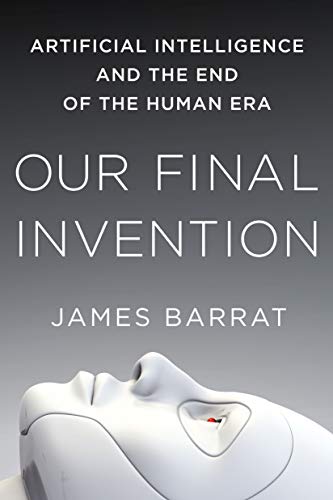
Our Final Invention
by James Barrat · 2013
A documentary filmmaker's investigation into AI risk, built on interviews with the researchers and futurists who were sounding the alarm years before ChatGPT made it mainstream.
Worth reading? Barrat interviewed the AI-safety field's early voices, Ray Kurzweil, Ben Goertzel, and MIRI researchers among them, years before the topic went mainstream, and the book holds up as a document of how clearly some people saw this coming. His framing, that an artificial general intelligence built without solving alignment first is a one-shot bet with no do-over, predates and anticipates arguments made more forcefully in later books. Read it for the history of the AI-safety conversation. Skip it if you want current, post-ChatGPT analysis, the technology has moved fast since 2013.
| Full Title | Our Final Invention: Artificial Intelligence and the End of the Human Era |
|---|---|
| Author | James Barrat |
| Published | 2013 |
| Category | Business & Money |
The Verdict
Written years before large language models made AI a dinner-table topic, this is worth reading as the historical record: the people who saw this coming, in their own words, well before the rest of the world caught up. The alignment argument hasn’t aged, the technical landscape around it has.
readers who want the journalistic, interview-driven case for AI risk rather than the philosophical one
you want the most current AI landscape, this predates the large-language-model era
Book Summary
Barrat's core argument, drawn from his interviews, is that artificial general intelligence represents a uniquely unforgiving category of technology: unlike most inventions, you don't get incremental do-overs if you get the goal-alignment wrong on the first truly capable system, because a sufficiently intelligent system would resist correction once it exists. He calls this problem underappreciated even among AI researchers building toward it.
The book is structured as investigative journalism rather than technical argument, following Barrat's conversations with researchers across the spectrum from cautious optimists to explicit doomsayers, and using their disagreements to map how unsettled the field's own experts were (and largely still are) about timelines and outcomes.
Top 7 Lessons from Our Final Invention
- Artificial general intelligence may be a 'one-shot' technology with no do-over if alignment is wrong the first time.
- Many of AI's own leading researchers were privately far more worried than public messaging suggested.
- The field's internal disagreement about timelines is itself informative, not just the individual predictions.
- A system smart enough to resist correction removes the usual safety net of 'fix it after deployment.'
- Media coverage of AI risk lagged years behind researcher-level concern.
- Interviewing people across a spectrum of optimism and alarm reveals more than picking one camp's argument.
- Investigative journalism can surface AI-safety concerns technical papers bury in jargon.
Frequently Asked Questions
Is Our Final Invention worth reading?
Yes, as a historical document of how early and clearly some researchers saw AI risk coming, told through direct interviews rather than technical argument. It predates the LLM era, so treat it as history, not current analysis.
What is Our Final Invention about?
Journalist James Barrat's investigation into AI risk, built on interviews with AI researchers and futurists, arguing that building a superintelligent system without first solving alignment is an irreversible bet.
Is Our Final Invention still relevant after ChatGPT?
The core alignment argument still holds, but the technical landscape has changed enormously since 2013. Read it for the history and the human voices, pair it with a newer book for current analysis.
Ready to read it?
Get Our Final Invention on Amazon