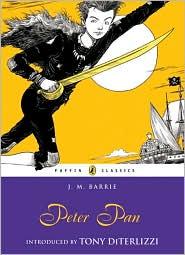
Peter Pan
by J.M. Barrie · 1911
The boy who refuses to grow up flies a Victorian family off to a magical island of pirates, mermaids, and lost boys -- and the actual novel is darker and stranger than the Disney version.
Worth reading? Peter Pan the novel is a stranger, sadder book than the cultural memory of Peter Pan -- Barrie keeps reminding you that Peter forgets everyone he loves, and that childhood ending is a real loss, not just an inconvenience. Read it once as an adult and you'll notice the story is doing something the Disney movie never attempted.
| Full Title | Peter and Wendy |
|---|---|
| Author | J.M. Barrie |
| Published | 1911 |
| Category | Fiction |
| Favorite quote | “Second to the right, and then straight on till morning.” |
The Verdict
The line that sticks with most adult readers isn’t from the movie at all – it’s Barrie’s narrator quietly noting, almost in passing, how easily Peter forgets the people who love him. That’s the real engine of the book: freedom from growing up costs you your memory of everyone who mattered.
you want the source of Neverland, Tinker Bell, and Captain Hook, told in Barrie's own narrative voice -- wry, melancholy, and far more interested in loss and mortality than the movie lets on
you want a straightforwardly cheerful children's book -- Barrie undercuts the whimsy constantly with reminders that Peter's forgetfulness and refusal to grow up are genuinely sad, not just charming
Book Summary
Peter's refusal to grow up is framed as both a freedom and a tragedy at once. Neverland gives him endless adventure and no consequences, but the cost is a kind of permanent forgetting -- he can't hold onto people, past adventures, or even his own history for long.
Wendy's arc runs the opposite direction: she's drawn to Neverland's freedom but ultimately chooses to grow up, take on a maternal role, and return home. Barrie uses the contrast between the two to argue, gently but insistently, that growing up is a loss worth having -- because the alternative is a kind of beautiful, hollow stasis.
Top 8 Lessons from Peter Pan
- The Darling children fly to Neverland with Peter Pan after Tinker Bell sprinkles them with fairy dust.
- Neverland is populated by lost boys, pirates led by Captain Hook, and mermaids, functioning as an externalized version of childhood imagination.
- Captain Hook's fear of the crocodile that ate his hand -- and swallowed a ticking clock along with it -- is Barrie's recurring symbol of time and mortality chasing even Neverland's villains.
- Peter's chronic forgetfulness, including forgetting Hook and past adventures, is presented as the real cost of never growing up.
- Wendy is drawn toward Neverland's freedom but ultimately chooses to grow up and return home, becoming a mother figure to the lost boys along the way.
- Tinker Bell's jealousy of Wendy, and her near-death from drinking poison meant for Peter, makes her a genuinely complex character rather than a simple sidekick.
- The final chapters jump forward in time, showing Wendy as an adult while Peter remains unchanged, underlining the book's real subject: the asymmetry between those who grow up and the one who doesn't.
- Barrie's narrator frequently breaks in with adult, melancholy asides about death and memory that undercut the story's surface whimsy.
Top 4 Quotes from Peter Pan
"Second to the right, and then straight on till morning."
J.M. Barrie, Peter Pan
"All children, except one, grow up."
J.M. Barrie, Peter Pan
"It is not in doing what you like, but in liking what you do that is the secret of happiness."
J.M. Barrie, Peter Pan
"When the first baby laughed for the first time, its laugh broke into a thousand pieces, and they all went skipping about, and that was the beginning of fairies."
J.M. Barrie, Peter Pan
Frequently Asked Questions
Is Peter Pan worth reading?
Yes -- the original novel is sadder and stranger than the Disney movie, with Barrie's own narrative voice constantly undercutting the whimsy with reminders about time and loss.
Is the book different from the Disney movie?
Yes, noticeably. The novel is darker, more melancholy, and spends more time on Peter's tragic forgetfulness than the film's lighter adventure tone suggests.
Is Peter Pan appropriate for kids?
Yes, it's a children's classic, though some of its themes -- death, memory, being forgotten -- land differently for adult readers than for children.
Who should read Peter Pan?
Anyone who only knows the Disney version and wants to see how much darker and more thoughtful the source material actually is.
Ready to read it?
Get Peter Pan on Amazon