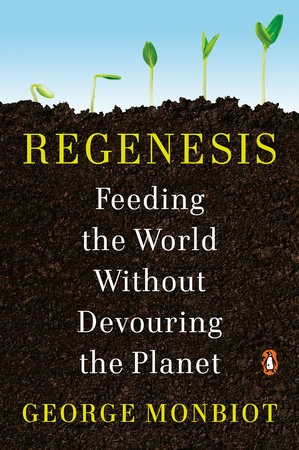
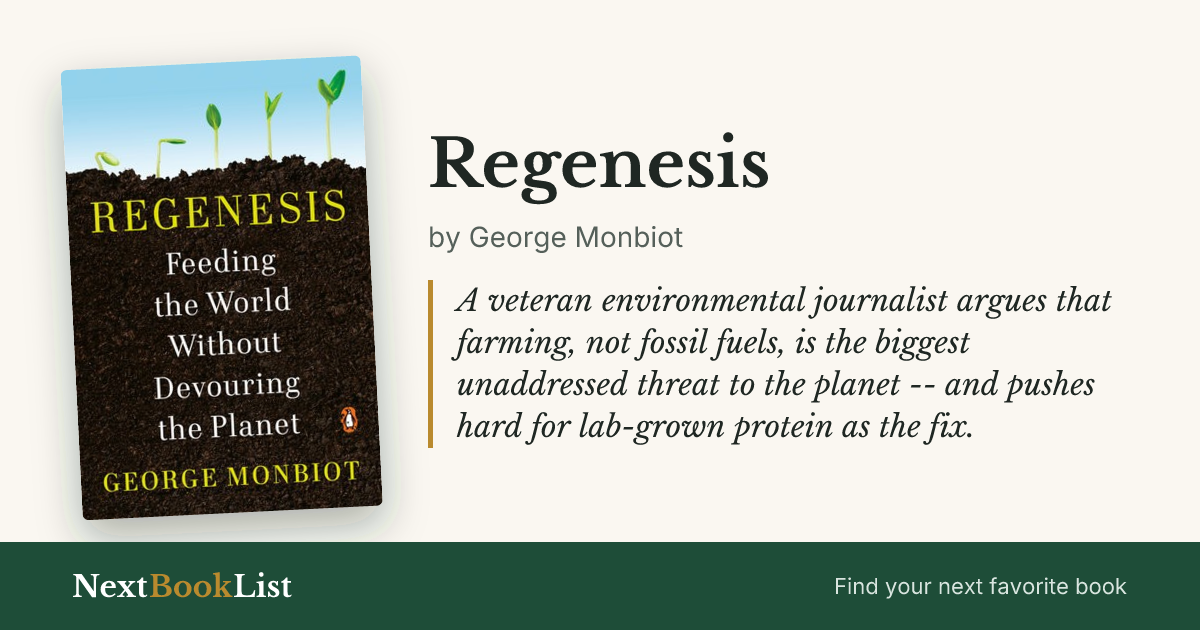
Regenesis
by George Monbiot · 2022
A veteran environmental journalist argues that farming, not fossil fuels, is the biggest unaddressed threat to the planet -- and pushes hard for lab-grown protein as the fix.
Worth reading? Monbiot's real contribution is reframing the environmental conversation away from just energy and toward farming -- he makes a detailed, well-sourced case that agriculture (especially livestock) drives a disproportionate share of habitat loss, soil degradation, and biodiversity collapse, using real time studying soil science alongside farmers and researchers. Where the book gets more polarizing is his enthusiastic advocacy for precision fermentation -- growing protein from microbes in vats rather than from animals or even most plants -- as a central solution; it's a genuinely researched position, not a hand-wave, but it's advocacy, not neutral survey. It beats a typical sustainable-agriculture book by going deeper into soil biology than most readers expect and by being willing to propose a solution most environmental writers wouldn't touch.
| Full Title | Regenesis: Feeding the World Without Devouring the Planet |
|---|---|
| Author | George Monbiot |
| Published | 2022 |
| Publisher | Penguin Books |
| Category | Science & Nature |
| Favorite quote | “Farming is the most destructive human activity ever to have blighted the Earth.” |
The Verdict
Monbiot’s case for treating farming, not just fossil fuels, as the central environmental problem is the part of this book that’s hardest to argue with. His enthusiasm for lab-grown protein as the fix is the part you’re allowed to stay skeptical of – but even then, it’s a researched position, not a hand-wave.
you want a provocative, well-reported case that modern agriculture (not just energy) is the central environmental problem, including a serious look at soil science and food-from-microbes
you're skeptical of lab-grown/precision-fermentation food solutions on principle -- Monbiot is a genuine advocate here, not a neutral surveyor of options
Book Summary
Farming -- not just fossil fuel combustion -- is the primary driver of habitat destruction, biodiversity loss, and soil degradation globally, and Monbiot argues this gets radically less attention in mainstream environmental discourse than energy does, despite arguably being just as urgent.
Healthy soil is a living, complex ecosystem (not an inert growing medium), and Monbiot spends considerable time with soil scientists and farmers documenting how conventional tillage and monoculture farming degrade this living system in ways that compound over time, threatening long-term food security independent of climate change.
Precision fermentation -- growing protein and fats from microbes in vats, using a fraction of the land and water that livestock or even most crops require -- is, per Monbiot, the most promising path to feeding a growing population while returning enormous amounts of farmland to wild habitat, a technology he actively advocates for rather than merely surveys.
Rewilding large amounts of current farmland (made possible by more efficient food production elsewhere) could reverse biodiversity loss at a scale most other environmental interventions can't match, if land currently used for low-yield livestock grazing were freed up.
Top 8 Lessons from Regenesis
- Farming, more than energy, may be the single largest driver of global habitat destruction and biodiversity loss.
- Healthy soil is a complex, living ecosystem, and conventional tillage and monoculture farming degrade it in ways that compound over time.
- Precision fermentation -- growing protein and fats from microbes in vats -- uses drastically less land and water than livestock farming.
- Freeing up land currently used for low-yield livestock grazing could allow large-scale rewilding and biodiversity recovery.
- Monbiot argues soil degradation threatens long-term food security independent of, and alongside, climate change.
- Precision fermentation is presented as advocacy for a specific technological solution, not a neutral survey of all options.
- Livestock farming uses a disproportionate share of agricultural land relative to the calories and protein it produces.
- Direct fieldwork with soil scientists and farmers grounds the book's claims about soil ecosystem complexity in observed research, not just theory.
Top 3 Quotes from Regenesis
"Farming is the most destructive human activity ever to have blighted the Earth."
George Monbiot, Regenesis
"Our loyalties are to the aesthetics, not the evidence. We are seduced by the way things look, and overlook the way they function. But beauty is seldom truth, and truth is seldom beauty."
George Monbiot, Regenesis
"Scientists at Germany's Max Planck Institute have found that as much as 40 percent of the rainfall in parts of East Africa appears to be caused by farmers watering their fields in India, Pakistan, and Bangladesh, between 4,000 and 6,000 kilometers away."
George Monbiot, Regenesis
Frequently Asked Questions
Is Regenesis worth reading?
Yes, if you want a provocative, well-researched reframing of environmental priorities toward farming and soil, including a serious (if advocacy-driven) case for lab-grown protein as a solution.
What is Regenesis about?
George Monbiot's argument that farming, more than fossil fuels, is the central unaddressed environmental threat, covering soil science, biodiversity loss from agriculture, and precision fermentation as a proposed fix.
Does Regenesis support lab-grown food?
Yes -- Monbiot is an active advocate for precision fermentation (growing protein from microbes), arguing it could free up enormous amounts of farmland for rewilding. This is his stated position, not a neutral comparison of options.
Is Regenesis mainly about climate change?
No -- while climate change is discussed, the book's central focus is on farming's impact on soil health and biodiversity, which Monbiot argues gets far less attention than energy in mainstream environmental discourse.
Ready to read it?
Get Regenesis on Amazon