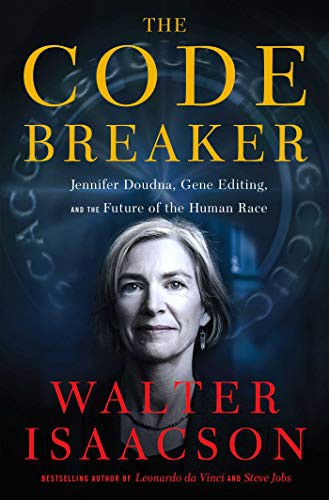
The Code Breaker
by Walter Isaacson · 2021
Isaacson's biography of Jennifer Doudna, co-inventor of CRISPR gene editing, doubles as a real-time account of how her discovery became central to the COVID-19 response -- and a clear-eyed look at the ethical questions gene editing raises for every generation after this one.
Worth reading? The Code Breaker works because Isaacson applies his usual formula (Einstein, Jobs, Leonardo) to a story that's still unfolding, and it pays off -- Doudna's CRISPR work becomes directly relevant to COVID-19 testing and vaccine science partway through the book, so the stakes stop being hypothetical. The chapters on the He Jiankui gene-edited babies scandal are the most unsettling in the book precisely because Isaacson doesn't resolve the ethical questions neatly.
| Full Title | The Code Breaker: Jennifer Doudna, Gene Editing, and the Future of the Human Race |
|---|---|
| Author | Walter Isaacson |
| Published | 2021 |
| Publisher | Simon & Schuster |
| Category | Science & Nature |
| Favorite quote | “The rise of that new industry, based on the ability to sequence, edit, and now write DNA, is likely to be, for better or worse, the most significant innovation of our era.” |
The Verdict
Isaacson’s formula (a genius, their rivals, the moment their work changes the world) has worked on Einstein and Jobs, and it works here too, but with a twist: this time the “changes the world” part happens mid-book, in real time, as CRISPR research gets redirected toward COVID-19 testing and vaccines.
The He Jiankui chapters are where the book earns its seriousness. Isaacson doesn’t let Doudna, or the reader, off the hook with an easy verdict on gene-edited babies – he shows the scientific community genuinely split on where the line between treatment and enhancement should sit.
Read it if you want CRISPR explained through the people who built it, with the ethical stakes treated as unresolved rather than tidy. Skip it if you want molecular-biology-level technical depth – this is character-driven science writing, not a lab manual.
you want a biography-driven explanation of CRISPR and gene editing that treats the science, the scientists' rivalries, and the ethics with equal seriousness, in Isaacson's usual character-first style
you want a purely technical molecular biology text -- Isaacson simplifies the science in service of narrative and character, which works for a general reader but won't satisfy someone wanting lab-level detail
Book Summary
The book traces Jennifer Doudna's path from a childhood fascination with DNA structure through her co-discovery, with Emmanuelle Charpentier, of CRISPR-Cas9 as a programmable gene-editing tool, and the fierce patent and credit disputes with Feng Zhang's lab that followed a discovery this consequential.
Isaacson uses CRISPR's arrival at a moment of global crisis to show the science becoming immediately practical: gene-editing techniques and expertise developed for CRISPR research were rapidly redirected toward COVID-19 detection and vaccine research once the pandemic began.
The book treats the 2018 case of He Jiankui, the Chinese scientist who used CRISPR to edit the genomes of twin embryos, as the moment the field's abstract ethical debates about designer babies and germline editing became concrete and impossible to ignore, and Isaacson lets the discomfort sit rather than offering a tidy resolution.
Top 8 Lessons from The Code Breaker
- CRISPR-Cas9, developed largely through Jennifer Doudna and Emmanuelle Charpentier's research, turned a naturally occurring bacterial immune mechanism into a programmable tool for precisely editing DNA.
- Major scientific breakthroughs often involve fierce, unresolved disputes over credit and patents -- the CRISPR patent fight between Doudna and Charpentier's team and Feng Zhang's lab shaped both scientific reputations and commercial licensing for years.
- Doudna and Charpentier were awarded the 2020 Nobel Prize in Chemistry for developing CRISPR-Cas9 gene editing, one of the fastest Nobel recognitions of a major discovery in the prize's history.
- Gene-editing infrastructure and expertise built for CRISPR research proved directly useful once the COVID-19 pandemic began, accelerating both diagnostic testing methods and vaccine research.
- He Jiankui's 2018 creation of gene-edited twin embryos in China turned abstract bioethics debates about germline editing into a concrete, global controversy almost overnight, and drew widespread condemnation from the scientific community.
- CRISPR raises a real distinction between editing genes to treat disease (widely accepted as an ethical goal) and editing genes for enhancement or trait selection (far more contested), a line the book keeps returning to.
- Doudna's own reaction to seeing CRISPR's potential, reportedly including anxiety dreams about the technology's misuse, is used by Isaacson to humanize the weight scientists carry when their work has civilization-scale implications.
- Isaacson frames the CRISPR story as part of a longer arc from the discovery of DNA's structure to the current era of programmable biology, comparing gene editing's disruptive potential to the personal computer and internet revolutions he's chronicled in his other biographies.
Top 4 Quotes from The Code Breaker
"The rise of that new industry, based on the ability to sequence, edit, and now write DNA, is likely to be, for better or worse, the most significant innovation of our era."
Walter Isaacson, The Code Breaker
"We have entered a third and even more momentous era, a life-science revolution. Children who study digital coding will be joined by those who study genetic code."
Walter Isaacson, The Code Breaker
"The beauty of nature and the joy that comes from unstructured human engagement is a powerful combination."
Walter Isaacson, The Code Breaker
"The key to innovation is connecting a curiosity about basic science to the practical work of devising tools that can be applied to our lives -- moving discoveries from lab bench to bedside."
Walter Isaacson, The Code Breaker
Frequently Asked Questions
Is The Code Breaker worth reading?
Yes -- it's an accessible biography-driven explanation of CRISPR gene editing that stays relevant by tying the science directly to COVID-19 and current ethical debates.
What is The Code Breaker about?
Walter Isaacson's biography of Jennifer Doudna, co-discoverer of CRISPR gene editing, covering the science, the patent disputes, her Nobel Prize, and the ethical questions gene editing raises.
Do I need a biology background to read The Code Breaker?
No -- Isaacson explains the molecular biology in accessible terms as part of the narrative, prioritizing character and story over lab-level technical detail.
Does The Code Breaker cover COVID-19?
Yes -- a significant part of the book covers how CRISPR-related research and expertise were redirected toward COVID-19 testing and vaccine development once the pandemic began.
Does the book take a side on gene-editing ethics?
Not firmly -- Isaacson lays out the arguments, especially around the He Jiankui gene-edited babies scandal, without resolving the ethical debate neatly for the reader.
Ready to read it?
Get The Code Breaker on Amazon