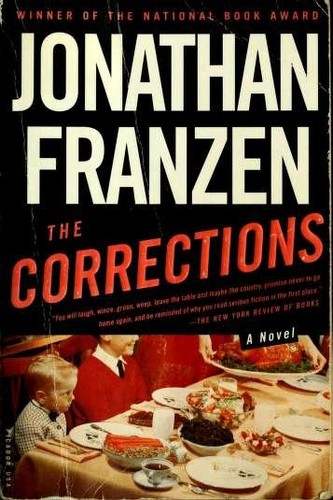
The Corrections
by Jonathan Franzen · 2001
A Midwestern couple's three adult children come home for one last Christmas while their father's mind quietly comes apart -- the novel that made literary fiction commercially viable again in 2001.
Worth reading? The Corrections is still Franzen's best book, tighter and funnier than his later Freedom despite being just as long. If you want the same family-dysfunction terrain with more warmth, try Anne Tyler; Franzen isn't interested in warmth, he's interested in precision, and that's what makes this one hold up.
| Author | Jonathan Franzen |
|---|---|
| Published | 2001 |
| Publisher | Picador |
| Category | Fiction |
| Favorite quote | “Without privacy there was no point in being an individual.” |
The Verdict
Franzen’s real trick here is making satire and genuine feeling coexist in the same paragraph – he can mock a character’s self-delusion and still make you feel the loneliness underneath it in the same breath. That balance is harder than it looks, and it’s the thing his imitators usually miss.
you want a big, satirical, psychologically dense family novel that nails turn-of-the-millennium American anxiety -- money, pharma, food trends, tech optimism -- through one deeply dysfunctional family
you want characters to root for -- the Lamberts are difficult people making difficult choices, and Franzen doesn't sand down their edges to make anyone likable
Book Summary
The Lambert family -- parents Alfred and Enid, and their three grown children -- each embody a different mode of "correction," a word Franzen borrows from the financial markets and applies to marriages, careers, and self-images that have been running on false premises for years.
Alfred's Parkinson's-driven mental decline anchors the plot, forcing Gary, Chip, and Denise home for one final Christmas and confronting each of them with unresolved resentment, status anxiety, and the gap between the adults they've become and the family mythology they grew up inside.
Underneath the family drama, the novel is a satire of turn-of-the-millennium American excess -- biotech hype, cruise ships, gourmet food culture, Eastern European economics -- treating the era's optimism as the backdrop to a very old-fashioned story about a family running out of ways to lie to itself.
Top 10 Lessons from The Corrections
- Alfred Lambert's Parkinson's-driven mental decline anchors the novel and forces his children home for one final Christmas.
- Enid Lambert's desperate wish for a normal, happy family holiday drives much of the plot's forced cheer and quiet despair.
- Gary, the eldest son, is a banker whose marriage and mental health are quietly falling apart behind a facade of success.
- Chip, the middle child, loses his academic career over an affair with a student and ends up entangled in a shady Eastern European investment scheme.
- Denise, the youngest, is a talented chef whose personal life is complicated by affairs that cross dangerous professional and family lines.
- Franzen uses the fictional drug Corecktall as a satirical stand-in for pharmaceutical promises of fixing the unfixable.
- The novel alternates between the Midwestern family home and the children's scattered, ambitious adult lives on the coasts.
- Money, status anxiety, and generational shame run under nearly every scene, even when the plot is ostensibly about something else.
- The book captures late-1990s American excess -- biotech hype, cruise culture, gourmet food trends -- as backdrop to a very old-fashioned family tragedy.
- Alfred's stubborn refusal to accept help or admit decline is presented as both his defining flaw and his last shred of dignity.
Top 4 Quotes from The Corrections
"Without privacy there was no point in being an individual."
Jonathan Franzen, The Corrections
"Fiction is a solution, the best solution, to the problem of existential solitude."
Jonathan Franzen, The Corrections
"He'd lost track of what he wanted, and since who a person was was what a person wanted, you could say that he'd lost track of himself."
Jonathan Franzen, The Corrections
"And meanwhile the sad truth was that not everyone could be extraordinary, not everyone could be extremely cool; because whom would this leave to be ordinary? Who would perform the thankless work of being comparatively uncool?"
Jonathan Franzen, The Corrections
Frequently Asked Questions
Is The Corrections worth reading?
Yes -- it's the sharpest American family novel of its era, funnier and tighter than Franzen's later Freedom, and it holds up two decades on.
What is The Corrections about?
A Midwestern couple's three adult children, each quietly falling apart in their own way, are pulled home for one final Christmas as their father's Parkinson's-driven decline forces a reckoning with the family's unresolved history.
Is The Corrections a hard read?
It's long and psychologically dense, but the prose itself is accessible and often very funny -- the difficulty is emotional, not stylistic.
Who should read The Corrections?
Readers who want a big, satirical family novel with real psychological depth. Skip it if you need likable characters to stay engaged.
Ready to read it?
Get The Corrections on Amazon