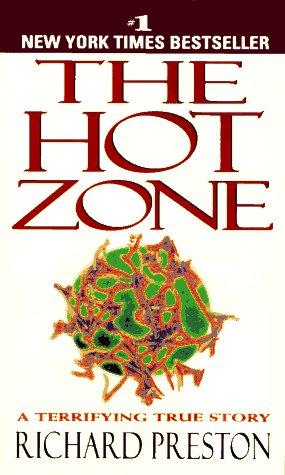
The Hot Zone
by Richard Preston · 1994
A strain of Ebola-like virus turns up in a monkey warehouse just outside Washington, D.C., and Preston tells the true story of the scientists who had to figure out, in real time, whether they were looking at the start of a catastrophic outbreak.
Worth reading? The Hot Zone reads like a thriller because the underlying event actually was one -- a filovirus outbreak in primates a short drive from the nation's capital, discovered by scientists who had to work out the threat level before knowing if it could infect and kill humans too. Preston's graphic detail on what these viruses do to the body is disturbing by design, not for shock value alone.
| Full Title | The Hot Zone: A Terrifying True Story |
|---|---|
| Author | Richard Preston |
| Published | 1994 |
| Publisher | Anchor Books |
| Category | Science & Nature |
| Favorite quote | “A hot virus from the rain forest lives within a twenty-four-hour plane flight from every city on earth.” |
The Verdict
Preston opens with Charles Monet’s death before the book even reaches its main event, and that choice does real work – by the time the Reston outbreak starts, you already know exactly what’s at stake if the virus turns out to be as lethal in humans as its relatives.
The scientists at the center of the book are working with genuinely incomplete information, and Preston doesn’t clean that up in hindsight – the tension comes from watching people make real decisions about biocontainment without knowing yet how dangerous the virus actually is.
Read it if you want thriller-paced science writing grounded in a real outbreak investigation. Skip it if graphic medical description of what hemorrhagic fever does to the human body is going to be more than you want to read.
you want science writing with the pacing of a thriller, grounded in a real outbreak investigation rather than invented tension
you're squeamish about graphic medical description -- Preston doesn't soften the details of what hemorrhagic fever viruses actually do to the human body
Book Summary
Preston opens with the story of Charles Monet, whose 1980 death from what appears to be a filovirus in Kenya establishes the terrifying baseline symptoms of hemorrhagic fever before the book moves to its central event.
In 1989, a shipment of monkeys imported to a research facility in Reston, Virginia, just outside Washington, D.C., begins dying of a virus that tests reveal to be closely related to Ebola, and U.S. Army scientists must determine in real time whether the strain is transmissible to and lethal for humans, and how to contain it.
The book uses the Reston outbreak, which ultimately proved not to cause serious illness in the humans exposed to it despite its close relation to deadlier Ebola strains, to explore the broader danger of filoviruses spreading from animal reservoirs to human populations, and how underprepared even sophisticated biocontainment systems were for a real outbreak.
Top 7 Lessons from The Hot Zone
- The book opens with a detailed account of Charles Monet's 1980 death from an apparent filovirus infection, establishing early on exactly how severe and fast-moving these diseases can be before the main story begins.
- The 1989 Reston, Virginia outbreak involved a virus closely related to Ebola found in imported research monkeys just outside Washington, D.C., putting a globally feared disease disturbingly close to a major U.S. population center.
- U.S. Army scientists at USAMRIID had to determine the outbreak's human risk level under real time pressure, illustrating how much outbreak response depends on incomplete information early in an event.
- The Reston strain proved not to cause serious illness in the humans who were exposed, a genuinely lucky outcome the book is careful not to present as evidence that all such outbreaks would end so mildly.
- Preston documents gaps and improvisation in the biocontainment response, showing that even specialized U.S. facilities were not fully prepared for handling a live, poorly understood hemorrhagic virus outbreak.
- The book links filovirus outbreaks to animal-to-human transmission from wildlife reservoirs, a mechanism now widely recognized as central to pandemic risk more broadly.
- Preston's detailed, clinical description of hemorrhagic fever symptoms is used deliberately to convey the actual stakes of the outbreak, not simply for narrative shock value.
Top 2 Quotes from The Hot Zone
"A hot virus from the rain forest lives within a twenty-four-hour plane flight from every city on earth."
Richard Preston, The Hot Zone
"In a sense, the Earth is mounting an immune response against the human species."
Richard Preston, The Hot Zone
Frequently Asked Questions
Is The Hot Zone worth reading?
Yes -- it's genuinely tense, thriller-paced science writing built on a real outbreak investigation, not invented drama.
What is The Hot Zone about?
The true story of a 1989 outbreak of an Ebola-related virus among research monkeys in Reston, Virginia, and the U.S. Army scientists who had to determine in real time whether it threatened the nearby human population.
Is The Hot Zone based on a true story?
Yes -- it's narrative nonfiction based on real events, including the 1989 Reston outbreak and the earlier case of Charles Monet's death from an apparent filovirus infection.
Did the Reston virus outbreak kill any humans?
No -- the Reston strain proved not to cause serious illness in the humans exposed to it, though the book is careful not to treat that outcome as typical for filovirus outbreaks generally.
Is The Hot Zone graphic?
Yes -- Preston describes the physical effects of hemorrhagic fever in detailed, clinical terms, which some readers find disturbing.
Ready to read it?
Get The Hot Zone on Amazon