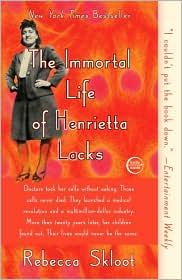
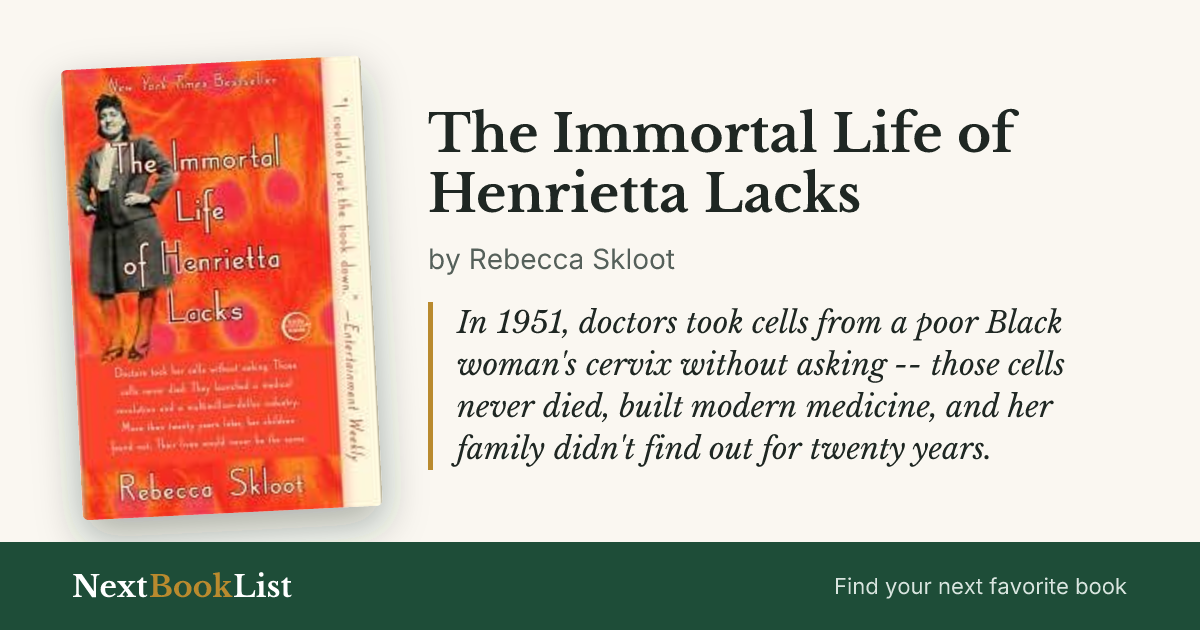
The Immortal Life of Henrietta Lacks
by Rebecca Skloot · 2010
In 1951, doctors took cells from a poor Black woman's cervix without asking -- those cells never died, built modern medicine, and her family didn't find out for twenty years.
Worth reading? This book works because Skloot refuses to let the science overshadow the person. Henrietta Lacks's cells (HeLa) enabled the polio vaccine, cancer research, IVF, and thousands of other breakthroughs, and for decades her own family didn't know her cells existed, let alone that they'd been bought and sold worldwide while the Lackses couldn't afford health insurance. Skloot spent over a decade earning the family's trust to tell this properly, and it shows -- it's as much a book about informed consent and medical racism as it is about cell biology, and it doesn't let either half off the hook.
| Author | Rebecca Skloot |
|---|---|
| Published | 2010 |
| Category | Science & Nature |
| Favorite quote | “There's a photo on my wall of a woman I've never met, its left corner torn and patched together with tape.” |
The Verdict
The book directly contributed to public pressure that led to real policy discussion around informed consent for tissue research, and to a later settlement between the Lacks family and a company profiting off HeLa-derived products. That’s a rare case of a book actually changing the situation it documents, not just describing it.
you want the full, human story behind the HeLa cells used in nearly every major medical breakthrough since 1951, and the racial and ethical exploitation baked into how they were obtained
you're looking for a clean science book about cell biology -- this is a journalist's decade-long investigation into a family and a medical-ethics scandal, with the science as backdrop, not the main event
Book Summary
The book's spine is simple and devastating: Henrietta Lacks, a poor Black tobacco farmer being treated for cervical cancer at Johns Hopkins in 1951, had cells taken from her tumor without her knowledge or consent -- standard practice for the era, but one that specifically fell hardest on poor and Black patients treated at charity wards. Her cells, unlike virtually every other human cell sample tried before, kept dividing indefinitely in the lab, becoming the "HeLa" line that underpins an enormous share of modern biomedical research, commercialized into a multi-billion-dollar industry her family saw none of.
Skloot interweaves that science history with the Lacks family's story across generations -- their poverty, their confusion and anger on learning what had been done, and the specific harm of a system that used a Black woman's body for enormous public benefit while leaving her descendants without basic health coverage. The book doesn't resolve neatly; it sits in the discomfort of enormous scientific good built on a specific, personal wrong.
Top 9 Lessons from The Immortal Life of Henrietta Lacks
- HeLa cells, taken without consent in 1951, became the first human cell line to reproduce indefinitely in a lab, making them foundational to decades of subsequent medical research.
- Informed consent as a formal medical practice barely existed in 1951 -- taking tissue from patients, especially poor and Black patients at charity hospitals, without asking was standard, not an aberration.
- HeLa cells enabled the polio vaccine, in vitro fertilization, cancer chemotherapy research, and gene mapping, among a huge range of other breakthroughs.
- The Lacks family didn't learn Henrietta's cells were being used in research until roughly two decades after her death, and even then got incomplete information.
- Companies built substantial commercial businesses selling HeLa cells and derived products while Henrietta's own descendants often couldn't afford health insurance.
- The legal and ethical questions around who owns a person's tissue once it leaves their body remain genuinely unresolved in U.S. law, decades after this specific case.
- Medical research's historic exploitation of Black patients (echoing cases like the Tuskegee syphilis study) shaped real, lasting distrust of the medical system in Black communities, which the book treats as rational rather than paranoid.
- Skloot spent years building trust with Henrietta's daughter Deborah before Deborah would participate, underscoring how much the family had been burned by researchers and journalists before her.
- The book argues scientific progress and ethical treatment of research subjects aren't in tension -- the harm here wasn't necessary for the medical benefit, it was a choice.
Top 2 Quotes from The Immortal Life of Henrietta Lacks
"There's a photo on my wall of a woman I've never met, its left corner torn and patched together with tape."
Rebecca Skloot, The Immortal Life of Henrietta Lacks
"Henrietta's cells have now been living outside her body far longer than they ever lived inside it."
Rebecca Skloot, The Immortal Life of Henrietta Lacks
Frequently Asked Questions
Is The Immortal Life of Henrietta Lacks a true story?
Yes. Rebecca Skloot spent over a decade researching and interviewing the Lacks family, medical historians, and scientists to reconstruct both the science and the family history.
Did Henrietta Lacks's family get compensated for HeLa cells?
Not from the original commercialization -- for decades the family received nothing while companies profited from HeLa-derived products. Later settlements and agreements began addressing that, partly because of the attention this book brought to the case.
What are HeLa cells used for?
An enormous range of medical research: the polio vaccine, cancer treatment research, HIV research, gene mapping, toxicity testing, and in vitro fertilization techniques, among many others.
Is this book more about science or about ethics?
Both, deliberately balanced -- it's structured to make you care about Henrietta and her family as people first, which is exactly the perspective the original researchers and the record largely left out.
Ready to read it?
Get The Immortal Life of Henrietta Lacks on Amazon