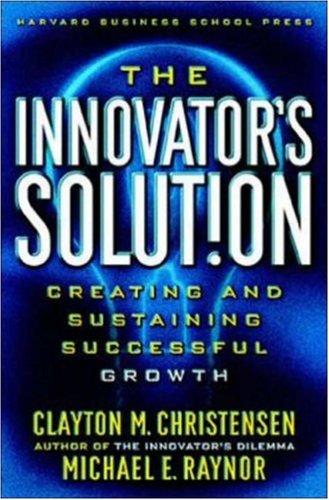
The Innovator's Solution
by Clayton M. Christensen & Michael E. Raynor · 2003
The Innovator's Dilemma diagnosed why great companies die. This one tells you what to actually build instead.
Worth reading? The Innovator's Dilemma told you why great companies die serving their best customers. The Innovator's Solution, from Christensen and Raynor, is the direct follow-up: given that diagnosis, what do you actually build, and how do you structure it so it survives? Where the Dilemma is diagnostic and a little fatalistic, the Solution is a playbook -- assessing disruption risk, matching organizational structure to the innovation, running the numbers on a new venture's cost base. Read the Dilemma first; this book assumes you already believe the disease is real and just want the treatment plan. Skip it if you haven't read the Dilemma, or if you need a general strategy book -- this one is specifically about managing disruptive growth, not strategy broadly.
| Full Title | The Innovator's Solution: Creating and Sustaining Successful Growth |
|---|---|
| Author | Clayton M. Christensen & Michael E. Raynor |
| Published | 2003 |
| Publisher | Harvard Business Review Press |
| Category | Business & Money |
| Favorite quote | “Resources, processes, and values -- collectively, these define an organization's strengths, as well as its weaknesses and blind spots.” |
The Verdict
Christensen wrote the Dilemma as an outside diagnosis of why companies fail. The Solution, co-written with Michael Raynor, is the inside job – what an actual executive does on Monday morning if they believe the diagnosis. It’s denser and more of a manual, but it’s the book that turns disruption theory from a warning into something you can run.
you read The Innovator's Dilemma, believed it, and now want the 'so what do I do' playbook
you haven't read The Innovator's Dilemma yet -- start there, this book assumes you already know the disease
Book Summary
The Innovator's Dilemma ended on a warning: sustaining innovation can keep you alive, but disruption from below is what actually kills you. The Innovator's Solution picks up exactly where that ended and asks the harder question -- if you run a company today, what do you actually do differently? Christensen and Raynor's answer is to build a repeatable, disciplined process for growth instead of treating disruption as a one-off bet you either win or lose.
The book introduces sharper diagnostic tools than the Dilemma had: assessing whether a market is vulnerable to disruption in the first place (are the current products overserving customers on features nobody needs?), figuring out what job a disruptive product needs to nail first, and matching organizational structure to the type of innovation -- a disruptive business needs a different process, cost structure, and set of values than the core business, and mixing the two kills the new venture almost every time.
It's more prescriptive and more "how-to" than the Dilemma, at some cost to the Dilemma's narrative punch. The book spends real time on the RPV framework -- resources, processes, and values -- for diagnosing what an organization can actually do, regardless of what its people intend or say they want.
Top 10 Lessons from The Innovator's Solution
- The Dilemma diagnosed the disease; the Solution prescribes the treatment.
- Ask whether your market is overserving customers -- that's where disruption gets in.
- Match a new venture's process and cost structure to disruptive economics, not the core business's.
- An organization's resources, processes, and values (RPV) determine what it can do, not its intentions.
- Growth needs a repeatable process, not a single lucky bet.
- Sustaining innovations extend the core business; disruptive ones need their own unit.
- Look at the job a disruptive entrant is doing first, not its current market share.
- Autonomy for the new unit isn't optional -- shared processes strangle disruptive ventures.
- Low-end disruption undercuts on price at the overserved bottom of a market.
- New-market disruption competes against non-consumption, not against existing products.
Top 2 Quotes from The Innovator's Solution
"Resources, processes, and values -- collectively, these define an organization's strengths, as well as its weaknesses and blind spots."
Clayton M. Christensen & Michael E. Raynor, The Innovator's Solution
"Growth is one of the most important challenges facing any business, and one of the hardest for its managers to get right."
Clayton M. Christensen & Michael E. Raynor, The Innovator's Solution
Frequently Asked Questions
Is The Innovator's Solution worth reading?
Yes, but only after The Innovator's Dilemma. This book assumes you already accept that disruption kills incumbents and moves straight to the harder question of what to build and how to structure it -- it's the practical sequel, not a standalone read.
What is the main idea of The Innovator's Solution?
Managing disruptive growth on purpose requires matching your organization's structure -- its resources, processes, and values -- to the kind of innovation you're pursuing, and usually means spinning out a separate unit rather than running it inside the core business.
Should I read this instead of The Innovator's Dilemma?
No, read them in order. The Dilemma explains why great companies fail; The Solution explains what to actually do about it. Reading the Solution first will make the RPV framework and disruption assessment feel abstract without the Dilemma's case studies underneath them.
Is The Innovator's Solution still relevant?
The core RPV and organizational-separation advice holds up well and still shows up in how companies structure innovation labs and spinouts today, even if some of the early-2000s tech examples feel dated.
Ready to read it?
Get The Innovator's Solution on Amazon