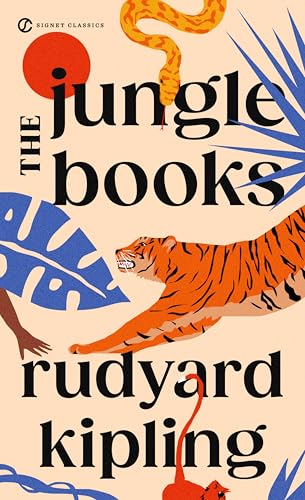
The Jungle Book
by Rudyard Kipling · 1894
A boy raised by wolves in the Indian jungle, taught the Law of the Jungle by a bear and a black panther -- the original Mowgli stories, darker and stranger than the Disney version.
Worth reading? The Jungle Book is really a linked short-story collection, not a novel, and Mowgli only headlines about half of it -- the rest is animal fables like 'Rikki-Tikki-Tavi' that are just as good and almost never get adapted. Read it for the Law of the Jungle poetry alone; it's more interesting than the movie's songs.
| Author | Rudyard Kipling |
|---|---|
| Published | 1894 |
| Category | Fiction |
| Favorite quote | “For the strength of the Pack is the Wolf, and the strength of the Wolf is the Pack.” |
The Verdict
The gap between the phrase “law of the jungle” as most people use it (ruthless self-interest) and what Kipling actually wrote (a code of communal obligation) is the whole book in miniature – it’s a stranger, more structured work than its pop-culture reputation suggests. Read the actual Law of the Jungle verses before you decide you already know this story.
you want the source material behind Mowgli, the Law of the Jungle, and 'the strength of the pack is the wolf, the strength of the wolf is the pack' -- and you're fine with a collection of linked short stories instead of one continuous plot
you're expecting the Disney movie's plot or tone -- the book is a linked-story collection, several with no Mowgli in them at all, and it's more somber and moralistic than the cartoon
Book Summary
Mowgli, a human infant raised by wolves after wandering into the jungle, is taught the Law of the Jungle by Baloo the bear and Bagheera the black panther -- a code that frames survival as a rule-bound, communal system rather than simple every-animal-for-itself chaos.
Kipling gives the jungle its own quasi-legal culture, with the Law functioning as both practical survival wisdom and a stand-in for the era's ideas about civilization, order, and obedience. Several stories outside the Mowgli arc, like "Rikki-Tikki-Tavi" and "Toomai of the Elephants," explore the same themes of loyalty, courage, and belonging through entirely different animal casts.
Top 9 Lessons from The Jungle Book
- Mowgli is adopted by the Seeonee wolf pack as an infant after wandering into the jungle, and raised under wolf law.
- Baloo the bear and Bagheera the black panther serve as Mowgli's teachers, instructing him in the Law of the Jungle.
- The tiger Shere Khan is Mowgli's lifelong enemy, having wanted to kill him as a cub.
- The Law of the Jungle frames survival as a communal, rule-bound system, not simple every-animal-for-itself chaos.
- Mowgli eventually uses fire, which the animals call 'the Red Flower,' to drive off Shere Khan, marking his growing separation from purely animal methods.
- The collection includes non-Mowgli stories, like 'Rikki-Tikki-Tavi,' about a mongoose defending a human family from cobras.
- 'Toomai of the Elephants' follows a young mahout's son who witnesses a secret elephant dance deep in the jungle.
- Mowgli's arc ends with him leaving the jungle to rejoin human society, unable to fully belong to either world.
- Kipling frames the animal characters with distinct, almost tribal codes of honor and law that mirror colonial-era ideas about civilization and order.
Top 4 Quotes from The Jungle Book
"Now this is the Law of the Jungle -- as old and as true as the sky; And the Wolf that shall keep it may prosper, but the Wolf that shall break it must die."
Rudyard Kipling, The Jungle Book
"For the strength of the Pack is the Wolf, and the strength of the Wolf is the Pack."
Rudyard Kipling, The Jungle Book
"Now these are the Laws of the Jungle, and many and mighty are they; But the head and the hoof of the Law and the haunch and the hump is -- Obey!"
Rudyard Kipling, The Jungle Book
"We be of one blood, ye and I."
Rudyard Kipling, The Jungle Book
Frequently Asked Questions
Is The Jungle Book worth reading?
Yes, especially if you only know the Disney movie -- the original is a linked short-story collection with more stories, more moral weight, and better poetry than the film's plot suggests.
Is The Jungle Book just about Mowgli?
No. Only about half the stories feature Mowgli. The rest, like 'Rikki-Tikki-Tavi' and 'Toomai of the Elephants,' are standalone animal fables with their own casts.
Is The Jungle Book appropriate for kids?
Yes, it's a classic children's book, though it's more somber and moralistic in places than the Disney adaptation, with real danger and death in several stories.
What is the Law of the Jungle?
A code of communal survival rules Kipling invents for the animal characters, emphasizing obligation to the pack over pure self-interest -- the opposite of how 'law of the jungle' gets used colloquially today.
Ready to read it?
Get The Jungle Book on Amazon