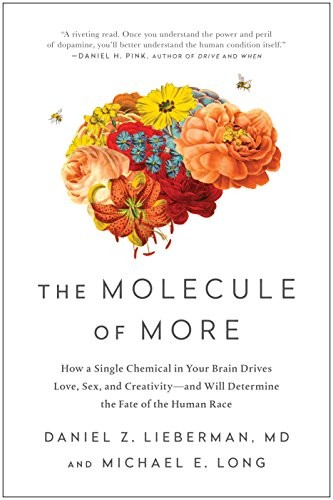
The Molecule of More
by Daniel Z. Lieberman & Michael E. Long · 2018
One brain chemical, dopamine, doesn't reward you for having things -- it only rewards you for wanting them, which explains why getting what you wanted so rarely feels like enough.
Worth reading? The book's single clean idea, that dopamine is entirely about anticipation and pursuit, never about the having, does more explanatory work than most popular psychology books manage with ten ideas. It reframes ambition, addiction, infatuation, and restlessness as variations on one mechanism, and the explanation holds up uncomfortably well against your own experience.
| Full Title | The Molecule of More: How a Single Chemical in Your Brain Drives Love, Sex, and Creativity -- and Will Determine the Fate of the Human Race |
|---|---|
| Author | Daniel Z. Lieberman & Michael E. Long |
| Published | 2018 |
| Publisher | BenBella Books |
| Category | Science & Nature |
| Favorite quote | “From dopamine's point of view, having things is uninteresting. It's only getting things that matters. If you live under a bridge, dopamine makes you want a tent. If you live in a tent, dopamine makes you want a house. If you live in the most expensive mansion in the world, dopamine makes you want a castle on the moon.” |
The Verdict
The book earns its keep with one idea, explained clearly and applied broadly: dopamine doesn’t care whether you have the thing, only whether you’re about to get it. Once you see that mechanism, a lot of otherwise confusing behavior, your own included, starts making a lot more sense.
It’s stronger on explanation than on prescription. The Here-and-Now framework toward the end gives you a real concept to work with, balancing pursuit against presence, but it’s not a structured program the way a typical self-help book would package it. Treat this as understanding first, tactics second.
Read it if you want to understand why getting what you wanted never quite feels like enough. Skip it if you’re looking for a step-by-step plan rather than a mental model – this book’s job is explaining the mechanism, and it does that well.
you want a clear, well-argued explanation of why desire and satisfaction feel so disconnected -- why the next thing always seems to matter more than the thing you already have
you want a self-help action plan -- this book explains the mechanism in real depth but stops short of a structured program for managing it
Book Summary
Dopamine isn't the brain's pleasure chemical, it's the wanting chemical -- it fires in anticipation of a reward and drops off once you actually have it, which is why acquiring something you wanted rarely produces lasting satisfaction: dopamine has already moved on to wanting the next thing before you've finished enjoying the last one.
The authors argue this explains a huge range of otherwise unrelated human behavior -- addiction, romantic infatuation that fades once a relationship becomes secure, restless ambition that's never satisfied by achievement, and even certain features of mental illness -- as different expressions of the same future-oriented dopamine circuitry.
The book proposes a second system, the "Here and Now" neurotransmitters (serotonin, oxytocin, endorphins, and others), that governs present-moment enjoyment of what you already have, and argues that a well-lived life requires deliberately balancing dopamine-driven pursuit against Here-and-Now presence, since an unchecked dopamine system will always push toward more, never toward contentment.
Top 8 Lessons from The Molecule of More
- Dopamine rewards anticipation and pursuit of a goal, not the achievement or possession of it -- satisfaction from 'having' comes from a separate set of brain chemicals entirely.
- Romantic infatuation's intensity is dopamine-driven and predictably fades once a relationship becomes stable and secure -- that's a mechanism, not a sign the relationship has failed.
- Addiction can be understood as a hijacking of the same wanting-more circuitry that also drives ambition and creative pursuit, not a wholly separate phenomenon.
- Achieving a long-sought goal rarely produces lasting satisfaction, because dopamine shifts its attention to the next desirable thing almost immediately.
- A 'Here and Now' system of neurotransmitters (serotonin, oxytocin, endorphins) governs present-moment contentment, distinct from and often in tension with dopamine's future-orientation.
- Unchecked pursuit of more (wealth, status, novelty) will never resolve into contentment on its own, because the dopamine system isn't designed to produce contentment -- it's designed to produce more wanting.
- Some of the same traits that drive extraordinary achievement (restless dissatisfaction, difficulty enjoying the present) can also predispose someone to addiction or anxiety.
- Balancing dopamine-driven ambition against Here-and-Now presence is a deliberate practice, not something that happens automatically once you're 'successful enough.'
Top 4 Quotes from The Molecule of More
"From dopamine's point of view, having things is uninteresting. It's only getting things that matters. If you live under a bridge, dopamine makes you want a tent. If you live in a tent, dopamine makes you want a house. If you live in the most expensive mansion in the world, dopamine makes you want a castle on the moon."
Daniel Z. Lieberman & Michael E. Long, The Molecule of More
"The dopamine motto is 'More.'"
Daniel Z. Lieberman & Michael E. Long, The Molecule of More
"Dopamine, they discovered, isn't about pleasure at all."
Daniel Z. Lieberman & Michael E. Long, The Molecule of More
"To enjoy the things we have, as opposed to the things that are only possible, our brains must transition from future-oriented dopamine to present-oriented chemicals, a collection of neurotransmitters we call the Here and Now molecules, or the H&Ns."
Daniel Z. Lieberman & Michael E. Long, The Molecule of More
Frequently Asked Questions
Is The Molecule of More worth reading?
Yes -- it takes one clean idea, dopamine as the chemical of wanting rather than having, and uses it to explain a genuinely wide range of behavior, from addiction to romantic infatuation to restless ambition.
What is the main idea of The Molecule of More?
Dopamine drives anticipation and pursuit, not enjoyment of what you already have, which is why achieving a goal rarely produces lasting satisfaction -- that separate satisfaction comes from a different set of 'Here and Now' brain chemicals.
Does the book explain why relationships and infatuation fade?
Yes -- it argues the intense early stage of romantic love is dopamine-driven and predictably fades once a relationship becomes secure, reframing that shift as a mechanism rather than a failure.
Is The Molecule of More a self-help book?
Not exactly -- it's closer to accessible neuroscience explanation than a structured action plan, though the Here-and-Now framework does offer a practical lens for balancing ambition against contentment.
Do I need a science background to read this book?
No -- it's written for a general audience and explains the neuroscience clearly, without requiring prior knowledge of neurotransmitters or brain chemistry.
Ready to read it?
Get The Molecule of More on Amazon