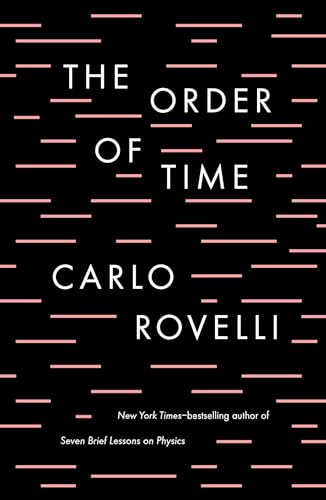
The Order of Time
by Carlo Rovelli · 2018
A physicist takes apart the thing you're most certain of -- that time flows, in one direction, at one speed, the same everywhere -- and shows that none of it survives contact with actual physics.
Worth reading? Rovelli's real achievement is structural: he spends the first half dismantling time (no universal now, no single direction, no flow at the fundamental level) before spending the second half explaining why we experience it so vividly anyway. It's short, but it's dense in the way poetry is dense, not the way a textbook is dense. You'll reread paragraphs, and that's the point.
| Full Title | The Order of Time |
|---|---|
| Author | Carlo Rovelli |
| Published | 2018 |
| Publisher | Riverhead Books |
| Category | Science & Nature |
| Favorite quote | “Time is not a single, universal, unstoppable ticking that is the same for everyone.” |
The Verdict
Rovelli isn’t writing a history-of-clocks book, and if you go in expecting one you’ll be disoriented in the first thirty pages. He starts by taking your intuitive sense of time apart piece by piece – no shared universal now, no built-in direction, possibly no flow at all at the deepest level physics can describe – before spending the second half explaining why you still feel time passing anyway.
The prose is closer to poetry than physics writing, and that’s deliberate. Short sentences carry a lot of weight, and the book rewards rereading paragraphs rather than racing through chapters. If you want a linear, hand-holding explainer, this isn’t that book.
Read it if you want a short physics book that will genuinely change how you think about time and you’re willing to sit with some unresolved questions. Skip it if you want a beginner-friendly, step-by-step introduction – Rovelli assumes you’ll meet him halfway.
you want a short, poetic physics book that will genuinely change how you think about time, not just a history of clocks
you want a beginner-friendly, linear explainer -- Rovelli writes in a looping, essayistic style and assumes you're willing to sit with unresolved questions
Book Summary
Modern physics has already dismantled most of our intuitive picture of time: there's no single universal "now" shared across the universe (relativity), time runs at different rates depending on gravity and speed, and at the most fundamental level physics describes, time as a distinct flowing dimension may not exist at all -- events simply relate to each other.
What we experience as time's arrow, the sense that the past is fixed and the future open, Rovelli traces to entropy and thermodynamics rather than to time itself: the universe moves from lower to higher entropy, and this large-scale statistical tendency is what creates our felt sense of "before" and "after," not some built-in property of time.
The book's second half argues that our subjective experience of time (memory linking a continuous self across moments, anticipation projecting forward) is a feature of how human brains are built to model a world of increasing entropy, not evidence that time flows the way it feels like it does -- meaning the "now" we feel so certain of may be a construction of human consciousness rather than a physical fact.
Top 8 Lessons from The Order of Time
- There is no single universal 'now' shared by the whole universe -- relativity means simultaneity is relative to an observer's position and motion.
- Time passes at different rates depending on gravity and velocity -- a clock at higher altitude runs measurably faster than one at sea level.
- At the most fundamental level current physics can describe, a flowing, directional 'time' as we intuitively picture it may not be a basic feature of reality.
- The arrow of time we experience (past fixed, future open) is best explained by entropy and thermodynamics, not by some intrinsic property of time itself.
- Entropy increases at the scale of the whole universe even though individual interactions at the smallest scale are largely time-symmetric -- the arrow is a large-scale statistical phenomenon.
- Human memory and anticipation, which stitch discrete moments into a felt continuous self, do much of the work of creating our subjective sense of time passing.
- Rovelli treats the loss of a naive, intuitive view of time as something to sit with rather than mourn -- physics replacing common sense is presented as ordinary, not tragic.
- Different physical theories (relativity, quantum mechanics, thermodynamics) each strip away a different piece of the common-sense picture of time, and no single unified picture yet reconciles all of them.
Top 4 Quotes from The Order of Time
"Time is not a single, universal, unstoppable ticking that is the same for everyone."
Carlo Rovelli, The Order of Time
"The difference between past and future, between cause and effect, between memory and hope, between regret and intention... does not lie in the elementary laws, and yet it is a central and constant aspect of our experience of time."
Carlo Rovelli, The Order of Time
"We are stories, contained within the twenty complicated centimeters behind our eyes, longing for coherence."
Carlo Rovelli, The Order of Time
"Perhaps time is the effect of our overlooking the physical microstates of things."
Carlo Rovelli, The Order of Time
Frequently Asked Questions
Is The Order of Time worth reading?
Yes, if you're open to a short, poetic book that genuinely unsettles how you think about time -- it's dense and rewards rereading rather than a quick linear explainer.
What is The Order of Time about?
Physicist Carlo Rovelli's case that time as we intuitively understand it -- a universal, flowing, one-directional now -- doesn't survive contact with relativity, thermodynamics, and quantum physics, and his explanation for why we still experience it that way.
Do I need a physics background to read The Order of Time?
No, but patience helps -- Rovelli writes for a general audience but in a looping, essayistic style rather than a step-by-step explainer.
Is The Order of Time hard to understand?
It's short but conceptually dense -- the ideas are accessible in plain language, but several chapters reward a second read rather than a quick first pass.
How does The Order of Time compare to other Rovelli books like Seven Brief Lessons on Physics?
Similar style, narrower and deeper subject -- instead of surveying physics broadly, this one book is entirely devoted to unpacking time specifically.
Ready to read it?
Get The Order of Time on Amazon