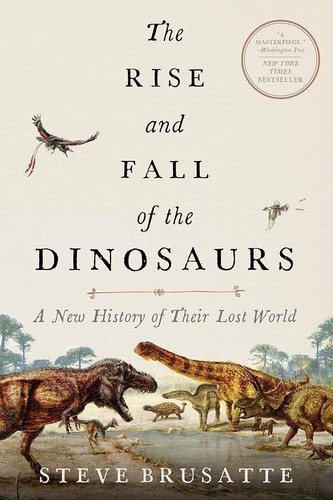
The Rise and Fall of the Dinosaurs
by Steve Brusatte · 2018
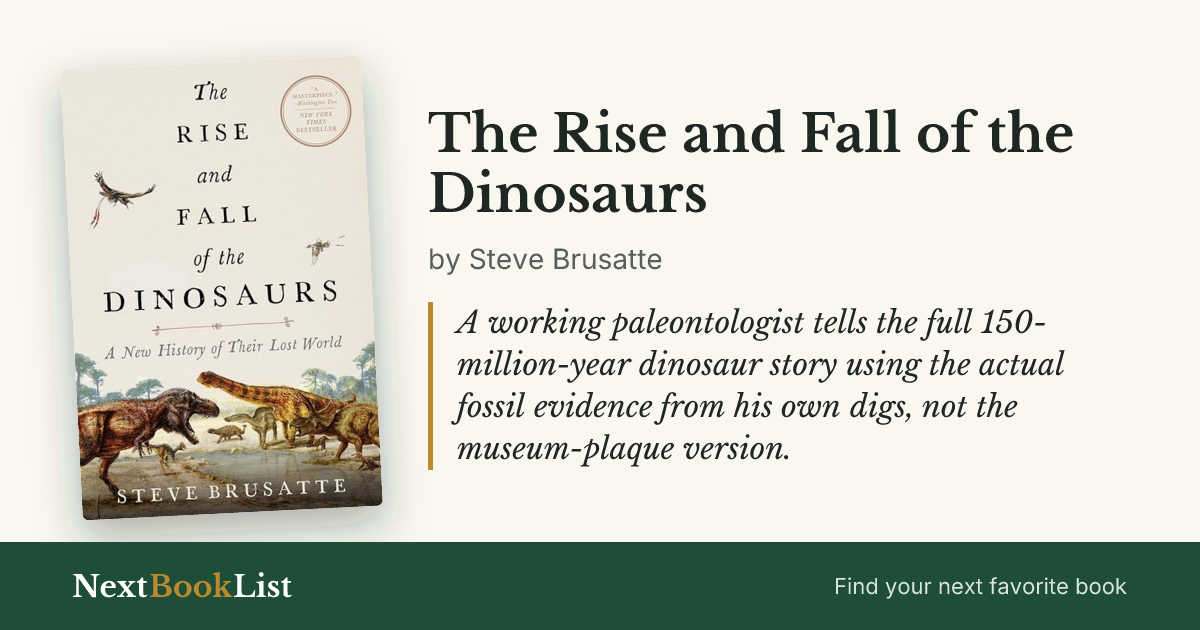
A working paleontologist tells the full 150-million-year dinosaur story using the actual fossil evidence from his own digs, not the museum-plaque version.
Worth reading? Brusatte's advantage over the average dinosaur book is that he's an actual working paleontologist describing fossils he and his colleagues dug up and named, not a science writer summarizing secondhand. The book tracks dinosaurs from their unglamorous, marginal origin after the Permian extinction through their 150-million-year dominance to the asteroid impact that ended it, and it's very good at showing how much modern paleontology has changed the picture -- CT scans of skulls, isotope analysis, feather impressions -- versus what most adults learned as kids. It beats a general-audience dinosaur book because Brusatte constantly shows his work: this is what the fossil actually shows, this is how we know it, this is what's still debated.
| Full Title | The Rise and Fall of the Dinosaurs: A New History of a Lost World |
|---|---|
| Author | Steve Brusatte |
| Published | 2018 |
| Publisher | William Morrow |
| Category | Science & Nature |
| Favorite quote | “You could call T. rex the James Dean of dinosaurs: it lived fast and died young.” |
The Verdict
Brusatte’s fieldwork credibility is what separates this from the shelf of other dinosaur books – when he says a fossil shows something, he’s usually the one who found or described it. If you want the current, evidence-based version of the dinosaur story instead of the one frozen in your childhood textbook, this is the upgrade.
you want the real, evidence-based dinosaur story -- evolution, ecology, and extinction -- told by someone who does the fieldwork
you want a picture book or kids' dinosaur encyclopedia -- this is narrative science writing aimed at adults, denser on evolutionary detail
Book Summary
Dinosaurs didn't start out dominant -- they emerged as small, marginal creatures after the Permian mass extinction wiped out most competing lineages, and only became the dominant land animals over tens of millions of years through a combination of luck (surviving later extinction events that killed off rivals) and genuine adaptive advantages.
Modern paleontology has been transformed by new technology -- CT scanning fossilized skulls to reconstruct brain and sensory anatomy, isotope analysis to infer body temperature and diet, and an explosion of feathered dinosaur fossils from China -- meaning much of what Brusatte describes overturns or refines what was taught as settled fact even one generation ago.
Many dinosaurs, especially the smaller theropod lineages that gave rise to birds, likely had feathers, complex social behaviors, and possibly warm-bloodedness, undermining the sluggish, cold-blooded "reptile" image most people still carry from childhood textbooks.
The end-Cretaceous asteroid impact was catastrophically sudden and total -- not a slow decline dinosaurs were already succumbing to, but a healthy, dominant group wiped out abruptly by a single geological instant, with birds as the one dinosaur lineage that survived.
Top 8 Lessons from The Rise and Fall of the Dinosaurs
- Dinosaurs began as small, marginal creatures after the Permian extinction, not as instant dominant giants.
- New technology -- CT scans, isotope analysis, Chinese feather fossils -- has rewritten much of what was taught as settled dinosaur fact a generation ago.
- Many theropod dinosaurs likely had feathers and complex behaviors, undermining the sluggish cold-blooded 'reptile' stereotype.
- Birds are the one dinosaur lineage that survived the end-Cretaceous extinction and are, technically, living dinosaurs.
- Dinosaurs' rise to dominance owed as much to surviving earlier extinction events as to any single adaptive advantage.
- The asteroid impact that ended the Cretaceous was a sudden catastrophe, not a slow decline of an already-failing group.
- Fossil evidence from a single well-preserved specimen can overturn decades of assumptions about an entire species' biology.
- Brusatte's own fieldwork (including naming several new species) grounds the book's claims in direct evidence rather than secondhand summary.
Top 4 Quotes from The Rise and Fall of the Dinosaurs
"You could call T. rex the James Dean of dinosaurs: it lived fast and died young."
Steve Brusatte, The Rise and Fall of the Dinosaurs
"Birds are just a weird group of dinosaurs that did the same thing."
Steve Brusatte, The Rise and Fall of the Dinosaurs
"There is a dinosaur outside my window. I'm watching it as I write this."
Steve Brusatte, The Rise and Fall of the Dinosaurs
"Dinosaurs had been around for over 150 million years when their time of reckoning came. They had endured hardships, evolved superpowers like fast metabolisms and enormous size, and vanquished their rivals so that they ruled an entire planet... Then, literally, in a split second, it ended."
Steve Brusatte, The Rise and Fall of the Dinosaurs
Frequently Asked Questions
Is The Rise and Fall of the Dinosaurs worth reading?
Yes -- it's the most current, evidence-grounded dinosaur narrative for adults, written by a working paleontologist rather than a secondhand science writer.
What is The Rise and Fall of the Dinosaurs about?
The full 150-million-year history of dinosaurs, from their marginal post-Permian origins through their dominance to the asteroid impact that ended the Cretaceous, told through Steve Brusatte's own fieldwork and recent fossil discoveries.
Is this book suitable for kids?
It's aimed at adults -- denser on evolutionary and geological detail than a children's dinosaur book, though a curious teenager could handle it.
Did dinosaurs really have feathers?
Per the fossil evidence Brusatte covers (especially specimens from China), many theropod dinosaurs -- the lineage that gave rise to birds -- likely had feathers, undermining the scaly, reptilian image most people grew up with.
Ready to read it?
Get The Rise and Fall of the Dinosaurs on Amazon