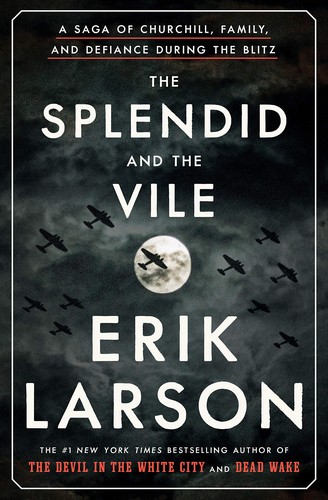
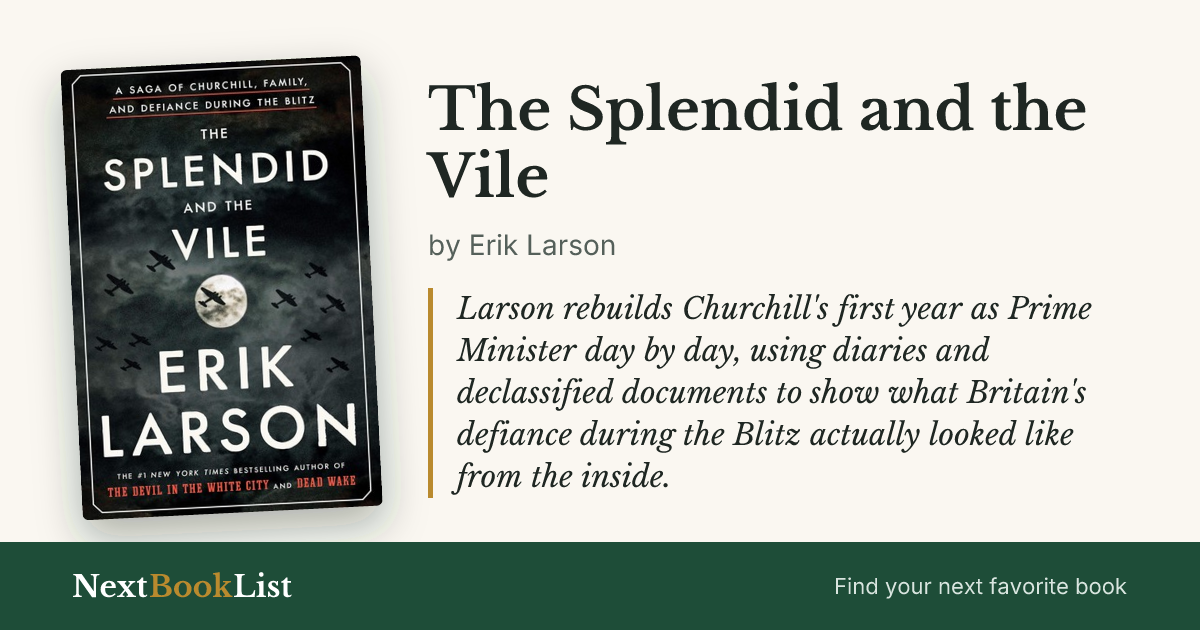
The Splendid and the Vile
by Erik Larson · 2020
Larson rebuilds Churchill's first year as Prime Minister day by day, using diaries and declassified documents to show what Britain's defiance during the Blitz actually looked like from the inside.
Worth reading? Larson has built a career on narrative history that reads with novelistic pacing without sacrificing factual grounding, and The Splendid and the Vile is his treatment of Churchill's first year as Prime Minister -- May 1940 to May 1941, covering the fall of France, the Blitz, and the decision to fight on when a negotiated peace with Hitler was a real, live option many in Churchill's own government favored. Built from diaries, declassified intelligence reports, and family letters, it gets close enough to daily texture (dinner conversations, Churchill's specific habits, his children's lives) that the larger historical stakes land with more weight, not less.
| Full Title | The Splendid and the Vile: A Saga of Churchill, Family, and Defiance During the Blitz |
|---|---|
| Author | Erik Larson |
| Published | 2020 |
| Category | History |
| Favorite quote | “There was a new phrase in the world's vocabulary. It was Blitzkrieg.” |
The Verdict
Larson’s method (extensive archival research reassembled into scene-by-scene narrative) is what makes this readable at novel-pace without sacrificing the factual grounding serious history demands. The juxtaposition of Churchill’s household drama against the literal bombing of London is the book’s real achievement – it makes an extraordinary year feel lived-in rather than mythologized.
you want narrative history that reads like a novel, built from meticulous archival research rather than a dry chronological account
you want military strategy and battlefield analysis -- this stays close to Churchill's household, inner circle, and London civilian life rather than the war's tactical dimension
Book Summary
Larson's central argument, made through granular daily reconstruction rather than direct assertion, is that Churchill's leadership during the Blitz wasn't primarily about strategy or military decisions -- it was about sustaining British public morale through an entire year when defeat, or a negotiated surrender to Hitler, was a genuinely live possibility that significant figures in his own government actively pushed for.
The book also captures how ordinary domestic life continued, strangely, alongside the extraordinary -- Churchill's children navigating romance and career decisions, dinner parties held during air raids, the specific rhythms of a government and a city refusing to fully halt even under nightly bombing. That juxtaposition of ordinary and extraordinary is Larson's signature move, and it's what separates this from a standard military or political history of the same period.
Top 7 Lessons from The Splendid and the Vile
- Wartime leadership is often as much about sustaining public morale as it is about strategic or military decisions.
- Defeat or negotiated surrender was a genuinely live political option during the Blitz, not a foregone conclusion that Britain would fight on.
- Granular, daily-level historical reconstruction (diaries, letters) can reveal stakes that summary-level history misses.
- Ordinary domestic life persists, strangely, even during extraordinary historical crisis -- the two aren't mutually exclusive.
- Public communication and rhetoric (Churchill's speeches) can be a decisive strategic tool, not just a symbolic accompaniment to real decisions.
- Internal political dissent (figures favoring negotiation with Hitler) often gets smoothed over in retrospective historical narrative.
- Individual leadership temperament (Churchill's specific stubbornness and rhetorical instincts) can meaningfully shape a nation's trajectory at a pivotal moment.
Top 1 Quotes from The Splendid and the Vile
"There was a new phrase in the world's vocabulary. It was Blitzkrieg."
Erik Larson, The Splendid and the Vile
Frequently Asked Questions
Is The Splendid and the Vile worth reading?
Yes, especially if you want narrative history with novelistic pacing and granular archival detail. It's more about morale, leadership, and daily life during the Blitz than military strategy specifically.
What time period does The Splendid and the Vile cover?
Roughly May 1940 to May 1941 -- Churchill's first year as Prime Minister, covering the fall of France, the Blitz, and the year Britain stood alone against Nazi Germany before the U.S. entered the war.
Is The Splendid and the Vile about military strategy?
Not primarily. It stays close to Churchill's household, inner circle, and London civilian life, focusing on leadership and morale rather than battlefield tactics.
Who is Erik Larson?
A narrative nonfiction author known for meticulously researched history written with novelistic pacing, including The Devil in the White City and In the Garden of Beasts, both built from similar archival, character-driven methods.
Ready to read it?
Get The Splendid and the Vile on Amazon