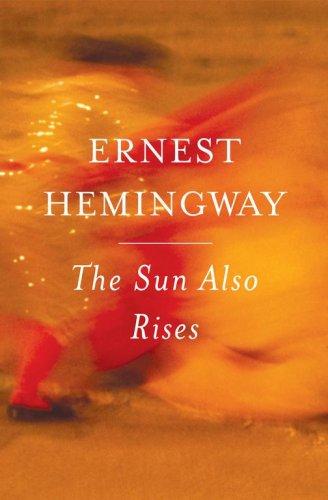
The Sun Also Rises
by Ernest Hemingway · 1926
A wounded WWI veteran and his circle of expat friends drink, bicker, and chase a woman none of them can actually have across Paris and Pamplona -- and Hemingway invents an entire prose style doing it.
Worth reading? The Sun Also Rises is the clearest entry point into Hemingway's style -- shorter and less demanding than A Farewell to Arms, with the same spare prose doing the emotional heavy lifting. Read this before the later, more famous Hemingway novels; it's where the voice gets fully formed.
| Author | Ernest Hemingway |
|---|---|
| Published | 1926 |
| Publisher | Scribner |
| Category | Fiction |
| Favorite quote | “Isn't it pretty to think so?” |
The Verdict
The bullfighting sections aren’t filler – they’re the closest thing the book has to a thesis statement, showing characters who can only feel alive watching someone else risk everything on purpose.
you want the book that defined the 'lost generation' and the spare, understated Hemingway style everyone since has either copied or reacted against
you want characters who grow or resolve their problems -- the whole point is that this generation is stuck, and the ending is a shrug, not a resolution
Book Summary
Jake Barnes's war wound (which leaves him impotent) is the literal, physical version of the novel's larger argument: this generation survived the war but came back unable to fully live, love, or connect the way they might have before it.
Hemingway's famous 'iceberg theory' -- stating almost nothing directly, letting emotion live in what's left unsaid -- is on full display here. The characters talk about bullfights and drinks while the real subject (grief, disillusionment, unspoken longing) sits underneath every scene.
Brett Ashley isn't written as a villain despite driving much of the group's misery; she's another casualty of the same disillusionment, unable to settle for a life that doesn't match the intensity of what the war took from everyone.
Top 7 Lessons from The Sun Also Rises
- Trauma can be present in everything a character does without ever being named directly on the page.
- A generation that survived catastrophe isn't automatically equipped to build something meaningful afterward.
- Understated prose can carry more emotional weight than explicit description -- what's left out matters as much as what's said.
- Chasing an idealized, unattainable person (Brett) is often really about chasing a version of pre-war certainty that no longer exists.
- Ritual and spectacle (the bullfights) can offer characters a controlled substitute for the chaos they can't otherwise process.
- Friendship among the disillusioned is often held together by shared vice as much as genuine connection.
- An ambiguous, non-resolving ending can be more honest than a tidy one when the characters' problems genuinely have no clean solution.
Top 5 Quotes from The Sun Also Rises
"You are all a lost generation."
Ernest Hemingway, The Sun Also Rises
"Isn't it pretty to think so?"
Ernest Hemingway, The Sun Also Rises
"I did not care what it was all about. All I wanted to know was how to live in it."
Ernest Hemingway, The Sun Also Rises
"You can't get away from yourself by moving from one place to another."
Ernest Hemingway, The Sun Also Rises
"Nobody ever lives their life all the way up except bull-fighters."
Ernest Hemingway, The Sun Also Rises
Frequently Asked Questions
Is The Sun Also Rises worth reading?
Yes -- it's the clearest example of Hemingway's spare, understated style, and it defined how a whole generation's disillusionment got written.
Is The Sun Also Rises hard to read?
No, the prose is deliberately simple and fast-moving, though the emotional content is often implied rather than stated.
What is the main theme of The Sun Also Rises?
That the 'lost generation' survived WWI physically but came back disillusioned and unable to fully connect or find meaning in the same way.
Who should read The Sun Also Rises?
Anyone who wants the foundational Hemingway novel and the clearest demonstration of his 'iceberg theory' of understated prose.
Ready to read it?
Get The Sun Also Rises on Amazon