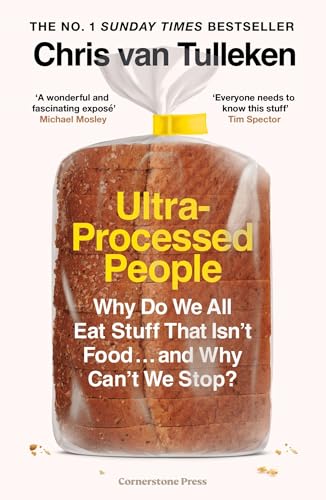
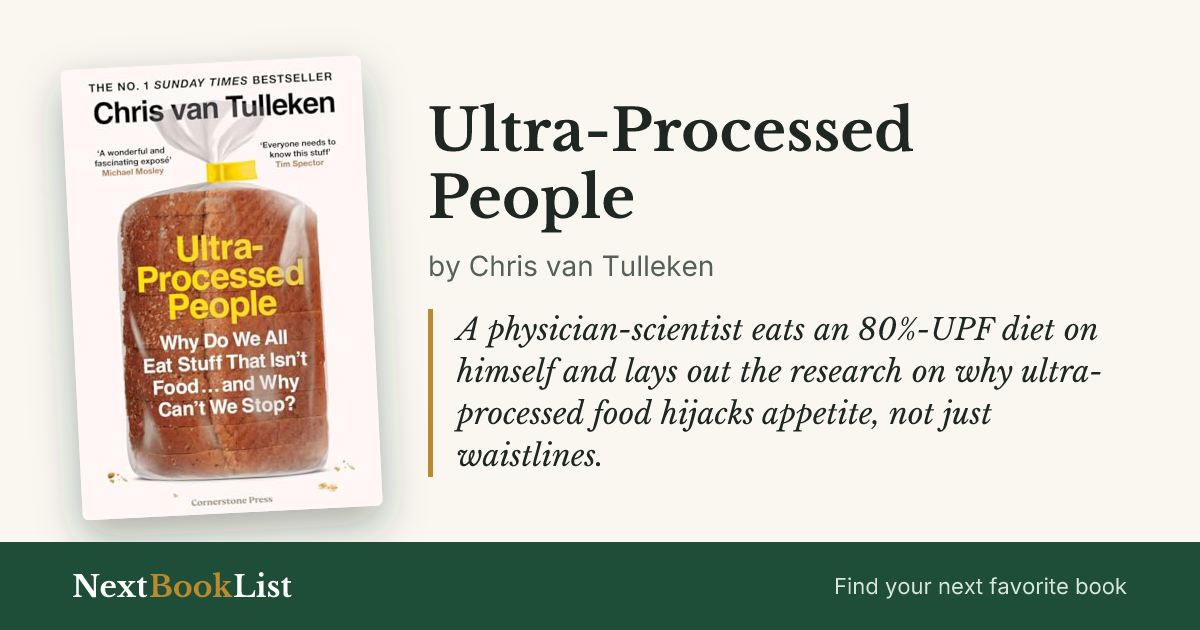
Ultra-Processed People
by Chris van Tulleken · 2023
A physician-scientist eats an 80%-UPF diet on himself and lays out the research on why ultra-processed food hijacks appetite, not just waistlines.
Worth reading? Van Tulleken's case rests on a simple, useful definition most nutrition books skip: ultra-processed food (UPF) isn't defined by fat, sugar, or calories, but by industrial formulation designed to be hyper-palatable and shelf-stable, using ingredients you wouldn't find in a home kitchen. He backs the argument by putting himself on an 80% UPF diet for a month and tracking what happens to his brain, hormones, and behavior, then walks through the NOVA classification research showing UPF consumption predicts weight gain independent of calorie count in controlled studies. It beats a generic 'eat less sugar' book because it explains why willpower keeps failing against these products specifically.
| Full Title | Ultra-Processed People: Why We Can't Stop Eating Food That Isn't Food |
|---|---|
| Author | Chris van Tulleken |
| Published | 2023 |
| Publisher | W. W. Norton & Company |
| Category | Science & Nature |
| Favorite quote | “It's not food. It's an industrially produced edible substance.” |
The Verdict
Van Tulleken doesn’t just cite the research – he becomes the experiment, and that’s what makes this land harder than the average nutrition book. Once you’ve got a clean definition of what actually counts as UPF (check the ingredient list, not the calorie count), it’s hard to unsee it on a supermarket shelf.
you want the actual mechanism behind why you can't stop eating certain foods, backed by a doctor who ran the experiment on himself
you're looking for a diet plan or meal-by-meal program -- this is a science and policy argument, not a cookbook
Book Summary
Ultra-processed food is defined by formulation, not nutrients -- it's industrially manufactured using ingredients and additives (emulsifiers, protein isolates, flavor compounds) that don't appear in any home kitchen, engineered specifically for palatability, shelf life, and profit margin rather than nutrition.
In the one controlled trial that directly compares diets matched for calories, sugar, fat, and fiber, people eating the ultra-processed version ate more calories and gained weight, while people on the unprocessed version lost weight -- suggesting UPF's effect on eating behavior isn't just about nutrient content, but something about the food's engineered structure itself overriding normal satiety signals.
Van Tulleken's month-long self-experiment eating 80% UPF documented measurable changes in his own brain activity, hormone levels, and food cravings, turning an abstract population-level statistic into a personal, first-hand account of appetite going out of his own control.
The harm isn't just to individual health -- UPF's dominance in the food supply is a business model problem, with a small number of multinational companies reformulating traditional foods into cheaper, more addictive, more profitable versions and marketing them as convenience or even health products.
Top 9 Lessons from Ultra-Processed People
- Ultra-processed food is defined by industrial formulation and additives, not by fat, sugar, or calorie content alone.
- In matched-calorie trials, people eating ultra-processed diets consume more calories than people eating unprocessed diets with identical nutrition labels.
- UPF is engineered specifically for hyper-palatability and shelf stability, using ingredients that don't exist in a home kitchen.
- Van Tulleken's own month-long 80% UPF diet produced measurable changes in his brain activity, hormones, and cravings.
- A handful of multinational food companies dominate global UPF production, driving reformulation of traditional foods into cheaper, more profitable versions.
- Food marketed as 'healthy' or 'natural' can still meet the technical definition of ultra-processed.
- UPF's effect on appetite appears to work by overriding normal satiety signals, not simply by providing more calories per bite.
- The NOVA classification system groups foods by degree of processing rather than by traditional nutrient categories like fat or sugar.
- Regulatory and industry incentives favor reformulating food for profit and shelf life over nutritional quality.
Top 3 Quotes from Ultra-Processed People
"It's not food. It's an industrially produced edible substance."
Chris van Tulleken, Ultra-Processed People
"UPF has a long, formal scientific definition, but it can be boiled down to this: if it's wrapped in plastic and has at least one ingredient that you wouldn't usually find in a standard home kitchen, it's UPF."
Chris van Tulleken, Ultra-Processed People
"It means that we cannot lose weight just by increasing activity. Variation in body-fat percentage is unrelated to physical activity level or energy expenditure."
Chris van Tulleken, Ultra-Processed People
Frequently Asked Questions
Is Ultra-Processed People worth reading?
Yes -- it's the most rigorous, accessible explanation available of why ultra-processed food specifically (not just sugar or fat) drives overeating, backed by both controlled trials and the author's own self-experiment.
What is Ultra-Processed People about?
Chris van Tulleken's case that ultra-processed food is a distinct category, defined by industrial formulation rather than nutrient content, that's engineered to override normal appetite regulation -- illustrated by his own month on an 80% UPF diet.
Does Ultra-Processed People give a diet plan?
No. It's a science and policy argument, not a meal plan -- the practical takeaway is mainly a definition (check for ingredients you wouldn't have at home) rather than a program to follow.
What is NOVA classification?
A food classification system, central to the book's argument, that groups foods by degree and purpose of industrial processing rather than by traditional categories like fat, sugar, or calorie content.
Ready to read it?
Get Ultra-Processed People on Amazon