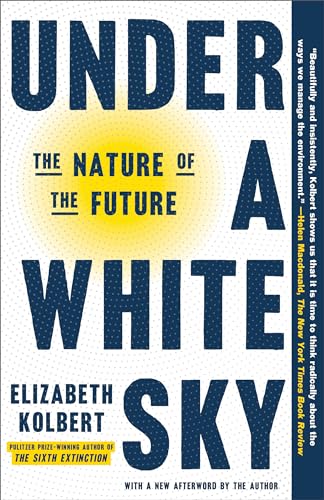
Under a White Sky
by Elizabeth Kolbert · 2021
The Sixth Extinction author tours the increasingly strange technological fixes humans are deploying to undo the ecological damage humans already caused.
Worth reading? Kolbert's throughline is the growing catalog of interventions -- electrifying a river to stop invasive carp, breeding 'super coral' for hotter oceans, engineering gene drives to wipe out invasive species, and geoengineering proposals to dim the sky itself -- that all share the same uncomfortable structure: humans made a mess with technology, and the fix on offer is more technology, layered on top. She reports each case directly from scientists and field sites rather than staying abstract, and she resists tidy conclusions; this isn't a book that tells you geoengineering is good or bad, it's a book that makes you sit with how strange and irreversible these choices already are. It beats a typical climate-solutions book by refusing false comfort -- there's no triumphant ending here, just an honest accounting of where we've already arrived.
| Full Title | Under a White Sky: The Nature of the Future |
|---|---|
| Author | Elizabeth Kolbert |
| Published | 2021 |
| Publisher | Crown |
| Category | Science & Nature |
| Favorite quote | “This has been a book about people trying to solve problems created by people trying to solve problems.” |
The Verdict
Kolbert’s refusal to hand you a clean verdict is what makes this land harder than a typical climate-solutions book – she’s not selling geoengineering or damning it, she’s just showing you how far down this road we’ve already walked. If you want the honest, unresolved version of where climate technology is headed, this is it.
you want clear-eyed, reported-from-the-field journalism on the paradox of using more technology to fix problems technology created
you want a hopeful, solutions-focused climate book -- Kolbert stays deliberately ambivalent and unresolved about whether these fixes are wise
Book Summary
Many environmental "fixes" now underway share a common, uncomfortable pattern: an earlier human intervention caused ecological damage, and the proposed solution is yet another engineered intervention layered on top, with its own unknown and potentially larger risks -- electrifying rivers to stop human-introduced carp, breeding heat-resistant "super coral" for reefs already dying from human-caused warming, gene-editing organisms to control other human-introduced invasive species.
Geoengineering -- deliberately altering the atmosphere or oceans at planetary scale, such as injecting particles to reflect sunlight and dim the sky (giving the book its title) -- has moved from fringe thought experiment to a proposal taken seriously by mainstream scientists and institutions, precisely because slower, more conventional emissions reductions haven't happened fast enough.
Kolbert deliberately withholds a tidy verdict on whether these interventions are wise; the book's honesty lies in showing that humanity has already crossed into an era of active, engineered management of nature, whether or not that was ever a deliberate collective choice, and there's no clean path back to a pre-intervention baseline.
Top 7 Lessons from Under a White Sky
- Many current environmental fixes are technological interventions layered on top of damage caused by earlier technological interventions.
- Geoengineering proposals like solar radiation management have moved from fringe idea to serious scientific and institutional consideration.
- Breeding heat-resistant 'super coral' is one active attempt to engineer reefs that can survive human-caused ocean warming.
- Gene drives can be used to eliminate invasive species at a genetic level, but carry unpredictable ecological risks of their own.
- Electrifying rivers and other blunt-force interventions are already deployed to control human-introduced invasive species like Asian carp.
- There is no clean return to a pre-intervention ecological baseline -- humans are already actively managing nature, deliberately or not.
- Kolbert deliberately avoids offering a tidy verdict on whether these engineered fixes are wise, favoring honest ambivalence over false comfort.
Top 4 Quotes from Under a White Sky
"This has been a book about people trying to solve problems created by people trying to solve problems."
Elizabeth Kolbert, Under a White Sky
"If we want everything to remain as it is, everything needs to change."
Elizabeth Kolbert, Under a White Sky
"Humans are producing no-analog climates, no-analog ecosystems, a whole no-analog future... And so we face a no-analog predicament. If there is to be an answer to the problem of control, it's going to be more control."
Elizabeth Kolbert, Under a White Sky
"The strongest argument for gene editing cane toads, house mice, and ship rats is also the simplest: what's the alternative?"
Elizabeth Kolbert, Under a White Sky
Frequently Asked Questions
Is Under a White Sky worth reading?
Yes -- it's rigorous, field-reported journalism on the paradox of using more engineering to fix problems engineering caused, and it resists easy optimism in a way most climate books don't.
What is Under a White Sky about?
Elizabeth Kolbert tours a series of technological interventions -- electrified rivers, super coral, gene drives, geoengineering -- that humans are deploying to manage ecological damage from earlier human interventions.
Where does the title Under a White Sky come from?
It refers to geoengineering proposals to inject particles into the atmosphere to reflect sunlight, which would whiten the visible sky -- one of the more extreme interventions the book covers.
Is Under a White Sky optimistic about the future?
No -- Kolbert deliberately avoids a hopeful or triumphant conclusion, presenting each intervention with its risks and unknowns intact rather than resolving into false comfort.
Ready to read it?
Get Under a White Sky on Amazon