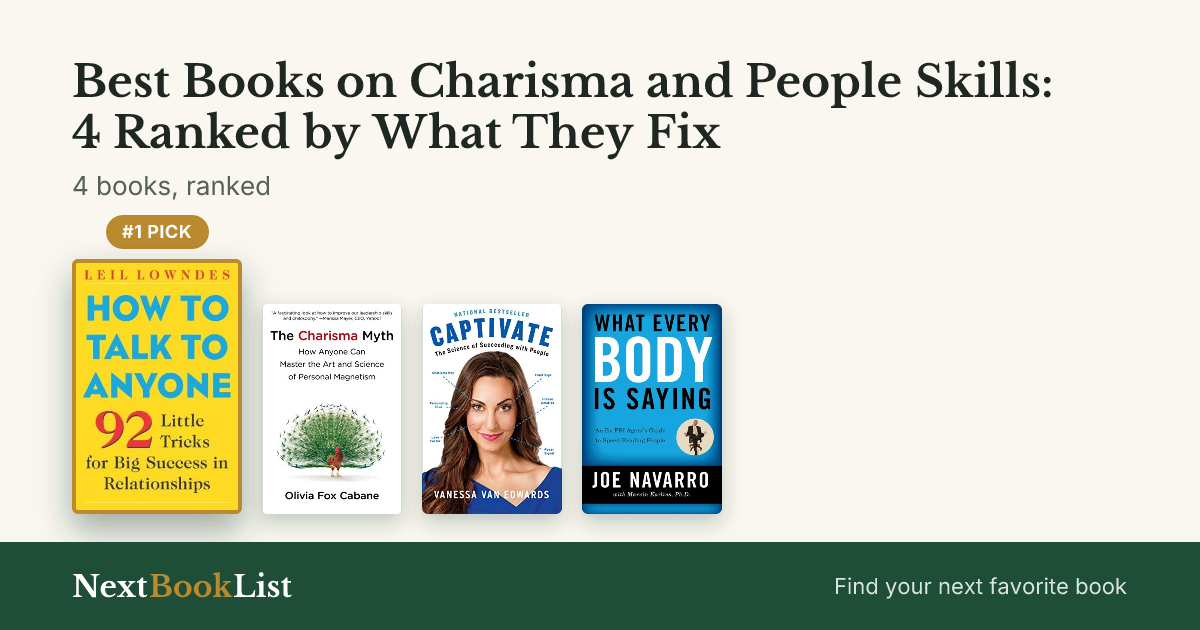
The best place to start is How to Talk to Anyone, because it’s the most tactical of the four. Leil Lowndes hands you specific scripts and moves for specific situations, small talk openers, how to work a room, how to exit a conversation without it feeling like a slight. You won’t walk away with a theory of why any of it works, but you’ll have something to say tomorrow.
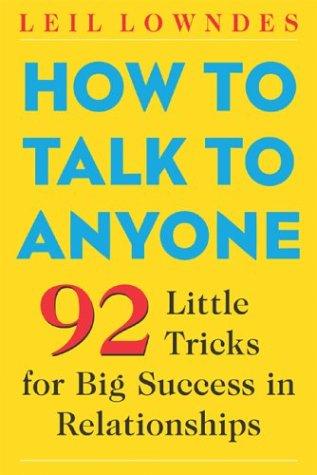
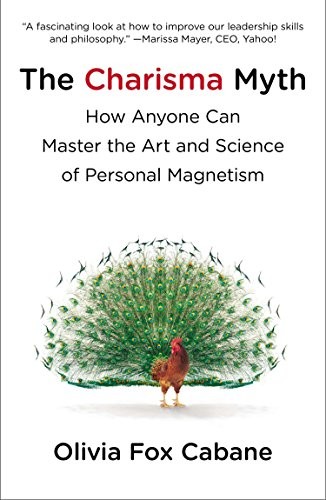
Once the tactics feel thin, The Charisma Myth gives you the theory: charisma isn’t a trait, it’s presence, power, and warmth, each trainable on its own. If you keep hitting the same wall in conversations and can’t name it, this is the book that names it for you. Captivate goes a layer deeper still, Vanessa Van Edwards runs the same territory through behavioral science and game theory, useful if you want to understand the mechanism rather than just apply the move.
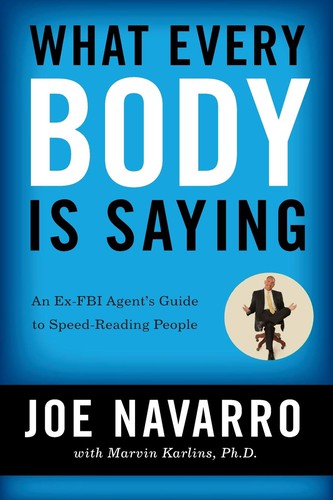
What Every BODY Is Saying is the odd one out, and it’s honest about it: a former FBI agent’s book on reading nonverbal cues. It’s narrower than the other three, it won’t teach you conversation, only what a crossed arm or a foot pointed at the exit is telling you. Read it last, and only if body language specifically is where you’re stuck.
One warning across all four: none of this replaces actually talking to people. Charisma books are Lindy-adjacent in theory, decades of interpersonal research packed into a paperback, but the research only pays off if you close the book and use it on a real person.
Vanessa Van Edwards · 2017
Vanessa Van Edwards's take on self-improvement, the honest verdict is below.
A behavioral-science guide to social skills and connection. Practical and specific; skip if you dislike step-by-step ‘people hacking,’ though the tactics are grounded and usable.
Read it if: anyone weighing whether Captivate belongs on their self-improvement and psychology shelf
Skip it if: you want a different angle than Vanessa Van Edwards's
Full verdict: Captivate →
Joe Navarro · 2008
Joe Navarro's take on self-improvement, the honest verdict is below.
An ex-FBI agent’s practical guide to reading body language. Grounded and useful; the best mainstream book on the topic. Skip if you expect to become a human lie detector, because it’s honest that certainty isn’t possible.
Read it if: anyone weighing whether What every BODY is saying belongs on their self-improvement and psychology shelf
Skip it if: you want a different angle than Joe Navarro's
Full verdict: What every BODY is saying →
Frequently Asked Questions
What is the best book for improving people skills overall?
How to Talk to Anyone. It's the broadest of the four, a big tactical grab-bag of specific conversation techniques you can start using in your next conversation. It won't give you a unified theory of charisma, but it fixes more everyday awkwardness per page than anything else on this list.
Is charisma something you're born with, or can you actually learn it?
The Charisma Myth makes the strongest case that it's learnable. Olivia Fox Cabane breaks it into three components, presence, power, and warmth, and argues you can train each one independently rather than treating charisma as a fixed trait you either have or don't.
What's the difference between Captivate and How to Talk to Anyone?
How to Talk to Anyone is a tactics book, scripts and moves for specific social situations. Captivate is more systematic, Vanessa Van Edwards applies behavioral science and game-theory framing to explain why those tactics work, which makes it a better fit if you want the reasoning, not just the line.
Should I read What Every BODY Is Saying if I already read the other three?
Only if body language specifically is your gap. It's narrower than the other three, a former FBI agent's book on reading nonverbal cues, and it won't teach you what to say. Read it as an add-on, not a substitute.