Best History Books: 11 Ranked by What They Actually Cover

Updated July 13, 2026 · 11 books

Best History Books: 11 Ranked by What They Actually Cover: ranked list of 11 books

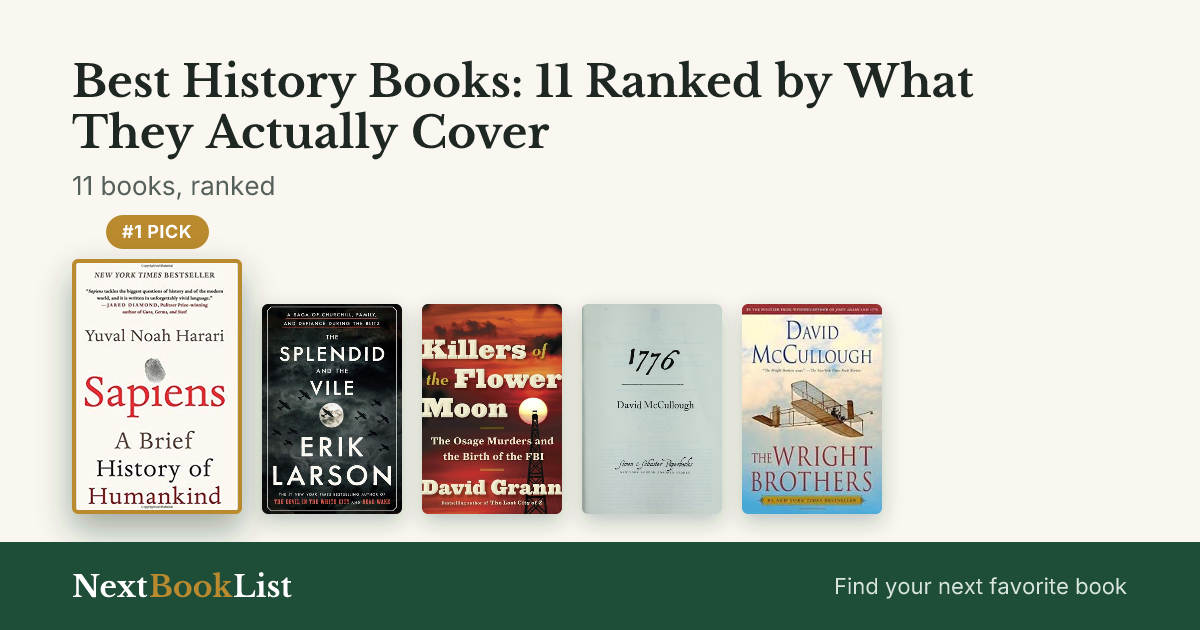
The best history book to start with is Sapiens, because Harari’s frame is the biggest one available, 300,000 years compressed into a single, readable argument about why Homo sapiens ended up running the planet. Read it for the scale, then narrow down to specific years and specific lives for the rest of the list.

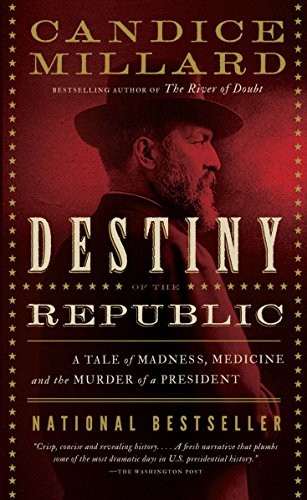
Narrative history that reads like a thriller despite being entirely true: Killers of the Flower Moon (the Osage murders and the birth of the FBI) and Destiny of the Republic (Garfield’s assassination, killed less by the bullet than by his own doctors). Both are built from meticulous research but paced like genre fiction.

One pivotal year at a time: 1776 follows Washington’s army through the year American victory came closest to not happening. Team of Rivals follows Lincoln’s decision to appoint his three defeated rivals to his own cabinet. The Wright Brothers narrows all the way down to two bicycle mechanics solving flight with no funding and no formal training.

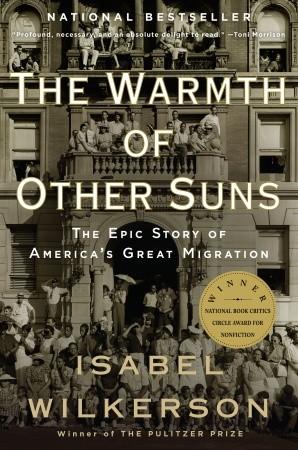
WWII from inside one household: The Splendid and the Vile (Churchill’s first year as Prime Minister) and In the Garden of Beasts (America’s first ambassador to Hitler’s Berlin) both stay close to a specific family rather than covering the whole war. The Warmth of Other Suns closes the American history thread with the Great Migration, told through three individual lives across six decades. Barbarians at the Gate and 1929 close the list with two financial disasters, the RJR Nabisco buyout and the 1929 crash, told with the same narrative pacing as the political history above them.

One warning: history written with novelistic pacing is still history. Every book on this list is built from primary sources and original research, not narrative license, the drama is real, not added.

Quick Comparison

#BookBest for
1SapiensYuval Noah Harariyou want the single most influential big-picture history book of the last decade, spanning cognitive, agricultural, and scientific revolutions in one readable volumeAmazon
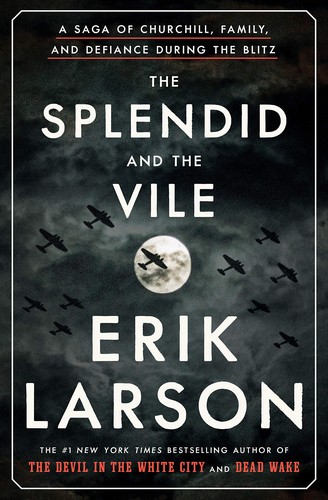
2The Splendid and the VileErik Larsonyou want narrative history that reads like a novel, built from meticulous archival research rather than a dry chronological accountAmazon
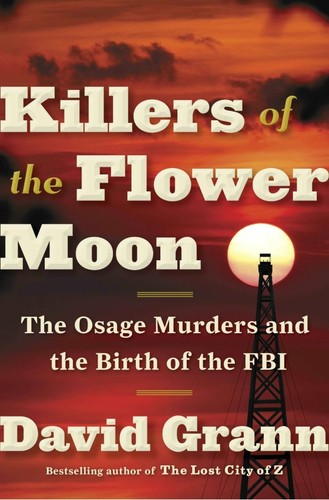
3Killers of the Flower MoonDavid Grannyou want investigative-journalism-grade true crime history about a genuinely underreported chapter of American historyAmazon
41776David McCulloughyou want the founding-era story told through Washington's army and its near-defeats, not the political theory of the Declaration of IndependenceAmazon
5The Wright BrothersDavid McCulloughyou want the human, unglamorous story behind one of history's most consequential inventions, built from the Wright family's own extensive papersAmazon
6Team of RivalsDoris Kearns Goodwinyou want a leadership-focused political biography built around one specific, counterintuitive decision and its consequencesAmazon
7In the Garden of BeastsErik Larsonyou want a ground-level account of how ordinary Americans in Berlin watched Nazi Germany's rise, told through people who didn't yet know how the story would endAmazon
8Destiny of the RepublicCandice Millardyou want a tightly-plotted historical narrative about a genuinely underappreciated presidency, told through the specific medical failure that ended itAmazon
9The Warmth of Other SunsIsabel Wilkersonyou want the Great Migration told through specific, deeply-researched individual lives rather than statistics and policy summaryAmazon
10Barbarians at the gateBryan Burroughanyone weighing whether Barbarians at the gate belongs on their history shelfAmazon
111929Andrew Ross Sorkinanyone weighing whether 1929 belongs on their history shelfAmazon

The Books

Sapiens by Yuval Noah Harari book cover

1. Sapiens

Yuval Noah Harari · 2015

A historian explains how an unremarkable ape came to dominate the planet, through a talent for believing collectively in things that don't physically exist.

Harari’s real skill is compression – distilling 300,000 years into a readable, argument-driven narrative without it collapsing into a dry timeline. Academic historians have pushed back on specific claims since publication, which is worth knowing going in, but the shared-fiction framework has genuinely changed how a lot of readers think about money, borders, and institutions.

Read it if: you want the single most influential big-picture history book of the last decade, spanning cognitive, agricultural, and scientific revolutions in one readable volume

Skip it if: you want rigorous, narrowly-scoped academic history -- Harari writes as a synthesizer covering 300,000 years in one book, which means broad strokes over granular precision by design
Full verdict: Sapiens →

The Splendid and the Vile by Erik Larson book cover

2. The Splendid and the Vile

Erik Larson · 2020

Larson rebuilds Churchill's first year as Prime Minister day by day, using diaries and declassified documents to show what Britain's defiance during the Blitz actually looked like from the inside.

Larson’s method (extensive archival research reassembled into scene-by-scene narrative) is what makes this readable at novel-pace without sacrificing the factual grounding serious history demands. The juxtaposition of Churchill’s household drama against the literal bombing of London is the book’s real achievement – it makes an extraordinary year feel lived-in rather than mythologized.

Read it if: you want narrative history that reads like a novel, built from meticulous archival research rather than a dry chronological account

Skip it if: you want military strategy and battlefield analysis -- this stays close to Churchill's household, inner circle, and London civilian life rather than the war's tactical dimension

Full verdict: The Splendid and the Vile →

Killers of the Flower Moon by David Grann book cover

3. Killers of the Flower Moon

David Grann · 2017

The Osage Nation became the wealthiest people per capita on Earth after oil was found under their land, then dozens were murdered, one by one, for the rights to that oil.

Grann’s reporting instincts (he’s a longtime New Yorker investigative journalist) show throughout – this isn’t secondhand historical summary, it’s built from original research including tracking down descendants and previously unexamined records. The final section, where his own investigation extends past where the official record stops, is what elevates this past a well-told historical account into something closer to unfinished justice.

Read it if: you want investigative-journalism-grade true crime history about a genuinely underreported chapter of American history

Skip it if: you're already familiar with the story through the 2023 Scorsese film adaptation and want fundamentally new material -- the book covers similar core events, with more space for context and Grann's own investigative process

Full verdict: Killers of the Flower Moon →

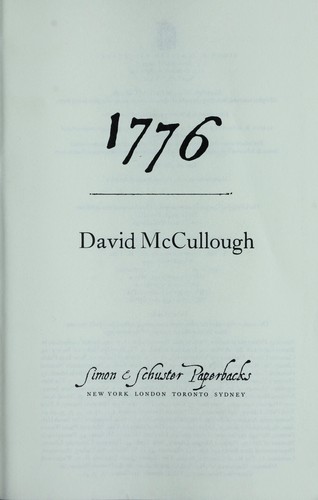
1776 by David McCullough book cover

4. 1776

David McCullough · 2005

The two-time Pulitzer winner narrows the entire American Revolution down to one year, following George Washington's army from near-collapse to Trenton, told with the human uncertainty a founding myth usually strips out.

McCullough’s real achievement is restoring uncertainty to a story every American reader already knows ends in victory – by staying close to Washington’s actual daily decisions and the army’s real material desperation, he makes 1776 feel like a year that genuinely could have gone the other way, which is closer to how it actually felt to the people living through it.

Read it if: you want the founding-era story told through Washington's army and its near-defeats, not the political theory of the Declaration of Independence

Skip it if: you want the full multi-year arc of the Revolutionary War -- this deliberately narrows to a single year, ending well before the war's actual conclusion

Full verdict: 1776 →

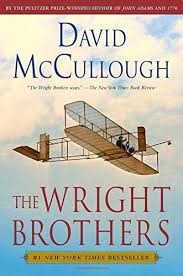
The Wright Brothers by David McCullough book cover

5. The Wright Brothers

David McCullough · 2015

Two bicycle mechanics from Dayton, Ohio, with no college education and no government funding, solved powered flight before teams with far more resources, told by the biographer who also gave us 1776 and John Adams.

McCullough’s access to the Wright family’s own letters is what makes this more than a familiar invention story – Katharine Wright’s role alone is worth the book, since she’s almost entirely absent from the popular version most readers already know. It’s a smaller, quieter book than McCullough’s presidential biographies, and that scale suits the material.

Read it if: you want the human, unglamorous story behind one of history's most consequential inventions, built from the Wright family's own extensive papers

Skip it if: you want deep engineering or aerodynamics detail -- McCullough writes character-driven narrative history, not a technical account of flight mechanics

Full verdict: The Wright Brothers →

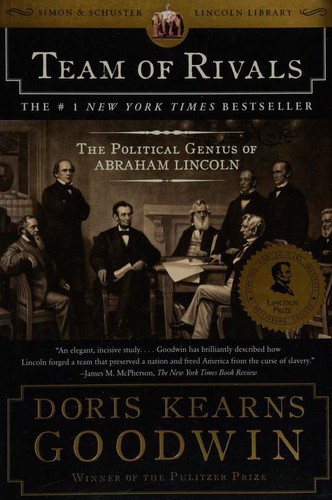
Team of Rivals by Doris Kearns Goodwin book cover

6. Team of Rivals

Doris Kearns Goodwin · 2005

Lincoln lost the 1860 Republican nomination to three rivals, then appointed all three to his cabinet. The move that shouldn't have worked became a masterclass in political leadership.

Goodwin’s real contribution is reframing a leadership story that could easily read as pure magnanimity into something more specific and replicable: a documented pattern of how Lincoln actually managed difficult, talented people over years, not just the singular decision to appoint them. That’s what gives the book its lasting relevance beyond Civil War history specifically.

Read it if: you want a leadership-focused political biography built around one specific, counterintuitive decision and its consequences

Skip it if: you want a compact, single-volume overview of Lincoln's life -- this is dense and comparably focused on the cabinet dynamic specifically, not a full cradle-to-grave biography

Full verdict: Team of Rivals →

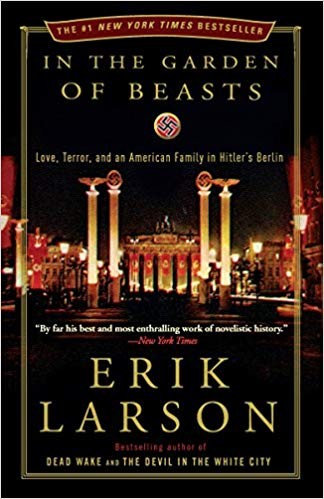
In the Garden of Beasts by Erik Larson book cover

7. In the Garden of Beasts

Erik Larson · 2011

America's first ambassador to Hitler's Germany brought his family to Berlin in 1933, including a daughter who dated Nazi officials before slowly realizing what she was actually witnessing.

Larson’s choice to center a single family, rather than attempting comprehensive political history, is what gives the book its real tension – you’re watching people you’ve come to know personally slowly, imperfectly grasp what they’re actually witnessing, which lands harder than an omniscient historical narrator ever could.

Read it if: you want a ground-level account of how ordinary Americans in Berlin watched Nazi Germany's rise, told through people who didn't yet know how the story would end

Skip it if: you want a comprehensive political or military history of the Nazi rise to power -- this stays close to one family's specific, limited vantage point in Berlin

Full verdict: In the Garden of Beasts →

Destiny of the Republic by Candice Millard book cover

8. Destiny of the Republic

Candice Millard · 2011

President Garfield survived the assassin's bullet, it was his own doctors, refusing to accept germ theory, who actually killed him over the following eleven weeks.

Millard’s structural choice – weaving Garfield’s own remarkable biography and Bell’s parallel technological race into the central medical-malpractice narrative – keeps a fairly narrow historical event from feeling small. The result reads less like a presidential biography and more like a genuine medical thriller with an outcome you already know and still can’t quite believe.

Read it if: you want a tightly-plotted historical narrative about a genuinely underappreciated presidency, told through the specific medical failure that ended it

Skip it if: you want a comprehensive Garfield biography or full account of Gilded Age politics -- this narrows tightly around the assassination and its medical aftermath specifically

Full verdict: Destiny of the Republic →

The Warmth of Other Suns by Isabel Wilkerson book cover

9. The Warmth of Other Suns

Isabel Wilkerson · 2010

Six million Black Americans left the South over six decades, the largest internal migration in U.S. history, told through three people who actually lived it.

Wilkerson’s fifteen years of research produced something rare: a work of genuine historical scale that never loses the texture of individual lives inside it. The three people she follows aren’t illustrations of a larger point – their full lives, with all their specific complications, are the actual subject, and the history emerges from that specificity rather than the other way around.

Read it if: you want the Great Migration told through specific, deeply-researched individual lives rather than statistics and policy summary

Skip it if: you want a compact overview -- this is a long, deeply researched book (over 600 pages) built from over a thousand interviews, not a brief survey

Full verdict: The Warmth of Other Suns →

Barbarians at the gate by Bryan Burrough book cover

10. Barbarians at the gate

Bryan Burrough · 2009

Bryan Burrough's take on history, the honest verdict is below.

The definitive account of the RJR Nabisco leveraged buyout and 1980s Wall Street excess. A gripping business classic; read it for the drama and the finance. Skip if you want a how-to, because it’s narrative history, not instruction.

Read it if: anyone weighing whether Barbarians at the gate belongs on their history shelf

Skip it if: you want a different angle than Bryan Burrough's

Full verdict: Barbarians at the gate →

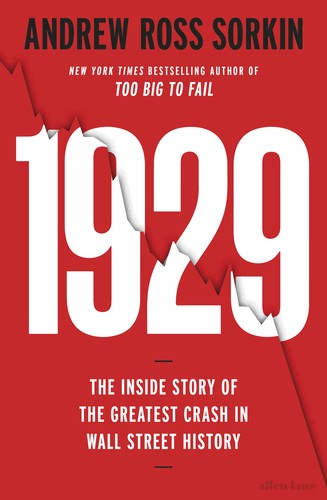
1929 by Andrew Ross Sorkin book cover

11. 1929

Andrew Ross Sorkin · 2025

Andrew Ross Sorkin's take on history, the honest verdict is below.

Sorkin’s narrative history of the great crash and its lead-up. Likely a gripping, character-driven account if it matches his prior work; treat this as a cautious take, since it’s a 2025 release I can’t verify in detail. Skip if you want technical economics over story.

Read it if: anyone weighing whether 1929 belongs on their history shelf

Skip it if: you want a different angle than Andrew Ross Sorkin's

Full verdict: 1929 →

Frequently Asked Questions

What is the best history book to start with?

Sapiens, if you want the biggest possible frame, 300,000 years of human history compressed into one readable argument about why our species dominates the planet. If you want something narrower and more tightly plotted, start with Killers of the Flower Moon instead.

What's the best narrative history book, built like a thriller?

Killers of the Flower Moon or Destiny of the Republic. Grann's account of the Osage murders and Millard's account of Garfield's assassination both read with genuine plot tension despite being entirely true, reported history.

I want WWII history specifically. Which one?

The Splendid and the Vile, Erik Larson's account of Churchill's first year as Prime Minister, or In the Garden of Beasts, his account of America's first ambassador to Hitler's Berlin. Both stay close to specific people rather than covering the whole war.

What's the best financial history book on this list?

Barbarians at the Gate and 1929, the RJR Nabisco leveraged buyout and the stock market crash, respectively. Both are financial disasters told with the same narrative pacing as the political and war histories elsewhere on the list.

Keep Reading