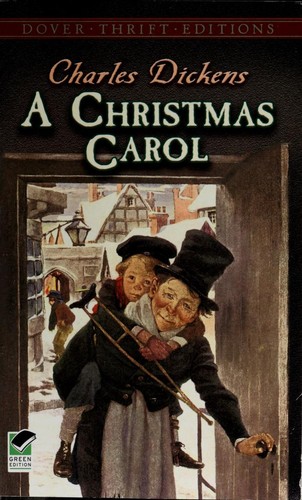
A Christmas Carol
by Charles Dickens · 1843
A miserly old man gets one night, three ghosts, and a last chance to stop being the villain of his own life -- the novella that basically invented the modern Christmas redemption story.
Worth reading? A Christmas Carol earns its 180-plus years in print. It's shorter and funnier than its cultural reputation suggests, and the real bite lives in Dickens's own prose, not the sanitized adaptations. If you want more Dickens after this, David Copperfield is the big commitment; this is the appetizer that proves he's worth it.
| Author | Charles Dickens |
|---|---|
| Published | 1843 |
| Category | Fiction |
| Favorite quote | “God bless us, every one!” |
The Verdict
The reason this outlasts almost every other Christmas story is that Dickens wasn’t just writing a ghost story – he was writing a direct argument against Victorian England’s casual cruelty to the poor, and he wrapped that argument in something entertaining enough to actually spread. It worked. Nearly two centuries later, “Scrooge” is still shorthand for miser, and that’s not an accident of marketing.
you want the original, still-sharpest version of the Christmas redemption arc -- short enough to read in one sitting, funnier and darker than most adaptations let on
you've seen enough adaptations (the Muppets, Scrooged, a dozen TV specials) that you feel like you already know it beat for beat -- Dickens's actual prose is worth it, but don't expect big plot surprises
Book Summary
Scrooge's redemption isn't a soft, sentimental turn -- Dickens structures it as three forced confrontations with memory, present suffering, and mortality, using the ghosts as a device to make Scrooge (and the reader) actually look at what his miserliness costs other people, especially the Cratchit family and Tiny Tim.
Underneath the ghost story, the book is a piece of Victorian social criticism aimed squarely at the era's Poor Laws and workhouse system. Scrooge's early line about the poor being better off dead "to decrease the surplus population" is Dickens directly quoting and indicting the era's own utilitarian arguments against helping the poor.
Top 8 Lessons from A Christmas Carol
- Scrooge is visited by the ghost of his dead business partner Jacob Marley, who warns him that three more spirits will visit.
- The Ghost of Christmas Past forces Scrooge to relive his lonely childhood and the choices that hardened him into a miser.
- The Ghost of Christmas Present shows Scrooge the Cratchit family's poverty, and the sickly Tiny Tim, whose fate depends on futures Scrooge could change.
- The Ghost of Christmas Yet to Come shows Scrooge a bleak future in which his own death goes unmourned and his belongings are picked over by strangers.
- Scrooge's early dismissal of the poor as better off dead directly echoes real Victorian arguments used to justify workhouses and the Poor Laws.
- Scrooge's nephew Fred represents a warmer counter-model of Christmas -- generosity and family connection over profit.
- Scrooge wakes on Christmas morning fundamentally changed and immediately acts on it, sending a prize turkey to the Cratchits anonymously.
- The novella closes with Scrooge becoming a second father to Tiny Tim and keeping Christmas 'better than any man in the ancient city' ever after.
Top 6 Quotes from A Christmas Carol
"Bah! Humbug!"
Charles Dickens, A Christmas Carol
"God bless us, every one!"
Charles Dickens, A Christmas Carol
"Mankind was my business. The common welfare was my business; charity, mercy, forbearance, and benevolence, were, all, my business."
Charles Dickens, A Christmas Carol
"I will honour Christmas in my heart, and try to keep it all the year."
Charles Dickens, A Christmas Carol
"There is nothing in the world so irresistibly contagious as laughter and good humour."
Charles Dickens, A Christmas Carol
"I am as light as a feather, I am as happy as an angel, I am as merry as a schoolboy."
Charles Dickens, A Christmas Carol
Frequently Asked Questions
Is A Christmas Carol worth reading?
Yes -- it's short, sharper and funnier than most adaptations suggest, and it's the original version of a redemption story that's been retold hundreds of times since.
How long does it take to read A Christmas Carol?
About two hours. It's a novella, roughly 80 pages in most editions, originally written to be read aloud in one sitting.
Is A Christmas Carol appropriate for kids?
Yes, with light guidance -- some of the ghost imagery and the Poor Laws commentary can go over a young child's head, but nothing in it is graphic.
Who should read A Christmas Carol?
Anyone who's only seen the adaptations and wants the original -- Dickens's own voice is wittier and more socially pointed than most screen versions preserve.
Ready to read it?
Get A Christmas Carol on Amazon