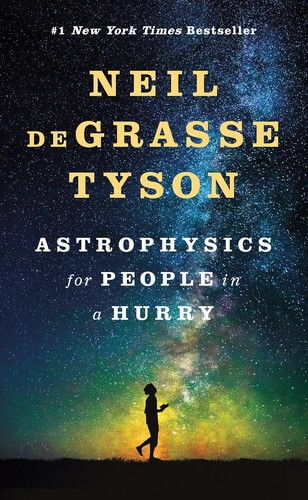
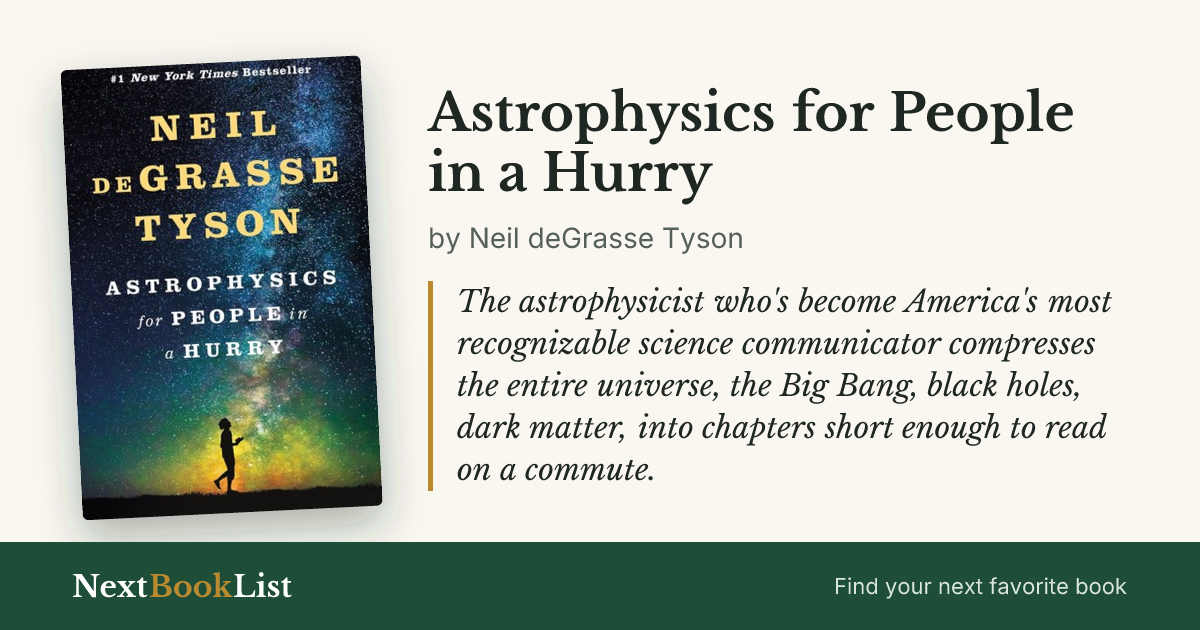
Astrophysics for People in a Hurry
by Neil deGrasse Tyson · 2017
The astrophysicist who's become America's most recognizable science communicator compresses the entire universe, the Big Bang, black holes, dark matter, into chapters short enough to read on a commute.
Worth reading? Tyson built this book specifically for readers who want to understand the universe's big questions without committing to a full physics education, and the format matches the promise: short, self-contained chapters on the Big Bang, dark matter, black holes, and the scale of the cosmos, each readable in a few minutes without requiring the previous chapter's content. It's intentionally shallow compared to a real astrophysics textbook, and that's the entire point -- it's an on-ramp, not a destination, and Tyson's skill as a science communicator (built over decades of public-facing work) is what keeps the compression from feeling like it's talking down to the reader.
| Author | Neil deGrasse Tyson |
|---|---|
| Published | 2017 |
| Category | Science & Nature |
| Favorite quote | “The universe is under no obligation to make sense to you.” |
The Verdict
Tyson’s real skill here is knowing exactly how much to compress without losing accuracy – these are genuinely short chapters covering genuinely enormous topics, and the fact that they hold together at all is a function of decades spent explaining this material to general audiences. Read it as the on-ramp it’s built to be, not the full education.
you want the fastest, most accessible entry point into astrophysics, with zero prior science background required
you want depth and technical rigor -- this is deliberately compressed and introductory by design, built for readers with no background, not for advancing existing knowledge
Book Summary
Tyson organizes the book around the universe's biggest, most conceptually vertigo-inducing questions -- what happened in the first fractions of a second after the Big Bang, what dark matter and dark energy actually are (and how much we still don't know), how black holes warp space and time, and just how small human timescales are relative to cosmic ones -- treating each as a self-contained chapter accessible without requiring the others.
His core communication strategy is building genuine scientific literacy through scale and wonder rather than equations -- explaining, for instance, just how much of the universe's mass and energy (dark matter and dark energy combined) remains fundamentally not understood by physics, a genuinely humbling admission that most popular science writing skips in favor of confident-sounding explanation.
Top 7 Lessons from Astrophysics for People in a Hurry
- The Big Bang and the universe's first fractions of a second remain genuinely strange and only partially understood, even by working physicists.
- Dark matter and dark energy together make up roughly 95% of the universe's mass and energy, and neither is well understood despite decades of research.
- Black holes warp space and time in ways that break ordinary intuition about distance, time, and causality.
- Human and even planetary timescales are vanishingly small relative to the universe's actual age and scale.
- Genuine scientific literacy can be built through conceptual understanding and a sense of wonder, not just equations and technical rigor.
- Admitting the limits of current scientific understanding (what we don't know about dark matter) is more honest and more useful than false confidence.
- Complex scientific topics can be made accessible without being dumbed down, if the communicator understands the material deeply enough to compress it well.
Top 4 Quotes from Astrophysics for People in a Hurry
"The universe is under no obligation to make sense to you."
Neil deGrasse Tyson, Astrophysics for People in a Hurry
"Not only are we in the universe, the universe is in us."
Neil deGrasse Tyson, Astrophysics for People in a Hurry
"People who believe they are ignorant of nothing have neither looked for, nor stumbled upon, the boundary between what is known and unknown in the universe."
Neil deGrasse Tyson, Astrophysics for People in a Hurry
"The cosmic perspective is humble."
Neil deGrasse Tyson, Astrophysics for People in a Hurry
Frequently Asked Questions
Is Astrophysics for People in a Hurry worth reading?
Yes, especially as a fast, accessible entry point into astrophysics with no prior science background required. It's intentionally compressed -- read it for the on-ramp, not for technical depth.
What topics does Astrophysics for People in a Hurry cover?
The Big Bang and the early universe, dark matter and dark energy, black holes, the periodic table's cosmic origins, and the overall scale of the cosmos, organized into short, self-contained chapters.
Do I need a science background to read this book?
No -- it's specifically designed for readers with no prior physics or astronomy background, using minimal math and building understanding through concept and scale rather than equations.
Who is Neil deGrasse Tyson?
An astrophysicist and director of the Hayden Planetarium, known as one of the most prominent public science communicators in the U.S., through television, books, and public speaking.
Ready to read it?
Get Astrophysics for People in a Hurry on Amazon