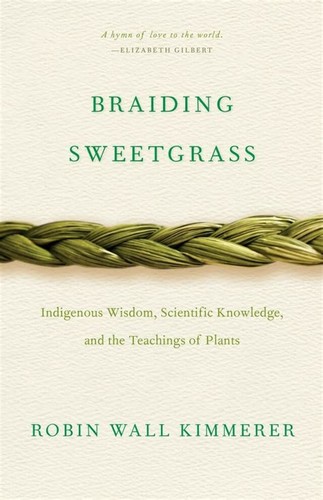
Braiding Sweetgrass
by Robin Wall Kimmerer · 2013
A botanist and enrolled member of the Citizen Potawatomi Nation braids Indigenous ecological knowledge together with Western scientific training, and argues plants have been trying to teach us something we stopped listening for.
Worth reading? Kimmerer's dual training -- a PhD botanist by profession, an enrolled member of the Citizen Potawatomi Nation by heritage -- is what makes Braiding Sweetgrass genuinely distinct rather than just another nature-writing entry. She moves fluidly between rigorous scientific description (how sweetgrass, strawberries, or lichen actually function biologically) and Indigenous teachings about reciprocity with the natural world, arguing the two aren't in tension so much as two different, valid ways of asking similar questions. It's become one of the best-selling essay collections of the decade for a reason: the writing is genuinely beautiful, not just conceptually interesting.
| Full Title | Braiding Sweetgrass: Indigenous Wisdom, Scientific Knowledge, and the Teachings of Plants |
|---|---|
| Author | Robin Wall Kimmerer |
| Published | 2013 |
| Category | Science & Nature |
| Favorite quote | “In some Native languages the term for plants translates to 'those who take care of us.'” |
The Verdict
Kimmerer’s rare dual fluency (rigorous botany and Indigenous teaching, held without contradiction) is what makes the book’s central argument land as genuinely productive rather than just a nice sentiment. It’s slow, essayistic reading best taken a chapter at a time, not raced through.
you want nature writing that treats Indigenous knowledge and Western science as complementary lenses, not competing ones, from someone trained rigorously in both
you want a purely data-driven scientific text -- this is essayistic and personal, closer to nature writing and memoir than a science textbook
Book Summary
Kimmerer's central argument is that Indigenous ecological knowledge and Western scientific method aren't competing epistemologies but complementary ones -- Western science excels at mechanistic explanation (how photosynthesis works, how a root system distributes nutrients) while Indigenous teachings, developed over generations of sustained relationship with specific land, carry knowledge about reciprocity, gratitude, and sustainable relationship that mechanistic science alone doesn't generate.
The book's recurring theme of the "Honorable Harvest" -- a set of Indigenous principles for taking from nature only what you need, asking permission, giving back in return, and never taking more than half of what's available -- offers a practical ethical framework for human relationship with natural resources that Kimmerer argues could meaningfully inform environmental policy and personal practice alike, not just remain an abstract cultural value.
Top 7 Lessons from Braiding Sweetgrass
- Indigenous ecological knowledge and Western science are complementary lenses on the natural world, not competing or incompatible ones.
- The 'Honorable Harvest' principle -- take only what you need, ask permission, give back, never take more than half -- offers a practical ethic for resource use.
- Gratitude and reciprocity toward the natural world can be a genuine ecological practice, not just a sentimental attitude.
- Plants and ecosystems operate through genuine reciprocal relationships (like mycorrhizal networks) that mechanistic description alone doesn't fully capture.
- Sustained, generational relationship with a specific piece of land produces a form of knowledge that short-term scientific study doesn't replicate.
- Treating nature purely as a resource to extract from, without reciprocity, is a relatively recent and specific cultural stance, not a universal human default.
- Scientific rigor and Indigenous spiritual or cultural knowledge can be held by the same person without contradiction.
Top 4 Quotes from Braiding Sweetgrass
"In some Native languages the term for plants translates to 'those who take care of us.'"
Robin Wall Kimmerer, Braiding Sweetgrass
"Restoration is a powerful antidote to despair."
Robin Wall Kimmerer, Braiding Sweetgrass
"All flourishing is mutual."
Robin Wall Kimmerer, Braiding Sweetgrass
"The land knows you, even when you are lost."
Robin Wall Kimmerer, Braiding Sweetgrass
Frequently Asked Questions
Is Braiding Sweetgrass worth reading?
Yes -- it's become one of the best-selling essay collections of the past decade, and the writing itself is genuinely distinguished, not just conceptually notable for blending Indigenous knowledge with scientific training.
What is Braiding Sweetgrass about?
Robin Wall Kimmerer, a botanist and enrolled member of the Citizen Potawatomi Nation, weaves together Indigenous ecological teachings and Western scientific knowledge across a series of essays about plants, land, and human relationship with the natural world.
What is the 'Honorable Harvest' in Braiding Sweetgrass?
A set of Indigenous principles Kimmerer describes for sustainable resource use: take only what you need, ask permission of what you're taking from, give something back in return, and never take more than half of what's available.
Is Braiding Sweetgrass a science book or a memoir?
Both, structured as a series of personal essays -- it combines rigorous botanical description with personal and cultural reflection, closer to literary nature writing than a conventional science text.
Ready to read it?
Get Braiding Sweetgrass on Amazon