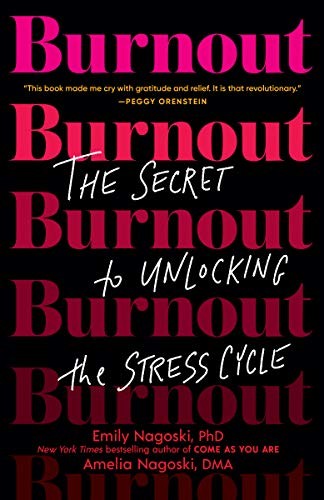
Burnout
by Emily Nagoski and Amelia Nagoski · 2019
Two sister scientists explain why 'just relax' doesn't work: stress and stressors are different things, and you have to complete the stress cycle in your body, not just remove the thing that triggered it.
Worth reading? Burnout beats most 'self-care' books because it makes a genuinely useful distinction most readers have never heard: stress and the stressor are separate, and dealing with the stressor (finishing the project, resolving the fight) doesn't automatically discharge the stress sitting in your body. It's a better companion to Why Zebras Don't Get Ulcers than most calm-down-and-breathe books, because it gives you specific, repeatable ways to complete the cycle -- not just the theory.
| Full Title | Burnout: The Secret to Unlocking the Stress Cycle |
|---|---|
| Author | Emily Nagoski and Amelia Nagoski |
| Published | 2019 |
| Publisher | Ballantine Books |
| Category | Self-Improvement & Psychology |
| Favorite quote | “Stress is not bad for you; being stuck is bad for you.” |
The Verdict
The best chapter is the one on Human Giver Syndrome – it names a specific, gendered pattern of self-erasure that most stress books either ignore or vaguely gesture at. If you’ve ever felt guilty resting, this book explains why, and then gives you the physiology to override the guilt. Pair it with a real look at your calendar, not just your feelings, for it to actually work.
you feel chronically exhausted even after the stressful thing is over, and you want the actual physiology of why, not another productivity hack
you want a step-by-step productivity or time-management system -- this is about processing stress physiologically (emotion, body, cycle completion), not managing your calendar
Book Summary
Stress is a physiological cycle (originally built for physical threats like being chased by a predator) that needs to be completed in the body -- through movement, breathing, affection, laughter, or crying -- or it lingers regardless of whether you've solved the problem that caused it.
The book names "Human Giver Syndrome" -- a cultural expectation, disproportionately placed on women, that your job is to give endlessly to others (family, employer, community) while asking for little in return, and that this expectation is a major, underdiagnosed driver of chronic burnout.
Completing the stress cycle isn't optional self-indulgence -- it's a physiological requirement, and the authors give concrete, evidence-based tools (movement, deep breathing, positive social interaction, laughter, crying, creative expression, physical affection lasting 20 seconds or more) for actually discharging built-up stress.
Top 9 Lessons from Burnout
- Stress and the stressor are two different things -- resolving the stressor doesn't automatically discharge the stress in your body.
- The stress-response cycle evolved for physical threats and needs a physical completion signal (movement, etc.) to actually end.
- Physical activity is the single most effective way to complete the stress cycle, even a short walk or a few minutes of stretching.
- A 20-second hug or extended physical affection can signal safety to the nervous system and help discharge stress.
- Human Giver Syndrome describes the cultural pressure (especially on women) to give endlessly and rarely receive, which the authors identify as a chronic burnout driver.
- Laughing and crying are treated as legitimate, physiologically effective stress-discharge tools, not just emotional venting.
- 'The Bikini Industrial Complex' -- the authors' term for external appearance pressure -- is named as a specific added burden that compounds stress for many women.
- Connection and social support act as a buffer against burnout, meaning isolation during stressful periods makes the cycle harder to complete.
- Meaning and purpose alone don't prevent burnout if the stress cycle itself never gets physically discharged.
Top 3 Quotes from Burnout
"Stress is not bad for you; being stuck is bad for you."
Emily Nagoski and Amelia Nagoski, Burnout
"The most efficient strategy... is exercise."
Emily Nagoski and Amelia Nagoski, Burnout
"You have to do something that tells your body the threat is over."
Emily Nagoski and Amelia Nagoski, Burnout
Frequently Asked Questions
Is Burnout worth reading?
Yes -- the stress-versus-stressor distinction alone is worth the read, and the book backs it with practical, evidence-based tools for actually discharging stress.
What is the main idea of Burnout?
That stress is a physiological cycle that must be completed in the body (through movement, affection, laughter, etc.), separate from solving whatever triggered the stress in the first place.
Is Burnout only for women?
The book's Human Giver Syndrome framework focuses heavily on cultural pressures placed on women, but the core stress-cycle science applies to anyone.
How is Burnout different from other stress management books?
Most stress books focus on removing stressors or general relaxation. Burnout focuses specifically on the physiological completion of the stress response, with concrete science behind each tool.
Ready to read it?
Get Burnout on Amazon