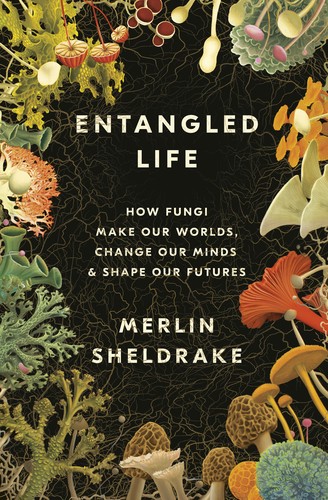
Entangled Life
by Merlin Sheldrake · 2020
A biologist who's eaten his own research subjects (and grown mushrooms out of an old book) makes the case that fungi are the most underappreciated organisms on the planet, and possibly the most important.
Worth reading? Sheldrake, who holds a PhD in tropical ecology and studies underground fungal networks directly, makes the case across this book that fungi have been systematically underappreciated relative to plants and animals despite being essential to nearly every terrestrial ecosystem -- decomposing matter, connecting plant root systems through mycorrhizal networks, and in some cases directly influencing animal behavior through infection. The writing is genuinely playful and personally immersive (Sheldrake experiments with growing mushrooms himself and writes candidly about psilocybin research) without sacrificing scientific rigor, which won it the Wainwright Prize and wide critical acclaim.
| Full Title | Entangled Life: How Fungi Make Our Worlds, Change Our Minds, and Shape Our Futures |
|---|---|
| Author | Merlin Sheldrake |
| Published | 2020 |
| Category | Science & Nature |
| Favorite quote | “Fungi are eating the world, and always have.” |
The Verdict
Sheldrake’s willingness to get genuinely hands-on with his subject – growing mushrooms out of an old book, eating what he studies, experimenting directly with psilocybin – gives the book an immersive quality most organism-focused nature writing lacks. It’s playful without losing scientific rigor, and it makes a genuinely convincing case that fungi deserve far more attention than they usually get.
you want rigorous, genuinely strange science writing about an organism kingdom most nature books skip entirely
you want a narrow, single-topic book -- Sheldrake covers an unusually wide range of fungal biology, ecology, and even psychedelic research, which some readers may find sprawling rather than tightly focused
Book Summary
Fungi represent an entire kingdom of life -- genetically closer to animals than to plants -- that's been comparatively understudied and underappreciated despite performing essential ecological functions: decomposing dead organic matter (without which nutrients would never recycle back into ecosystems), forming underground mycorrhizal networks that connect and support plant root systems, and in some documented cases, directly manipulating host animal behavior through infection (like the "zombie ant" fungus that controls its host's movements before killing it).
Sheldrake also explores fungi's more startling edges -- lichens as genuinely intimate symbiotic relationships between fungi and algae or cyanobacteria, psilocybin mushrooms' effects on human consciousness and their re-emerging therapeutic research, and slime molds (technically not true fungi, but covered for their startling problem-solving behavior despite lacking anything resembling a brain) -- treating the whole kingdom as a lens for questioning where the boundaries of individual organisms and even cognition actually lie.
Top 7 Lessons from Entangled Life
- Fungi form an entire kingdom of life, genetically closer to animals than plants, essential to nearly every terrestrial ecosystem.
- Decomposition by fungi is what allows nutrients to recycle back into ecosystems -- without it, dead matter would simply accumulate.
- Mycorrhizal fungal networks connect and support plant root systems underground, facilitating nutrient and signal exchange between plants.
- Some fungi can directly manipulate host animal behavior through infection, as in the documented 'zombie ant' fungus.
- Lichens are intimate symbiotic partnerships between fungi and algae or cyanobacteria, not single organisms.
- Slime molds, despite lacking anything resembling a brain, demonstrate startling problem-solving behavior that challenges assumptions about what cognition requires.
- Studying an underappreciated organism kingdom can reveal genuinely novel questions about biology, cognition, and ecological interdependence.
Top 2 Quotes from Entangled Life
"Fungi are eating the world, and always have."
Merlin Sheldrake, Entangled Life
"The more we learn about fungi, the less makes sense without them."
Merlin Sheldrake, Entangled Life
Frequently Asked Questions
Is Entangled Life worth reading?
Yes -- it's rigorous, genuinely strange science writing about an organism kingdom (fungi) that most popular science books skip entirely, and it won the Wainwright Prize for nature writing.
What is Entangled Life about?
Merlin Sheldrake's exploration of fungal biology and ecology, covering decomposition, mycorrhizal networks connecting plant root systems, fungi that manipulate host animal behavior, lichens, and psilocybin mushroom research.
Does Entangled Life cover psychedelic mushrooms?
Yes -- Sheldrake covers psilocybin mushrooms' effects on consciousness and their re-emerging therapeutic research, writing candidly about his own direct experimentation as part of the broader exploration of fungal biology.
Who is Merlin Sheldrake?
A biologist with a PhD in tropical ecology who studies underground fungal networks directly, bringing both formal research credentials and hands-on personal experimentation (growing mushrooms, tasting research subjects) to the writing.
Ready to read it?
Get Entangled Life on Amazon