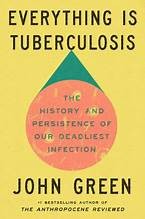
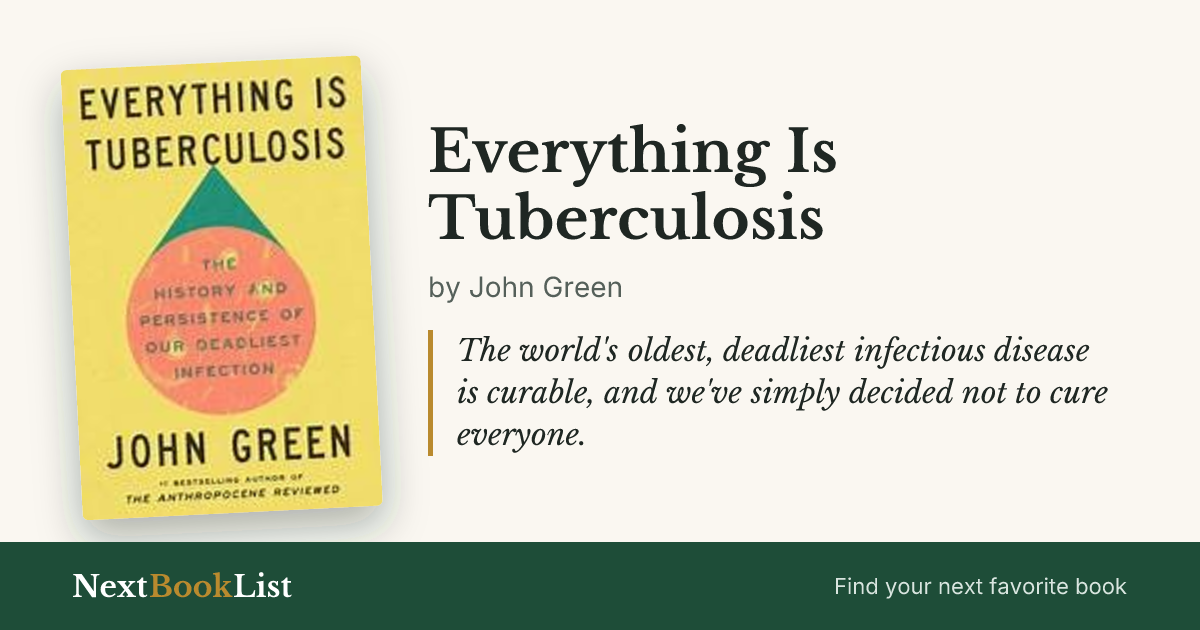
Everything Is Tuberculosis
by John Green · 2025
The world's oldest, deadliest infectious disease is curable, and we've simply decided not to cure everyone.
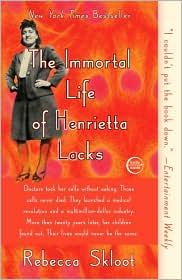
Worth reading? Everything Is Tuberculosis is the rare disease book that doubles as a policy argument, and it earns both halves. Green tells you the science and history of TB, then makes the case -- through one specific patient, Henry -- that the disease persists because of poverty and drug pricing, not biology. Compare it to Rebecca Skloot's The Immortal Life of Henrietta Lacks for the move of grounding a systemic argument in one person's story; Green's version is shorter and angrier.
| Full Title | Everything Is Tuberculosis: The History and Persistence of Our Deadliest Infection |
|---|---|
| Author | John Green |
| Published | 2025 |
| Publisher | Crash Course Books |
| Category | Science & Nature |
| Favorite quote | “What's different now from 1804 or 1904 is that tuberculosis is curable, and has been since the mid-1950s. We know how to live in a world without tuberculosis. But we choose not to live in that world.” |
The Verdict
Green does the thing good narrative nonfiction is supposed to do: he takes a statistic (over a million TB deaths a year, from a curable disease) and makes it impossible to look away from by attaching it to one kid, Henry, whose survival became a fight against a system, not just a bacterium.
It’s a short book that argues bigger than its page count. Green isn’t neutral about who’s responsible for TB still killing people in 2025, and he shouldn’t be – the case he builds for drug pricing and access as the real disease is hard to argue with once you’ve read it.
you want a short, humane book on why a solved medical problem still kills over a million people a year
you want a purely clinical history of TB with no argument attached -- Green is making a moral case, not just telling a story
Book Summary
Tuberculosis has been curable since the mid-1950s, yet it remains the deadliest infectious disease in human history and still kills more than a million people a year. Green's argument is that this gap between "curable" and "cured" isn't a medical mystery -- it's a distribution problem created by poverty, colonial history, and pharmaceutical pricing. The book is anchored by Henry, a boy Green met in Sierra Leone whose fight against drug-resistant TB puts a face on the statistics. Green interweaves Henry's story with TB's cultural history -- how it was romanticized as "consumption" in the 19th century, and how that mythology still shapes who we imagine getting sick and who we imagine deserving treatment. Green connects his own history with health anxiety to his empathy for patients navigating a system that treats survival as conditional on where you happen to live. The book's closing argument is blunt: curing TB globally is a matter of political will and money, not scientific limitation.
Top 9 Lessons from Everything Is Tuberculosis
- TB has been curable since the mid-1950s but remains the deadliest infectious disease in human history.
- The book is anchored by Henry, a boy Green met in Sierra Leone fighting drug-resistant TB.
- 19th-century culture romanticized TB as 'consumption,' a disease associated with genius and delicacy -- a myth that still distorts how we think about who gets sick.
- Colonial-era public health systems set patterns of unequal care that persist in how TB is treated today.
- Drug pricing and patents, not lack of scientific knowledge, are presented as the main barrier to a TB-free world.
- Green argues that illness has no moral logic -- biology doesn't reward good people or punish bad ones.
- The 'cure gap' between rich and poor countries is framed as a policy choice, not a scientific inevitability.
- Green ties his own history with OCD and health anxiety to his empathy for patients living with a stigmatized, often-fatal diagnosis.
- The book argues that treating illness as a 'statistics problem' instead of a 'people problem' is what allows the gap in care to persist.
Top 4 Quotes from Everything Is Tuberculosis
"We can do and be so much for each other—but only when we see one another in our full humanity, not as statistics or problems, but as people who deserve to be alive in the world."
John Green, Everything Is Tuberculosis
"We must also address the root cause of tuberculosis, which is injustice. In a world where everyone can eat, and access healthcare, and be treated humanely, tuberculosis has no chance."
John Green, Everything Is Tuberculosis
"What's different now from 1804 or 1904 is that tuberculosis is curable, and has been since the mid-1950s. We know how to live in a world without tuberculosis. But we choose not to live in that world."
John Green, Everything Is Tuberculosis
"Framing illness as even involving morality seems to me a mistake, because of course cancer does not give a shit whether you are a good person. Biology has no moral compass. It does not punish the evil and reward the good. It doesn't even know about evil and good."
John Green, Everything Is Tuberculosis
Frequently Asked Questions
Is Everything Is Tuberculosis worth reading?
Yes -- it's a short, well-argued book that turns disease history into a genuine moral argument, grounded in one real patient's story rather than abstract statistics.
What is the main argument of Everything Is Tuberculosis?
That tuberculosis has been curable for 70 years and still kills over a million people annually because of poverty, drug pricing, and unequal access -- not because we lack the medical knowledge to stop it.
Is Everything Is Tuberculosis hard to read?
No. It's under 250 pages, written in Green's accessible nonfiction voice, and structured around one patient's story rather than dense clinical detail.
Who should read Everything Is Tuberculosis?
Anyone curious about global health inequality, medical history, or John Green's nonfiction work. Skip it if you want a neutral clinical history with no argument attached.
Ready to read it?
Get Everything Is Tuberculosis on Amazon