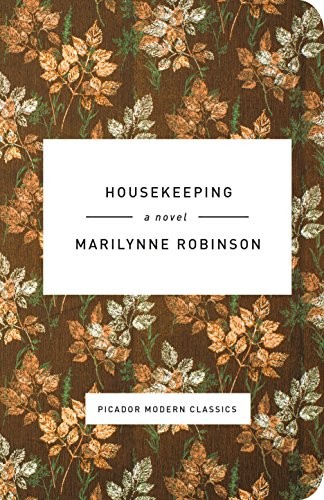
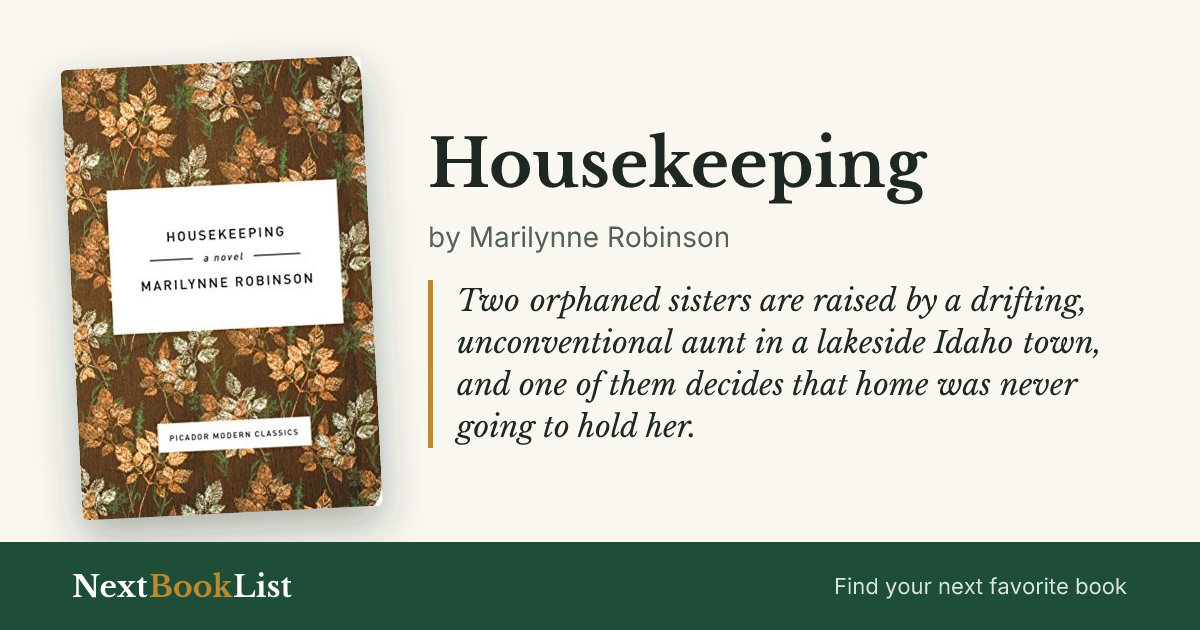
Housekeeping
by Marilynne Robinson · 1980
Two orphaned sisters are raised by a drifting, unconventional aunt in a lakeside Idaho town, and one of them decides that home was never going to hold her.
Worth reading? This is a slower, more interior read than most literary fiction gets away with, and it earns the patience it demands -- Robinson's sentences are doing more work than the plot is. If you want a similarly meditative but more plot-forward book about grief and family, try her later Gilead instead; if you want prose-first fiction where language carries the weight, this is the better pick.
| Author | Marilynne Robinson |
|---|---|
| Published | 1980 |
| Publisher | Picador |
| Category | Fiction |
| Favorite quote | “Memory is the sense of loss, and loss pulls us after it.” |
The Verdict
The plot summary undersells this badly – almost nothing “happens” in the conventional sense, and that’s not a flaw, it’s the design. Robinson is writing about impermanence and grief at the sentence level, and the flood-prone lake town becomes a genuine metaphor rather than set dressing.
Skip it if you need momentum – this asks you to sit in mood and language for long stretches. But if you want to see what literary fiction can do when it trusts the reader to slow down, this is one of the best examples of the last 50 years.
you want dense, meditative literary prose about grief, impermanence, and the pull between belonging and drifting -- more mood and language than plot
you want a driven narrative -- this is slow, interior, and built on long meditative sentences rather than incident; it rewards patience more than it grips you
Book Summary
Ruth and her younger sister Lucille are raised by a series of relatives after their mother's suicide, ending up in the care of their eccentric, transient aunt Sylvie, who treats housekeeping -- literal and figurative -- as optional. The girls slowly diverge: Lucille chases conventional respectability and eventually leaves, while Ruth drifts closer to Sylvie's rootless way of living.
Robinson's real subject is impermanence -- how loss, water, and transience run through the whole book (the town sits by a lake that periodically floods and has already swallowed a train full of people in the past). Houses, families, and identities in this novel are never as solid or as safely kept as "housekeeping" implies; the book keeps suggesting that trying to hold onto anything permanently is its own kind of delusion.
It's also a quiet rebuttal of domestic normalcy as the only valid way to live. Sylvie's refusal to keep house in any conventional sense isn't just eccentricity, it's presented as an alternate, unsettling kind of freedom -- one Ruth ultimately chooses over the stability Lucille pursues.
Top 8 Lessons from Housekeeping
- Ruth and Lucille's diverging paths -- one toward conventional stability, one toward drifting -- show that shared trauma doesn't produce shared responses to it.
- Sylvie's refusal to keep a conventional household is treated as a real alternative way of living, not simply neglect, even though it unsettles the town.
- The recurring image of the lake and the drowned train argues that loss and instability are baked into the town itself, not just this one family.
- Ruth's eventual choice to leave with Sylvie rather than stay and be 'kept' argues that some people find more freedom in rootlessness than in belonging.
- The novel treats memory and grief as something that reshapes identity permanently rather than something you recover from and move past.
- Lucille's embarrassment at Sylvie's eccentricity shows how badly conformity can be needed by someone who's already lost too much stability.
- Robinson uses the physical house -- its clutter, its disrepair under Sylvie's care -- as a direct stand-in for how fragile domestic order really is.
- The community's judgment of Sylvie's parenting reflects how quickly a town polices women who won't perform conventional domesticity.
Top 4 Quotes from Housekeeping
"My name is Ruth. I grew up with my younger sister, Lucille, under the care of my grandmother, Mrs. Sylvia Foster, and when she died, of her sisters-in-law, Misses Lily and Nona Foster, and when they fled, of her daughter, Mrs. Sylvia Fisher."
Marilynne Robinson, Housekeeping
"Memory is the sense of loss, and loss pulls us after it."
Marilynne Robinson, Housekeeping
"Imagine a Carthage sown with salt, and all the sowers gone, and the seeds lain a thousand years in an earth so shocked and seared that it seems it would rather die than grow again."
Marilynne Robinson, Housekeeping
"For need can blossom into all the compensations it lacks."
Marilynne Robinson, Housekeeping
Frequently Asked Questions
Is Housekeeping worth reading?
Yes, if you want dense, beautifully written literary fiction about grief and impermanence -- it's a modern classic, though it's slower and more interior than plot-driven fiction.
What is the main theme of Housekeeping?
Impermanence and the tension between belonging and drifting -- whether conventional stability or rootless freedom is the more honest way to live after loss.
Is Housekeeping hard to read?
It can be -- the prose is dense and meditative, with long sentences and minimal plot momentum, which makes it a slower read than its short page count suggests.
Who should read Housekeeping?
Readers who want literary, language-forward fiction about family and grief rather than a fast-moving story. Skip it if you need clear plot stakes.
Ready to read it?
Get Housekeeping on Amazon