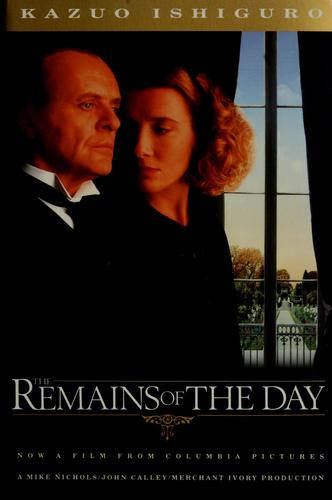
The Remains of the Day
by Kazuo Ishiguro · 1989
An aging English butler drives across the countryside reminiscing about a lifetime of perfect service -- and slowly, without ever quite admitting it, realizes he sacrificed love and moral clarity for it.
Worth reading? The Remains of the Day is Ishiguro's quietest, most controlled novel, and the restraint is the point -- it earns an emotional gut-punch precisely because it never raises its voice. If you want proof that understatement can hit harder than melodrama, start here.
| Author | Kazuo Ishiguro |
|---|---|
| Published | 1989 |
| Publisher | Vintage International |
| Category | Fiction |
| Favorite quote | “The evening's the best part of the day.” |
The Verdict
The road trip framing device does more work than it first seems to – every stop gives Stevens a new excuse to revisit the past, and Ishiguro uses that repetition to slowly wear down his defenses until the truth leaks through almost by accident.
you want a quiet, devastating study of a narrator who can't admit what he's lost until it's far too late to fix
you want overt drama -- everything important in this book happens in what Stevens doesn't say, which some readers find too restrained to land emotionally
Book Summary
Stevens's obsessive devotion to 'dignity' and professional service is Ishiguro's vehicle for a larger critique: unquestioning loyalty, whether to an employer or an ideology, can mean quietly participating in moral failure (Lord Darlington's Nazi sympathies) without ever confronting it directly.
The novel's central tragedy is emotional, not political -- Stevens suppressed his feelings for the housekeeper Miss Kenton so thoroughly, for so long, in service of professional restraint, that by the time he can admit them, the moment and the relationship are gone.
Ishiguro uses Stevens's own narration against him: his careful, formal justifications for past choices keep cracking just enough to show the reader (though rarely Stevens himself) the real cost of the life he chose.
Top 7 Lessons from The Remains of the Day
- Total professional devotion can become a way of avoiding harder personal and moral questions.
- Unquestioning loyalty to an authority figure can mean quietly enabling their worst decisions.
- Suppressing emotion in the name of restraint has a real, often irreversible cost if held onto too long.
- A narrator's careful self-justification can reveal more truth through its cracks than through what it directly states.
- Dignity defined purely as professional composure can become a trap rather than a virtue.
- Retrospective regret often arrives only once the chance to act differently has permanently passed.
- Looking back and reframing your life's choices as noble can be a form of self-protection against facing regret directly.
Top 4 Quotes from The Remains of the Day
"What is the point of worrying oneself too much about what one could or could not have done to control the course one's life took?"
Kazuo Ishiguro, The Remains of the Day
"The evening's the best part of the day."
Kazuo Ishiguro, The Remains of the Day
"For all its considerable qualities, this vocation is not one that permits of choices."
Kazuo Ishiguro, The Remains of the Day
"Indeed -- why should I not admit it? -- in that moment, my heart was breaking."
Kazuo Ishiguro, The Remains of the Day
Frequently Asked Questions
Is The Remains of the Day worth reading?
Yes -- it's one of the most controlled, devastating character studies in modern fiction, built entirely on what the narrator can't quite admit.
Is The Remains of the Day hard to read?
No, the prose is clean and restrained, though the emotional payoff requires patience since almost nothing is stated directly.
What is the main theme of The Remains of the Day?
That unquestioning loyalty and suppressed emotion, pursued in the name of duty and dignity, can cost you the relationships and moral clarity that actually mattered.
Who should read The Remains of the Day?
Readers who want a quiet, restrained novel where the real drama lives entirely in what the narrator refuses to say.
Ready to read it?
Get The Remains of the Day on Amazon