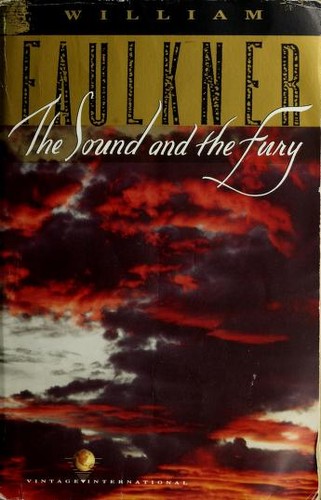
The Sound and the Fury
by William Faulkner · 1929
One Southern family's collapse, told four times by four narrators, one of whom can't tell time and one of whom won't stop lying to himself.
Worth reading? This is one of the hardest entry points into Faulkner, and also one of his best books -- if you want an easier on-ramp to his style, start with As I Lay Dying instead, which uses similar techniques with more forward momentum. If you're ready for the deep end, this rewards a second read more than almost any other American novel.
| Author | William Faulkner |
|---|---|
| Published | 1929 |
| Publisher | Vintage International |
| Category | Fiction |
| Favorite quote | “Clocks slay time... time is dead as long as it is being clicked off by little wheels; only when the clock stops does time come to life.” |
The Verdict
Faulkner famously said he wrote this one and it still didn’t say what he wanted, which tells you how ambitious the structure is trying to be. The Benjy section is a genuine wall for first-time readers – push through it, because Quentin’s and Jason’s sections make more sense once you’ve got the family’s shape in your head, and Dilsey’s closing section is the emotional payoff the first three withhold.
Skip it if you want a first read to be smooth – it won’t be, on purpose. But if you’re willing to read it twice, or read it with a guide the first time, it’s one of the most rewarding structural experiments in American fiction.
you want the deep end of modernist fiction -- fractured time, unreliable and cognitively impaired narrators, and prose that makes you work for every scene
you want a book that's readable on the first pass -- the opening section, narrated by Benjy, jumps across decades without warning and is genuinely disorienting even for experienced readers
Book Summary
The novel tells the decline of the Compson family, once-prominent Mississippi aristocrats, through four sections: Benjy, intellectually disabled and unable to track time, narrates in a fractured, nonlinear stream that jumps between decades without signaling it; Quentin, obsessed with his sister Caddy's honor and his family's decayed status, narrates the day of his suicide at Harvard; Jason, bitter and grasping, narrates in the most linear but most poisonous voice; and a final third-person section centers on Dilsey, the Black servant who holds the disintegrating household together.
Faulkner is using structure to make an argument: the same events (Caddy's sexuality, the family's financial and moral decline, the loss of the Compson name) look completely different depending on whose damaged perspective you're inside. Nobody in the family can see clearly, which is the whole tragedy -- their obsession with a mythologized Southern past blinds every one of them to the present.
Dilsey's section, arriving last and told in relatively clear third person after three increasingly claustrophobic first-person sections, is Faulkner's clearest moral statement: the person actually holding the family together is the one with the least power and the most decency, and none of the Compsons ever really see that.
Top 8 Lessons from The Sound and the Fury
- Benjy's fractured, nonlinear narration argues that time and trauma don't organize themselves neatly, even in memory.
- Quentin's obsession with Caddy's 'honor' and the family's decayed status shows how clinging to a mythologized past can become fatal.
- Jason's bitter, transactional narration contrasts sharply with his siblings -- he's rejected the old Southern honor code entirely and replaced it with pure self-interest, which is presented as no better.
- Dilsey's steady endurance, arriving in the final section, is Faulkner's argument that decency and competence in this novel belong to the person with the least social power.
- The Compson family's decline is framed as inseparable from a broader collapse of the old aristocratic South, not just personal failure.
- Faulkner's title, from Macbeth's 'sound and fury, signifying nothing,' frames the whole family's suffering as ultimately without redemptive meaning.
- Caddy, the sister all three brothers obsess over, is never given her own narrating section -- she exists only through their distorted views of her, which is itself a comment on how women get erased by other people's stories about them.
- The recurring motif of clocks and broken watches (especially in Quentin's section) argues that trying to control or stop time is a losing, self-destructive project.
Top 5 Quotes from The Sound and the Fury
"Clocks slay time... time is dead as long as it is being clicked off by little wheels; only when the clock stops does time come to life."
William Faulkner, The Sound and the Fury
"I give it to you not that you may remember time, but that you might forget it now and then for a moment and not spend all your breath trying to conquer it."
William Faulkner, The Sound and the Fury
"Was is the saddest word there is."
William Faulkner, The Sound and the Fury
"Through the fence, between the curling flower spaces, I could see them hitting."
William Faulkner, The Sound and the Fury
"Once a bitch always a bitch, what I say."
William Faulkner, The Sound and the Fury
Frequently Asked Questions
Is The Sound and the Fury worth reading?
Yes, but go in prepared -- it's widely considered one of the great American novels, and also one of the most demanding, especially its opening Benjy section.
Is The Sound and the Fury hard to read?
Yes, significantly. The nonlinear, unsignaled time jumps in the first section confuse most first-time readers, and it genuinely benefits from a second read or an annotated edition.
What is the main theme of The Sound and the Fury?
The decline of a Southern aristocratic family, told through fractured, unreliable perspectives, arguing that obsession with a mythologized past destroys the present.
Should I read The Sound and the Fury more than once?
Most readers and critics say yes -- the first read is largely about orientation, and a second read is where the structure's payoff actually lands.
Ready to read it?
Get The Sound and the Fury on Amazon