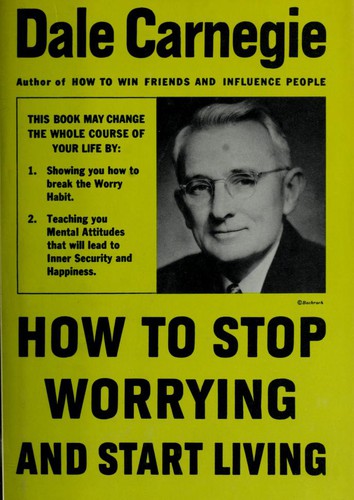
How to Stop Worrying and Start Living
by Dale Carnegie · 1948
Carnegie's 1948 antidote to anxiety: a set of plain, repeatable habits for not letting your mind torture you about tomorrow.
Worth reading? This is Carnegie's other book, the one everyone forgets next to How to Win Friends, and it might be the more useful of the two if anxiety is your problem. It came out in 1948 and has never gone out of print, which tells you how permanent the worry problem is. The advice is unfashionably simple: live one day at a time, name your worst fear, stay busy, stop fighting what you can't change. None of it is deep, all of it works, and that's the point. Carnegie wasn't a psychologist; he was a compiler of what calmer people actually do. It belongs on the Lindy list because the worry it treats is human and timeless, and the methods have been quietly fixing it for 75 years. If modern anxiety books feel like they're overselling you, this one under-sells and over-delivers.
| Full Title | How to Stop Worrying and Start Living |
|---|---|
| Author | Dale Carnegie |
| Published | 1948 |
| Publisher | Simon & Schuster |
| Category | Self-Improvement & Psychology |
The Verdict
Carnegie’s 1948 companion to How to Win Friends tackles anxiety with plain, repeatable habits, live in day-tight compartments, face the worst case, stay busy. 75 years of print and the worry problem hasn’t changed.
Read it if your worry is chronic and you want simple, old-school, proven methods rather than a clinical diagnosis.
Skip it if you need actual therapy for clinical anxiety. This is practical self-help, not a substitute for treatment.
Book Summary
Carnegie's best tool is 'live in day-tight compartments,' borrowed from a ship captain's advice: don't mentally borrow trouble from tomorrow or yesterday. Seal off today and occupy it fully.
He pushes you to face the worst-case scenario on purpose. Write down the worst that could happen, accept it, then spend your energy improving the odds. Naming the fear usually shrinks it to something manageable.
The book is crammed with anecdotes of real worriers who stopped, because Carnegie's point is that worry is a habit you can unlearn, and habits change through repeated small actions, not insight.
Top 10 Lessons from How to Stop Worrying and Start Living
- Live in day-tight compartments. Don't mentally borrow trouble from tomorrow; seal off today and occupy it.
- Face the worst case on paper. Name the worst that could happen, accept it, then work the odds. Fear shrinks when named.
- Worry is a habit you can unlearn, like any other. Repetition of calm action beats a single insight.
- Keep busy. An idle mind is worry's workshop; purposeful activity crowds anxiety out.
- Don't fuss about things you can't change. Sort every problem into 'can fix' and 'can't,' then ignore the second pile.
- Cooperate with the inevitable. Resistance to what already is just adds suffering to the fact.
- Ask yourself, 'what is the worst that can happen?' More often than not, survivable. Then act.
- Budget your worries. Give a problem a limited, scheduled time instead of letting it run all day.
- Count your blessings, specifically. Gratitude is Carnegie's antidote to the anxiety spiral.
- Most things we fear never happen. Act on the real problem, not the imagined catastrophe.
Top 4 Quotes from How to Stop Worrying and Start Living
"It isn't what you have, or who you are, or where you are, or what you are doing that makes you happy or unhappy. It is what you think about it."
Dale Carnegie, How to Stop Worrying and Start Living
"Our fatigue is often caused not by work, but by worry, frustration, and resentment."
Dale Carnegie, How to Stop Worrying and Start Living
"One of the most tragic things I know about human nature is that all of us tend to put off living. We are all dreaming of some magical rose garden over the horizon instead of enjoying the roses that are blooming outside our windows today."
Dale Carnegie, How to Stop Worrying and Start Living
"If you want to conquer fear, don't sit home and think about it. Go out and get busy."
Dale Carnegie, How to Stop Worrying and Start Living
Frequently Asked Questions
Is this the same Dale Carnegie as How to Win Friends?
Yes. How to Stop Worrying and Start Living (1948) is his follow-up, aimed at inner peace rather than social skill. Many readers find it more directly useful than the famous first book.
How is it different from modern anxiety books?
It predates clinical CBT and leans on anecdote and habit, not diagnosis. The famous 'live in day-tight compartments' and 'face the worst case' techniques are the ancestors of later cognitive methods.
Why is it Lindy-qualified?
Seventy-five years of continuous print and a permanent readership proves the worry it addresses hasn't changed. Simple, repeatable methods that keep working across generations is exactly the Lindy bar.
Ready to read it?
Get How to Stop Worrying and Start Living on Amazon