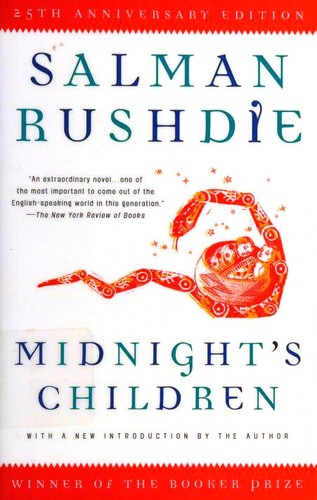
Midnight's Children
by Salman Rushdie · 1981
A boy born at the exact stroke of India's independence gets telepathic powers and an entire nation's history tangled into his life story.
Worth reading? This won the Booker of Bookers for a reason -- it's the book that showed a generation of writers how to fuse magical realism with real political history. It's demanding and sprawling, so if you want a gentler entry into Rushdie, try Haroun and the Sea of Stories first; if you want the full ambitious version, start here.
| Full Title | Midnight's Children |
|---|---|
| Author | Salman Rushdie |
| Published | 1981 |
| Publisher | Random House Trade Paperbacks |
| Category | Fiction |
| Favorite quote | “I was born in the city of Bombay ... once upon a time. No, that won't do, there's no getting away from the date: I was born in Doctor Narlikar's Nursing Home on August 15th, 1947.” |
The Verdict
The premise sounds like a gimmick – a boy magically tied to his nation’s birth – and then Rushdie spends 500-plus pages proving it isn’t one. Saleem’s unreliability as a narrator is the whole point: he gets dates wrong, contradicts himself, and keeps going anyway, because the book’s real argument is that memory (personal or national) was never going to be objective.
Skip it if you want tight, linear plotting – this sprawls on purpose, closer to an oral epic than a conventional novel. But if you want to see magical realism used to actually say something about a specific country’s history rather than just add color, this is one of the best examples written in English.
you want ambitious, maximalist literary fiction that treats a country's history as inseparable from one unreliable narrator's personal story
you want a tight, linear plot -- this is sprawling, digressive, and self-consciously unreliable, closer to a shaggy oral epic than a conventional novel
Book Summary
Saleem Sinai is born at the exact midnight moment of India's independence in 1947, and his life becomes magically fused to the nation's -- he gains telepathic powers and discovers 1,000 other "midnight's children" born in that same hour, each with a strange gift, whose fates track the fractures and crises of India's early decades. Rushdie uses Saleem's family saga, spanning three generations, as a lens onto Partition, war with Pakistan, and Indira Gandhi's Emergency.
The book is famous for its magical realism grafted onto real political history, and for Saleem's unreliable narration -- he openly admits to getting facts wrong, then keeps narrating anyway, which is Rushdie's larger argument that personal and national memory are both selective, self-serving, and still worth telling. "Memory's truth" matters more here than factual accuracy.
It's also a book about the messiness of a newly independent, multiethnic, multireligious nation trying to hold together -- Saleem's body literally starts cracking and disintegrating as the novel goes on, mirroring the country's own fractures (linguistic reorganization, war, authoritarian crackdown) across the same decades.
Top 8 Lessons from Midnight's Children
- Saleem's telepathic link to 1,000 other midnight-born children argues that a generation's fate is shared even when their individual lives diverge wildly.
- Saleem's unreliable narration, and his own admissions of getting facts wrong, argue that personal and national memory are both selective rather than objective.
- The novel treats Partition and the Emergency not as background history but as forces that directly reshape individual families and bodies.
- Saleem's body cracking apart as the story progresses is a direct metaphor for a young nation's own fractures along religious, linguistic, and political lines.
- Rushdie fuses magical realism with real political events to argue that a country's official history and its lived, mythologized memory are never the same thing.
- The 1,000 midnight's children, each gifted differently, represent India's own diversity -- and their infighting mirrors the country's difficulty uniting around a single identity.
- Saleem's grandfather's story, opening the novel a generation before Saleem's birth, shows how family patterns and secrets repeat and compound across generations.
- The Widow (Indira Gandhi figure) and the Emergency section treat authoritarian overreach as a direct assault on the individuality the midnight's children represent.
Top 4 Quotes from Midnight's Children
"I was born in the city of Bombay ... once upon a time. No, that won't do, there's no getting away from the date: I was born in Doctor Narlikar's Nursing Home on August 15th, 1947."
Salman Rushdie, Midnight's Children
"To understand just one life, you have to swallow the world."
Salman Rushdie, Midnight's Children
"I told you the truth, I say again, ... memory's truth, because memory has its own special kind."
Salman Rushdie, Midnight's Children
"There are as many versions of India as Indians."
Salman Rushdie, Midnight's Children
Frequently Asked Questions
Is Midnight's Children worth reading?
Yes -- it won the Booker Prize and was later named the 'Booker of Bookers,' and it's one of the most influential postcolonial novels in English. It's demanding, but the payoff is real.
Is Midnight's Children hard to read?
Yes, relatively -- it's long, digressive, and narrated unreliably on purpose, with a large cast and dense references to Indian history.
What is the main theme of Midnight's Children?
That personal identity and national history are inseparable, and that memory -- personal or national -- is always a selective, subjective retelling rather than a factual record.
Do I need to know Indian history to read Midnight's Children?
It helps but isn't required -- Rushdie folds in enough context that you can follow the political events, though background on Partition and the Emergency deepens the experience.
Ready to read it?
Get Midnight's Children on Amazon