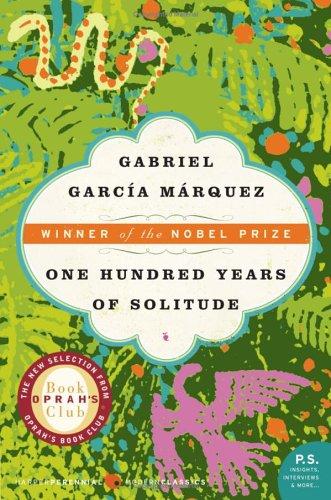
One Hundred Years of Solitude
by Gabriel Garcia Marquez · 1967
Seven generations of the Buendia family found a town, repeat each other's names and mistakes, and slowly discover that solitude is the family's real inheritance -- told with the straightest face imaginable while ghosts, plagues of insomnia, and a rain of yellow flowers happen on every other page.
Worth reading? One Hundred Years of Solitude is the book magical realism gets measured against, and it earns that reputation by never treating the fantastical as a special effect -- levitation and a four-year rainstorm get the same flat, matter-of-fact prose as a business transaction. It rewards a second read more than almost any novel on this list, once you already know how the Buendia line ends and can watch the patterns form. If the repeating names defeat you on a first attempt, that's normal -- keep the family tree open and push through.
| Full Title | One Hundred Years of Solitude (Cien años de soledad) |
|---|---|
| Author | Gabriel Garcia Marquez |
| Published | 1967 |
| Publisher | Harper Perennial Modern Classics |
| Category | Fiction |
| Favorite quote | “Many years later, as he faced the firing squad, Colonel Aureliano Buendia was to remember that distant afternoon when his father took him to discover ice.” |
The Verdict
The opening line is one of the best in world literature, and the whole book operates on that same trick – collapsing past, present, and future into a single sentence, then making you live inside that collapsed time for seven generations. Keep a family tree handy. You’ll need it, and the effort is the point.
you want the book that defined magical realism, and you're willing to keep a family tree handy to track six generations of Aurelianos and Jose Arcadios
you get frustrated by repeating character names and non-linear time -- the novel deliberately blurs generations into each other, and that's a feature you either surrender to or fight the whole way through
Book Summary
The Buendia family is trapped in cyclical patterns -- names, personality traits, and mistakes repeat across generations, and the novel suggests that a family (or a nation) that doesn't reckon honestly with its history is doomed to keep reliving it rather than moving past it.
Marquez treats the magical and the mundane with identical narrative weight, which is the actual technical innovation of magical realism -- it's not that strange things happen, it's that nobody in the story, including the narrator, treats them as strange. That flatness is what makes the fantastical feel true rather than whimsical.
Macondo's rise and fall mirrors the broader history of Latin America -- colonization, civil war, foreign capital (the banana company), and eventual erasure. The Buendias' solitude is personal, but it's also political: isolation as the cost of a history nobody in power wants remembered accurately.
Top 8 Lessons from One Hundred Years of Solitude
- Unexamined family patterns repeat across generations until someone breaks the cycle -- and in this novel, almost no one does.
- Solitude, not love or ambition, is presented as the true inheritance passed down through the Buendia line.
- Treating magical events with total narrative calm makes them feel more real, not less.
- Macondo's history (founding, boom, foreign exploitation, decline) mirrors the broader arc of Latin American history.
- Repeating names across generations (Jose Arcadio, Aureliano) is a structural device for the novel's argument about cyclical time.
- Colonel Aureliano Buendia's endless wars produce endless stalemate -- ambition without a clear endpoint just consumes a life.
- The banana company's arrival and the subsequent massacre dramatize how foreign capital erases inconvenient history.
- The novel's final revelation (that the whole story was foretold in Melquiades' manuscripts) reframes everything before it as fate rather than free choice.
Top 4 Quotes from One Hundred Years of Solitude
"Many years later, as he faced the firing squad, Colonel Aureliano Buendia was to remember that distant afternoon when his father took him to discover ice."
Gabriel Garcia Marquez, One Hundred Years of Solitude
"The world was so recent that many things lacked names, and in order to indicate them it was necessary to point."
Gabriel Garcia Marquez, One Hundred Years of Solitude
"It's enough for me to be sure that you and I exist at this moment."
Gabriel Garcia Marquez, One Hundred Years of Solitude
"What matters in a good marriage is not happiness, but stability."
Gabriel Garcia Marquez, One Hundred Years of Solitude
Frequently Asked Questions
Is One Hundred Years of Solitude worth reading?
Yes -- it's the defining work of magical realism and rewards patience and a second read more than almost any novel of its era.
Is One Hundred Years of Solitude hard to read?
Yes, at first -- repeating character names across generations and non-linear time make it genuinely disorienting. A family tree helps a lot on a first read.
What is the main theme of One Hundred Years of Solitude?
Cyclical family and national history -- patterns and mistakes repeat across generations until solitude becomes the Buendia family's true inheritance.
What is magical realism, and does this book define it?
Magical realism treats fantastical events with the same flat, matter-of-fact tone as ordinary ones. This novel is widely considered the genre's landmark text.
Ready to read it?
Get One Hundred Years of Solitude on Amazon