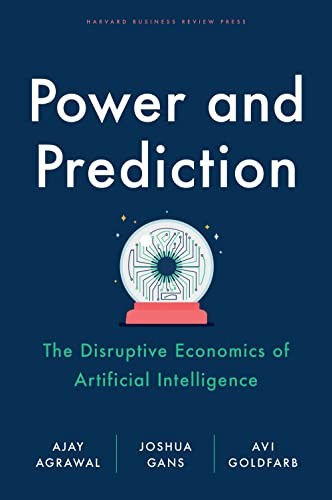
Power and Prediction
by Ajay Agrawal, Joshua Gans, and Avi Goldfarb · 2022
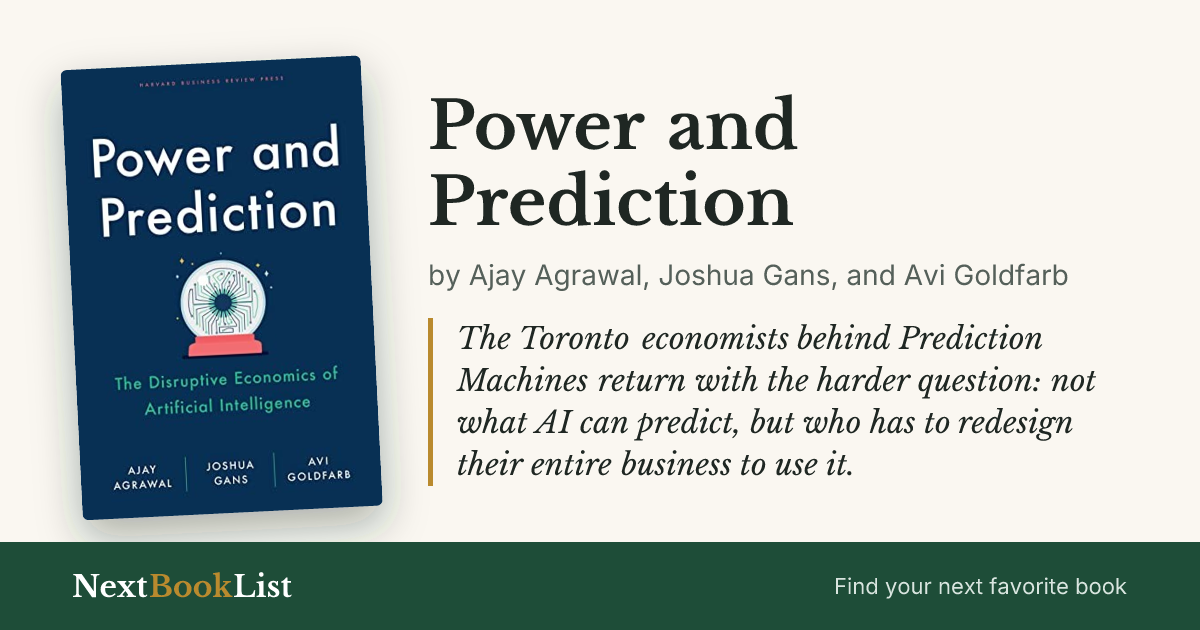
The Toronto economists behind Prediction Machines return with the harder question: not what AI can predict, but who has to redesign their entire business to use it.
Worth reading? The authors' first book argued AI is fundamentally a drop in the cost of prediction. This one asks the harder follow-up: prediction is only useful inside a decision system, so who actually benefits when prediction gets cheap, the incumbent who bolts it onto an old system, or the new entrant who redesigns the whole system around it? Their historical parallel (electricity didn't help factories until factories were rebuilt around it, not just retrofitted) is the sharpest idea in the book. Read it as a sequel once Prediction Machines clicks. Skip it as a standalone entry point.
| Full Title | Power and Prediction: The Disruptive Economics of Artificial Intelligence |
|---|---|
| Author | Ajay Agrawal, Joshua Gans, and Avi Goldfarb |
| Published | 2022 |
| Category | Business & Money |
The Verdict
The authors’ first book, Prediction Machines, gave the field its best one-line explanation of what AI actually is economically. This sequel is the harder, more useful question: who actually wins when prediction gets cheap, and the electrification analogy is one of the best in business writing for explaining why bolting on new technology usually underperforms rebuilding around it.
operators and strategists who liked the 'AI as cheap prediction' framing and want the sequel on system-level redesign
you haven't read Prediction Machines yet, start there first
Book Summary
Building on their earlier 'AI as cheap prediction' thesis, the authors introduce the idea of a 'point solution' versus a 'system solution': bolting AI prediction onto an existing workflow (point solution) captures modest gains, but redesigning the entire decision system around cheap prediction (system solution) captures the real value, and usually requires a new entrant unburdened by legacy structure to pull off.
Their central historical analogy is the electrification of factories: adding electric motors to steam-era factory layouts barely helped, factories only got dramatically more productive once they were redesigned around distributed electric power. They argue AI is following the same pattern, and most companies today are still in the 'point solution' phase, underestimating how much redesign the real gains require.
Top 7 Lessons from Power and Prediction
- Cheap prediction only creates value inside a redesigned decision system, not bolted onto an old one.
- The electrification-of-factories analogy: gains came from redesign, not retrofitting.
- New entrants without legacy structure are often better positioned to capture system-level AI gains than incumbents.
- Most companies today are still stuck at 'point solutions,' underestimating the redesign required.
- Prediction is a means to a decision, not an end in itself, and the decision system is where value actually lives.
- AI disruption favors whoever is willing to rebuild the system, not whoever has the best model.
- Judgment (what to do with a prediction) becomes more valuable, not less, as prediction gets cheaper.
Top 2 Quotes from Power and Prediction
"When your predictions are accurate enough, something happens. You cross a threshold where you should actually rethink your whole business model and product based on machine learning."
Ajay Agrawal, Joshua Gans, and Avi Goldfarb, Power and Prediction
"If you go to a business and tell it you can save it $50,000 per year in labor costs if it eliminates this one job, then your AI product better eliminate that entire job. Instead, what entrepreneurs found was that their product was perhaps eliminating one task in a person's job, and that wasn't going to be enough to save their would-be customer any meaningful labor costs."
Ajay Agrawal, Joshua Gans, and Avi Goldfarb, Power and Prediction
Frequently Asked Questions
Is Power and Prediction worth reading?
Yes, as a follow-up to Prediction Machines, for the sharper argument that real AI value requires redesigning decision systems, not just adding prediction to existing ones.
What is the main idea of Power and Prediction?
Cheap AI prediction only creates major value when businesses rebuild their decision systems around it, the way factories only gained from electricity after being redesigned around it, not just retrofitted.
Should I read Prediction Machines before Power and Prediction?
Yes. Power and Prediction assumes you already understand AI as a prediction-cost drop from the authors' first book, and builds the harder argument on top of it.
Ready to read it?
Get Power and Prediction on Amazon