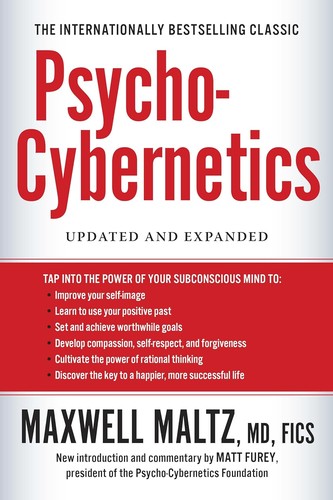
Psycho-Cybernetics
by Maxwell Maltz · 1960
A plastic surgeon's discovery that fixing the face didn't fix the self-image, so he reverse-engineered how the mind actually rewrites itself.
Worth reading? Maxwell Maltz was a plastic surgeon, not a psychologist, and that's why this 1960 book is so useful. He stumbled onto the mechanism obsessively, by watching which face-job patients actually changed their lives and which didn't. The face wasn't the lever; the self-image was. Psycho-Cybernetics is the hidden ancestor of half the self-help shelf. Visualization, self-image, 'act as if,' the inner goal-seeker, it's all Maltz, usually without the credit. The 'cybernetics' language is dated 1960s metaphor, but the core, that you can rewire your default self-concept through repeated mental rehearsal, is sound and has helped millions. It's Lindy because it's been in print for 60+ years and quietly spawned a genre. If you've ever known you were capable of more and couldn't explain why you kept undercutting yourself, this is the original manual for fixing that.
| Full Title | Psycho-Cybernetics: A New Way to Get More Living Out of Life |
|---|---|
| Author | Maxwell Maltz |
| Published | 1960 |
| Publisher | Prentice Hall |
| Category | Self-Improvement & Psychology |
| Favorite quote | “You will act like the sort of person you conceive yourself to be.” |
The Verdict
Maltz’s 1960 classic, written by a plastic surgeon who noticed the face wasn’t the lever, the self-image was, is the hidden ancestor of every visualization and self-image technique since. 60+ years and still in print.
Read it if you intellectually know you should be more confident but your self-image keeps sabotaging you.
Skip it if you want hard science. Maltz was a surgeon, not a researcher, and the 'cybernetics' framing is a 1960s metaphor, not a mechanism.

Book Summary
Maltz, a plastic surgeon, noticed something odd: some patients whose faces he rebuilt were transformed, others looked identical afterward but still felt ugly. The external change didn't touch the internal self-image, which is the real driver.
His model: the brain is a goal-seeking 'servo-mechanism' that steers toward the self-image you've programmed into it. Change the self-image, consciously and repeatedly, and behavior follows automatically, like a torpedo locking onto a target.
The practical method is mental rehearsal, vividly imagine the successful outcome until the subconscious accepts it as real. This is the direct ancestor of every 'visualization' and 'self-image' technique in modern self-help.
Top 10 Lessons from Psycho-Cybernetics
- Your self-image, not your actual ability, runs the show. Change the image and behavior follows.
- The brain is a goal-seeking mechanism; it steers toward whatever you've programmed as 'you.'
- Mental rehearsal works. Vividly imagine the win until your subconscious accepts it as real, then act normally.
- External fixes don't heal internal beliefs. Maltz saw it in patients whose new faces didn't change their old self-loathing.
- You already succeed automatically at being 'you.' Reprogram 'you' and success becomes automatic too.
- The 'cybernetic' loop: set a target, act, get feedback, correct, like a guided missile. You don't need to see the whole path.
- Failure is feedback, not identity. The mechanism adjusts; it doesn't quit.
- Habits of thought are physical in effect. Repeat a self-concept long enough and the body believes it.
- Don't wait to feel confident to act. Act, and confidence follows the behavior, not the reverse.
- This book is the root of visualization culture. Almost every later self-image technique is Maltz with new packaging.
Top 5 Quotes from Psycho-Cybernetics
"Your self-image is your own conception of the 'sort of person you are.'"
Maxwell Maltz, Psycho-Cybernetics
"You will act like the sort of person you conceive yourself to be."
Maxwell Maltz, Psycho-Cybernetics
"Your nervous system cannot tell the difference between an imagined experience and a 'real' experience."
Maxwell Maltz, Psycho-Cybernetics
"Man is by nature a goal-striving being. And because man is 'built that way,' he is not happy unless he is functioning as he was made to function -- as a goal striver."
Maxwell Maltz, Psycho-Cybernetics
"When we consciously and deliberately develop new and better habits, our self-image tends to outgrow the old habits and grow into the new pattern."
Maxwell Maltz, Psycho-Cybernetics
Frequently Asked Questions
Is Psycho-Cybernetics real science?
Partly. Maltz was a plastic surgeon who observed that self-image drove outcomes more than looks did, and his mental-rehearsal method was later echoed by sports psychology and CBT. The 'cybernetics' framing is a 1960s metaphor, not a literal mechanism.
What's the one takeaway?
Your self-image is the control panel. Change the picture of who you are, through vivid repeated rehearsal, and your behavior reorganizes to match it automatically.
Why is it Lindy-qualified?
Sixty-plus years in print and a direct lineage to the entire visualization and self-image industry. The idea that you can reprogram your self-concept has helped generations and shows no sign of expiring.
Ready to read it?
Get Psycho-Cybernetics on Amazon