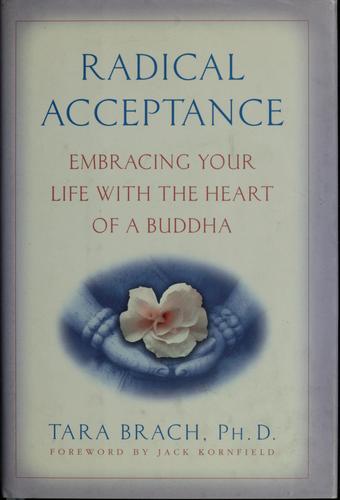
Radical Acceptance
by Tara Brach · 2003
Tara Brach's answer to the voice in your head that says you're not enough: stop fighting it, and look at it clearly instead.
Worth reading? Radical Acceptance and Kristin Neff's Self-Compassion cover the same ground -- the voice that tells you you're not enough -- but from different starting points. Neff works from research psychology and gives you exercises stripped of religious framing. Brach works from two decades of Buddhist teaching and gives you a practice (RAIN) wrapped in Dharma stories, including her own history with bulimia and self-hatred. If the spiritual framing helps rather than distracts you, Brach's version hits harder. If you just want the technique without the Buddhism, start with Neff. Skip it if religious or spiritual language makes you tune out -- Brach doesn't dilute the Buddhist framing to make it more secular, and fighting that framing the whole way through will cost you the actual practice underneath it. For anyone willing to sit with it, RAIN (Recognize, Allow, Investigate, Nurture) is one of the more durable tools in the self-compassion category.
| Full Title | Radical Acceptance: Embracing Your Life with the Heart of a Buddha |
|---|---|
| Author | Tara Brach |
| Published | 2003 |
| Publisher | Bantam |
| Category | Self-Improvement & Psychology |
| Favorite quote | “If your compassion does not include yourself, it is incomplete.” |
The Verdict
Tara Brach built Radical Acceptance out of her own history with self-hatred and years of teaching Buddhist psychology, and it shows: this isn’t detached theory, it’s a practice she says pulled her out of the same trap it’s meant to address. If you’ve tried “just love yourself” advice and found it hollow, RAIN gives you something to actually do with the feeling instead.
you're stuck in self-judgment and want a structured way to work with it, not just told to 'love yourself'
you want a purely secular, non-Buddhist approach to self-compassion -- try Kristin Neff's Self-Compassion instead
Book Summary
Brach's core diagnosis is what she calls the "trance of unworthiness" -- the reflexive belief, running under almost everything you do, that something is wrong with you. Most self-improvement tries to fix this by proving you're worthy through achievement. Brach argues that only entrenches the trance, because you're still accepting its premise.
Her alternative is radical acceptance: seeing your experience clearly, without the story layered on top, and meeting it with compassion instead of judgment. The tool she teaches for this is RAIN -- Recognize what's happening, Allow it to be there without pushing it away, Investigate it with curiosity instead of analysis, and Nurture yourself the way you would a frightened child. It's not passive resignation; it's dropping the inner war so you can actually see what's in front of you.
She frames this through the old Buddhist story of the Buddha meeting Mara (the personification of fear and self-doubt) not with a fight, but with recognition: "I see you, Mara." The practice isn't defeating your self-doubt. It's stopping the fight with it long enough to see it clearly -- which, paradoxically, is what lets it lose its grip.
Top 10 Lessons from Radical Acceptance
- The 'trance of unworthiness' is the reflexive belief that something is fundamentally wrong with you.
- Trying to prove your worth through achievement keeps you inside the trance instead of out of it.
- RAIN: Recognize, Allow, Investigate, Nurture -- a four-step way to work with a painful feeling.
- Acceptance isn't passive resignation -- it's dropping the inner war so you can see clearly.
- Naming a fear or feeling directly ('I see you, Mara') takes power away from it.
- Self-compassion isn't indulgence -- it's the precondition for actually changing.
- Investigating a feeling with curiosity gets further than analyzing it intellectually.
- Most suffering comes from the story wrapped around an experience, not the experience itself.
- Nurturing yourself the way you'd comfort a scared child is a real skill, not a platitude.
- You can't hate yourself into a version of yourself you'd actually want to be.
Top 4 Quotes from Radical Acceptance
"If your compassion does not include yourself, it is incomplete."
Tara Brach, Radical Acceptance
"I see you, Mara."
Tara Brach, Radical Acceptance
"Radical Acceptance is the willingness to experience ourselves and our life as it is."
Tara Brach, Radical Acceptance
"You can't hate yourself into a version of yourself you can love."
Tara Brach, Radical Acceptance
Frequently Asked Questions
Is Radical Acceptance worth reading?
Yes, if you're stuck in self-judgment and open to a Buddhist framing of why -- the RAIN practice is genuinely useful. Skip it if you want a secular, non-religious version; Kristin Neff's Self-Compassion covers similar ground without the Dharma framing.
What is the main idea of Radical Acceptance?
That most suffering comes from fighting or judging your own experience, not from the experience itself, and that meeting it with clear-eyed compassion (RAIN) does more than trying to fix or suppress it.
What is RAIN in Radical Acceptance?
Recognize what's happening, Allow it to be there, Investigate it with curiosity, and Nurture yourself with compassion. It's the book's core practice for working with a difficult emotion in the moment.
Is Radical Acceptance religious?
It's built on Buddhist teaching and Tara Brach's own experience as a meditation teacher, with Dharma stories throughout. The practice itself (RAIN) works secularly, but the framing is explicitly Buddhist -- go in expecting that.
Ready to read it?
Get Radical Acceptance on Amazon