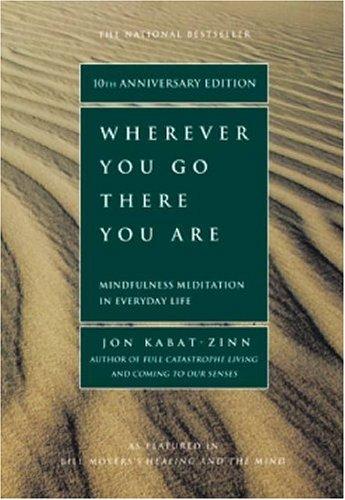
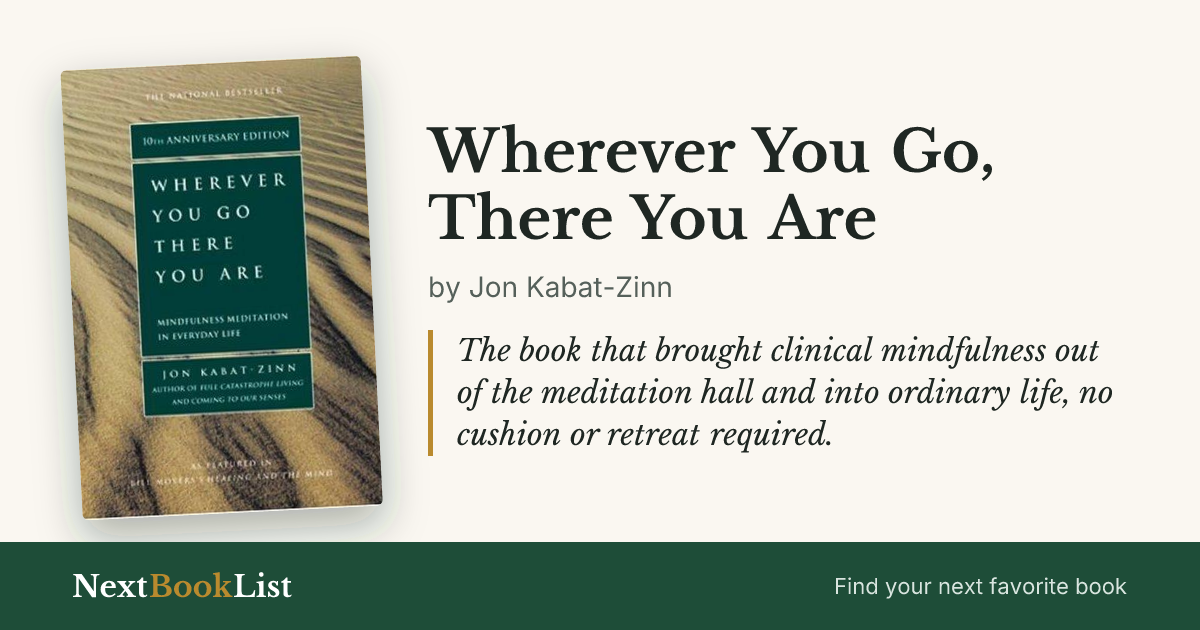
Wherever You Go, There You Are
by Jon Kabat-Zinn · 1994
The book that brought clinical mindfulness out of the meditation hall and into ordinary life, no cushion or retreat required.
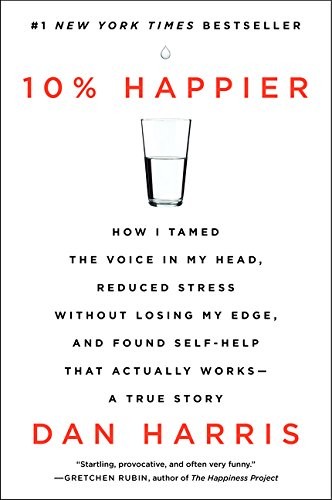
Worth reading? Kabat-Zinn built his reputation secularizing mindfulness for medical use (his Mindfulness-Based Stress Reduction program is still the clinical gold standard), and this book is the accessible, non-clinical distillation of that work: short chapters you can read in any order, built around bringing awareness to ordinary moments rather than escaping into a separate meditation practice. It's gentler and less structured than 10% Happier's memoir-driven approach -- read this first if you want the philosophy, 10% Happier if you want the skeptic's journey toward the same place.
| Full Title | Wherever You Go, There You Are: Mindfulness Meditation in Everyday Life |
|---|---|
| Author | Jon Kabat-Zinn |
| Published | 1994 |
| Category | Self-Improvement & Psychology |
| Favorite quote | “You can't stop the waves, but you can learn to surf.” |
The Verdict
Kabat-Zinn’s real achievement was making mindfulness legible to doctors, hospitals, and skeptics who’d never touch a Buddhist text – the Mindfulness-Based Stress Reduction program built on this book’s ideas is still used in clinical settings thirty years later. Read it in short bursts; it’s built for dipping in and out, not one long sitting.
you want a secular, practical entry point into mindfulness that doesn't require adopting Buddhism or a formal practice
you want a structured 8-week program with exercises, this is more reflective essay collection than workbook; Full Catastrophe Living is Kabat-Zinn's more structured clinical companion
Book Summary
Mindfulness, in Kabat-Zinn's framing, isn't a special state you achieve during formal meditation and then leave behind -- it's paying attention, on purpose, to the present moment, without judgment, and that attention can be brought to washing dishes or waiting in line just as much as to sitting on a cushion. Making mindfulness exceptional (something you only do at 6am for twenty minutes) misses the actual opportunity, which is available in literally every moment.
He also pushes against goal-oriented meditation -- the instinct to meditate in order to relax, or to become a better person, or to reduce stress, is itself a subtle form of the striving and non-acceptance that mindfulness is meant to address. The practice, paradoxically, works better when approached without an agenda for what it should produce.
Top 7 Lessons from Wherever You Go, There You Are
- Mindfulness is present-moment attention without judgment, available in any ordinary activity, not just formal meditation.
- Bring awareness to routine moments (washing dishes, walking, waiting) rather than treating mindfulness as separate from daily life.
- Meditating in order to achieve a specific outcome (relaxation, self-improvement) subtly undermines the practice's core of non-striving.
- Non-judgment means noticing a thought or feeling without immediately labeling it good or bad.
- Beginner's mind: approach familiar situations as if seeing them for the first time, without accumulated assumptions.
- Acceptance of the present moment as it is doesn't mean passivity -- it's the starting point for clear action, not resignation.
- Short, consistent moments of attention throughout the day matter as much as any formal sitting practice.
Top 3 Quotes from Wherever You Go, There You Are
"You can't stop the waves, but you can learn to surf."
Jon Kabat-Zinn, Wherever You Go, There You Are
"Wherever you go, there you are."
Jon Kabat-Zinn, Wherever You Go, There You Are
"The best way to capture moments is to pay attention. This is how we cultivate mindfulness."
Jon Kabat-Zinn, Wherever You Go, There You Are
Frequently Asked Questions
Is Wherever You Go, There You Are worth reading?
Yes, as an accessible, secular entry point into mindfulness. It's more reflective and philosophical than a structured workbook, so pair it with a formal practice guide if you want exercises.
What is the main idea of Wherever You Go, There You Are?
Mindfulness is present-moment, non-judgmental attention available in any ordinary activity, not a special state reserved for formal meditation sessions.
Is this book religious or Buddhist?
Kabat-Zinn draws on Buddhist meditation traditions but presents the practice in secular, clinical language, which is part of why his Mindfulness-Based Stress Reduction program spread widely in medical and psychological settings.
How is this different from 10% Happier?
10% Happier is Dan Harris's memoir-style account of a skeptical journalist adopting meditation. Wherever You Go, There You Are is Kabat-Zinn's own reflective, essay-style case for mindfulness as a daily practice, without the memoir framing.
Ready to read it?
Get Wherever You Go, There You Are on Amazon