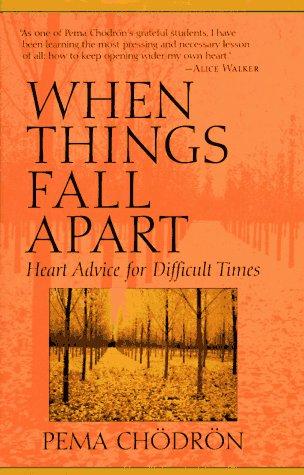
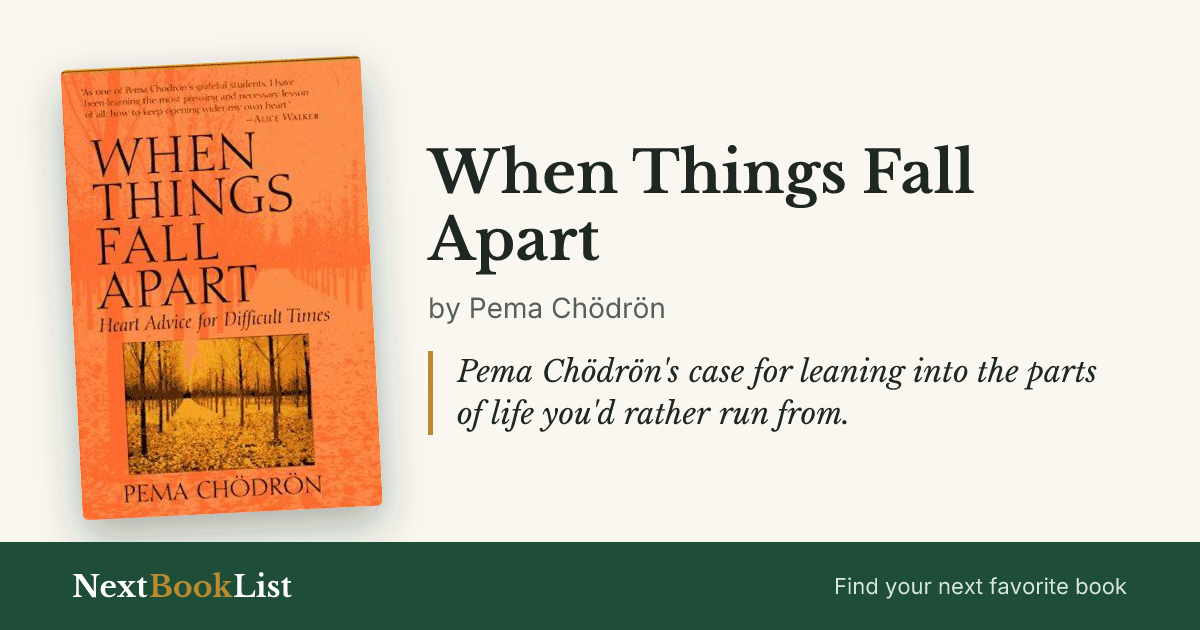
When Things Fall Apart
by Pema Chödrön · 1997
Pema Chödrön's case for leaning into the parts of life you'd rather run from.
Worth reading? When Things Fall Apart earns its reputation as the book people actually reach for during a divorce, a diagnosis, or a genuine collapse -- more than Eckhart Tolle's The Power of Now, which asks you to step into presence but doesn't spend much time in the wreckage first. Chödrön does. She writes from inside real groundlessness (her own marriage ending, her teacher's death) instead of from a place of already having transcended it, and that's why it lands differently. Skip it if you want practical steps for a specific problem -- this is a book about changing your relationship to pain, not a checklist for fixing your situation. If you're currently in crisis and need concrete safety, get that first. For the slower work of sitting with a life that's stopped making sense, it's one of the most honest books in the category.
| Full Title | When Things Fall Apart: Heart Advice for Difficult Times |
|---|---|
| Author | Pema Chödrön |
| Published | 1997 |
| Publisher | Shambhala |
| Category | Self-Improvement & Psychology |
| Favorite quote | “Nothing ever goes away until it teaches us what we need to know.” |
The Verdict
Pema Chödrön wrote this while going through her own version of things falling apart, and it reads that way – not as advice handed down from someone who’s already fine, but as heart advice from someone who’s actually been in the wreckage. If your usual coping tools have stopped working, this is one of the more honest books to reach for next.
you're going through a breakup, loss, or a period where nothing is working and the usual advice feels hollow
you want tactical steps, not a shift in how you relate to pain -- this book won't give you a five-step plan
Book Summary
Chödrön's central claim is that groundlessness -- the moment everything you counted on stops working -- isn't a problem to escape. It's the actual truth of being alive, and most of our suffering comes from pretending it isn't. We build elaborate structures (routines, relationships, plans) to avoid ever feeling that ground give way, and then panic when it inevitably does.
Her answer isn't to fix the feeling but to "lean into the sharp points" -- to stay with fear, grief, or shame instead of fleeing into distraction or numbing. She teaches this through tonglen, a practice of breathing in pain (yours and others') and breathing out relief, which inverts the instinct to protect yourself from discomfort. The point isn't masochism; it's that avoidance is what actually keeps pain circling back.
She also reframes compassion for yourself and others as inseparable from this same willingness to stay present with difficulty. Maitri -- unconditional friendliness toward your own experience, including the ugly parts -- isn't a nice add-on to the practice. It's the whole practice, because you can't stay with what you refuse to be friendly toward.
Top 10 Lessons from When Things Fall Apart
- Groundlessness isn't a problem to fix -- it's the actual condition of being alive.
- Most suffering comes from fighting the fact that nothing is solid, not from the situation itself.
- 'Lean into the sharp points' -- stay with discomfort instead of fleeing into distraction.
- Tonglen: breathe in pain, breathe out relief, as a way to stop protecting yourself from feeling.
- Maitri (unconditional friendliness toward yourself) isn't separate from the practice -- it is the practice.
- Avoidance doesn't make pain go away, it just guarantees it comes back later, worse.
- Fear often shows up right before real growth, not as a sign to stop.
- Compassion for others gets thin if you haven't first extended it to yourself.
- Nothing that happens to you is wasted if you're willing to actually look at it.
- The relief you're looking for isn't on the other side of the pain -- it's in how you relate to it right now.
Top 5 Quotes from When Things Fall Apart
"Nothing ever goes away until it teaches us what we need to know."
Pema Chödrön, When Things Fall Apart
"To be fully alive, fully human, and completely awake is to be continually thrown out of the nest."
Pema Chödrön, When Things Fall Apart
"Fear is a natural reaction to moving closer to the truth."
Pema Chödrön, When Things Fall Apart
"Only to the extent that we expose ourselves over and over to annihilation can that which is indestructible be found in us."
Pema Chödrön, When Things Fall Apart
"The most fundamental aggression to ourselves, the most fundamental harm we can do to ourselves, is to remain ignorant by not having the courage and the respect to look at ourselves honestly and gently."
Pema Chödrön, When Things Fall Apart
Frequently Asked Questions
Is When Things Fall Apart worth reading?
Yes, especially during a genuine crisis -- breakup, loss, diagnosis -- where the usual advice feels too tidy. Skip it if you want practical steps rather than a shift in how you relate to pain.
What is the main idea of When Things Fall Apart?
That groundlessness -- the moment life stops making sense -- isn't a malfunction to escape but the actual nature of things, and leaning into that discomfort does more than running from it.
What is tonglen in When Things Fall Apart?
A Buddhist practice Chödrön teaches of breathing in pain (yours or someone else's) and breathing out relief, used to reverse the instinct to shield yourself from difficulty.
Is When Things Fall Apart a religious book?
It's rooted in Buddhist teaching, and Chödrön writes as an ordained Buddhist nun, but the core practices (staying present with pain, self-compassion) don't require adopting the religion to use.
Ready to read it?
Get When Things Fall Apart on Amazon