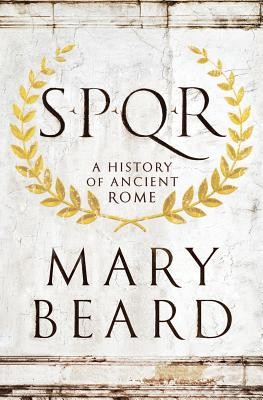
SPQR
by Mary Beard · 2015
Mary Beard spends less time on emperors and battles than on how an ordinary Roman actually ate, worked, and argued -- and how much of what we 'know' about Rome is later myth.
Worth reading? SPQR works because Beard treats the reader like someone capable of handling uncertainty. Instead of retelling Romulus and Remus as settled fact, she explains why we can't actually know most of what popular imagination assumes about early Rome, and that honesty is the book's real value. It stops at 212 CE (the extension of citizenship across the empire) rather than chasing the fall of Rome through to the end, which some readers find like an unfinished story -- but it's a deliberate choice, and the ground she does cover is unusually well-earned.
| Full Title | SPQR: A History of Ancient Rome |
|---|---|
| Author | Mary Beard |
| Published | 2015 |
| Category | History |
The Verdict
Beard won the Wolfson History Prize for SPQR, which tells you the academic historians rated the rigor as highly as general readers rated the readability – a combination that’s rarer than it should be in popular history. If you’ve read Sapiens or Guns, Germs, and Steel and want the same big-picture ambition applied with more source skepticism, this is the next stop.
you want a rigorous, readable history of Rome from a working classicist who's more interested in ordinary Roman life and the gaps in the record than in another emperors-and-conquests highlight reel
you're looking for a sweeping narrative of Rome's rise and fall with cinematic battle scenes -- Beard is a skeptic by training and spends real time questioning sources instead of retelling legend as fact
Book Summary
Beard structures SPQR around a central question: how did a small, unremarkable town on the Tiber become the government of most of the known world, and what do we actually know about how that happened versus what later Romans (and later historians) wanted to believe about it? She's constantly separating the founding myths Rome told about itself from what the archaeological and documentary record can support, which makes the book as much about historiography as about Rome itself.
Her second focus is ordinary Roman life -- what people ate, how provincial towns were governed, what it meant to be a Roman citizen versus a subject, how the empire actually administered itself day to day -- rather than a parade of emperors. She argues that Roman history is often told through the lens of a handful of famous, colorful rulers when the more interesting and more representative story is in the institutions and ordinary people that outlasted every one of them.
Top 9 Lessons from SPQR
- Most of what popular culture 'knows' about early Rome (Romulus and Remus, the founding date of 753 BCE) is myth Romans themselves constructed later, not settled history.
- Roman citizenship, not conquest alone, was the empire's real innovation -- extending legal status to conquered peoples created durable loyalty conquest by force couldn't.
- The Roman Republic's collapse into empire wasn't inevitable -- it was the result of specific, contingent political failures that could plausibly have gone otherwise.
- Provincial administration, tax collection, and infrastructure mattered more to how Rome actually functioned day to day than any individual emperor's personality.
- The historical record for early Rome is much thinner and more contested than the confident narratives told about it suggest.
- Roman social mobility was real but narrow -- a former slave's descendants could rise, but the system was built to preserve elite power overall.
- Much of what we call 'Roman history' comes from a handful of elite, politically motivated ancient authors, which shapes what got recorded and what didn't.
- Rome's relationship with conquered peoples varied enormously by region and era -- there's no single, uniform 'Roman rule' to generalize about.
- Beard treats gaps and contradictions in the evidence as part of the story, not an embarrassment to smooth over.
Frequently Asked Questions
Is SPQR a good introduction to Roman history?
Yes, for readers who want rigor over romance -- it's more skeptical and evidence-focused than a popular narrative history, which makes it a stronger foundation even if it's a slightly slower read.
Why does SPQR stop at 212 CE?
Beard ends at the point Roman citizenship was extended to nearly all free inhabitants of the empire, which she treats as the completion of the story she set out to tell -- the transformation of a city-state into something closer to a multi-ethnic state. Rome's later decline is deliberately left for other books.
Is SPQR better than a book like Gibbon's Decline and Fall?
They're not really competing for the same job. Gibbon is a sweeping 18th-century narrative of Rome's fall; Beard is a modern classicist questioning what we can actually know about Rome's rise. Read Beard first for the more reliable foundation.
Ready to read it?
Get SPQR on Amazon