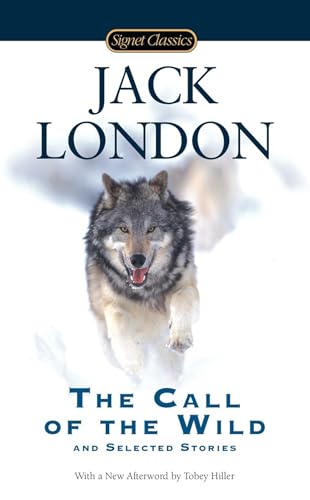
The Call of the Wild
by Jack London · 1903
A stolen family dog gets sold into the Yukon gold rush and slowly, brutally, remembers he's a wild animal.
Worth reading? The Call of the Wild has stayed in print for over 120 years because it's short, brutal, and doesn't flinch, which makes it a better introduction to London than the longer, more sprawling White Fang. Skip it if you want a comforting animal story -- Buck's journey involves real cruelty and real killing, and London treats both as facts of nature rather than tragedies to soften.
| Author | Jack London |
|---|---|
| Published | 1903 |
| Publisher | Signet Classics |
| Category | Fiction |
| Favorite quote | “There is an ecstasy that marks the summit of life, and beyond which life cannot rise.” |
The Verdict
This is the better starting point in London’s catalog over the longer White Fang, mostly because it doesn’t overstay its welcome. Buck’s transformation from house pet to wild animal happens across maybe 170 pages, and every chapter earns its place.
It’s not a comforting animal story. Dogs die, owners are cruel, and London treats all of it as simple fact rather than tragedy. That unsentimental streak is exactly what’s kept this in print for over a century.
you want a short, brutal, beautifully written survival story about an animal shedding domestication one hardship at a time
you're looking for a gentle dog story -- this is closer to a survival novel with real violence in it than a Lassie-style pet tale
Book Summary
Buck, a comfortable domestic dog in California, is stolen and sold into the brutal Yukon sled-dog trade during the Klondike Gold Rush. Through a series of increasingly harsh owners -- some cruel, some genuinely kind -- Buck sheds his domestication piece by piece and reawakens the wild instincts London believed were always underneath.
The "law of club and fang" that Buck learns early on is the book's operating principle: survival here runs on force and hierarchy, not fairness. London draws a hard, almost Darwinian line under every event -- the dogs that adapt fastest to raw dominance survive, and the ones that don't, don't.
Buck's bond with John Thornton, his final and only genuinely loving owner, is the one relationship the book treats as pure rather than transactional -- which makes it clear how much of Buck's story really is a slow return to wildness, since even that bond isn't enough to hold him once Thornton is gone.
Top 8 Lessons from The Call of the Wild
- Buck starts the novel as a spoiled, comfortable house dog -- the story only works because London establishes how far he has to fall.
- The 'law of club and fang' -- survival by force and hierarchy, not fairness -- is stated early and never softened for the rest of the book.
- Buck's fight with Spitz for control of the sled team is framed as a necessary, almost inevitable step in his transformation, not a tragedy.
- Different owners along Buck's journey represent different relationships to power -- the Scottish mail carriers who work him fairly, the incompetent tenderfoot owners who nearly kill him through ignorance, and John Thornton, who earns Buck's loyalty through genuine care.
- London repeatedly frames Buck's instincts as ancestral memory -- primal urges from his wolf lineage resurfacing under enough hardship.
- Buck's killing of the Yeehat tribesmen who murdered Thornton is presented as the final severing of his last tie to human loyalty.
- The novel ends with Buck joining a wolf pack, completing the reversal of domestication the whole book has been building toward.
- London uses the harsh Yukon setting itself as an active force in the story, not just a backdrop -- cold, starvation, and terrain kill characters as surely as other animals do.
Top 4 Quotes from The Call of the Wild
"There is an ecstasy that marks the summit of life, and beyond which life cannot rise. And such is the paradox of living, this ecstasy comes when one is most alive, and it comes as a complete forgetfulness that one is alive."
Jack London, The Call of the Wild
"He had killed, and killing satisfied him."
Jack London, The Call of the Wild
"Deep in the forest a call was sounding, and as often as he heard this call, mysteriously thrilling and luring, he felt compelled to turn his back upon the fire and the beaten earth around it, and to plunge into the forest."
Jack London, The Call of the Wild
"The dominant primordial beast was strong in Buck, and, under the fierce conditions of trail life, it grew and grew."
Jack London, The Call of the Wild
Frequently Asked Questions
Is The Call of the Wild worth reading?
Yes -- it's short, brutal, and one of the best entry points into Jack London. It doesn't soften the violence of its setting, which is exactly why it still hits.
Is The Call of the Wild appropriate for kids?
It's often assigned in school, but it contains real animal violence and death -- worth previewing if you're choosing it for a younger or sensitive reader.
What is the main theme of The Call of the Wild?
That civilization is a thin layer over instinct -- under enough hardship, Buck sheds his domestication and reverts to something closer to his wild, ancestral nature.
How long does it take to read The Call of the Wild?
About 2 to 3 hours. It's under 200 pages and moves fast.
Ready to read it?
Get The Call of the Wild on Amazon