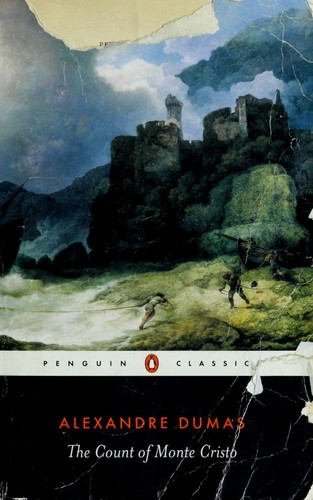
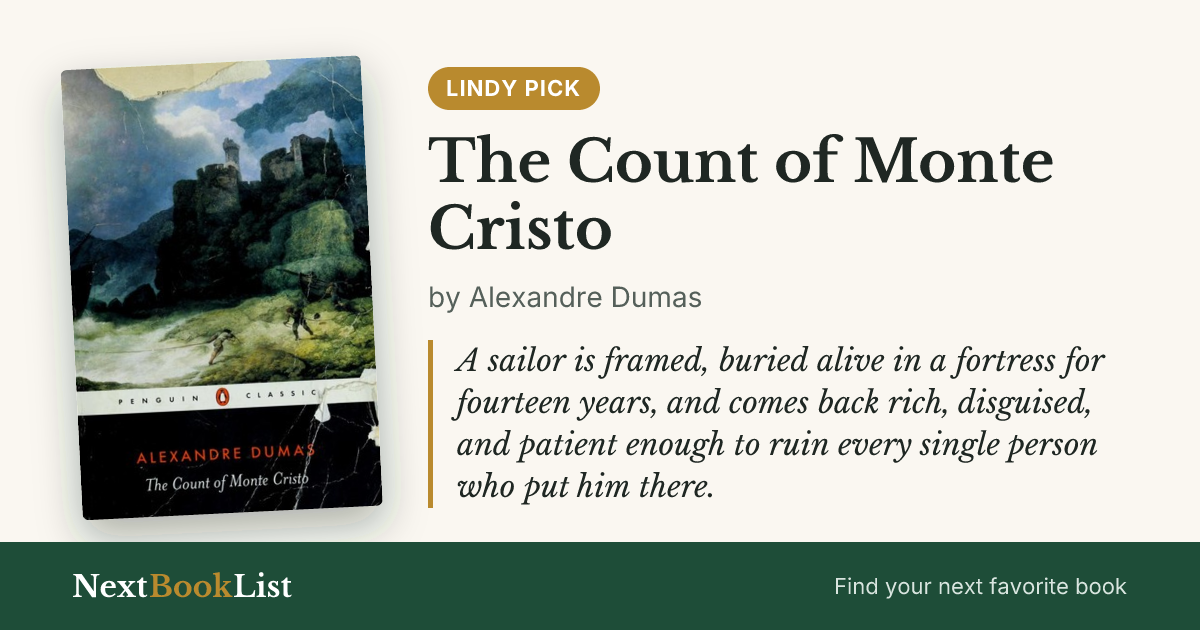
The Count of Monte Cristo
by Alexandre Dumas · 1844
A sailor is framed, buried alive in a fortress for fourteen years, and comes back rich, disguised, and patient enough to ruin every single person who put him there.
Worth reading? The Count of Monte Cristo is still the best revenge novel written, because Dumas makes the revenge take years, cost something, and eventually curdle into doubt. If you want a tighter, faster version of the wronged-man-gets-even story, you won't find one this good; most modern thrillers borrowing this plot skip the patience and the price. Skip it only if 1,200 pages of 19th-century serialized plotting is genuinely more than you want to commit to.
| Author | Alexandre Dumas |
|---|---|
| Published | 1844 |
| Publisher | Penguin Classics |
| Category | Fiction |
| Favorite quote | “Until the day when God will deign to reveal the future to man, all human wisdom is summed up in these two words, wait and hope.” |
The Verdict
The escape from the Château d’If gets all the movie adaptations, but the real engine of the book is what comes after: fourteen years of patience compressed into a decade of precise, individually engineered revenge. Dumas never lets you forget that Dantès is settling actual debts against actual people, not just delivering satisfying comeuppance.
Read this over a modern revenge thriller when you want to see the genre’s actual founding text, one that takes both the planning and the moral cost seriously instead of rushing to the payoff.
you want the original revenge thriller, one that takes patience and consequence seriously instead of just staging a satisfying comeuppance
you want something short, this is a genuine commitment (1,200+ pages depending on edition) with subplots that wander well past the prison-escape setup
Book Summary
Edmond Dantès, a young sailor days from marrying the woman he loves and making captain, gets framed by jealous rivals and a self-serving prosecutor and thrown into the Château d'If without trial. He spends fourteen years there, taught by a fellow prisoner, before escaping with both a fortune and a plan.
The novel isn't really about the escape, it's about what Dantès does with the following decade: methodical, patient, individually tailored revenge against each person who destroyed his life, executed under disguises while he moves through Parisian high society as the mysterious Count.
By the end Dumas complicates his own premise. Innocent people get hurt in the crossfire of Dantès's plans, and Dantès himself starts to wonder whether he had the right to act as an instrument of providence. "Wait and hope" isn't just a plot mechanic, it's the book's actual argument: patience beats impulse, but even earned revenge has a cost.
Top 10 Lessons from The Count of Monte Cristo
- Edmond Dantès is framed by jealous rivals, Danglars and Fernand Mondego, aided by a prosecutor, Villefort, protecting his own secret, and imprisoned without trial.
- In prison, the Abbé Faria teaches him languages, science, and swordsmanship, and reveals the location of a hidden fortune before dying.
- Dantès spends years quietly researching each man who wronged him before acting, the revenge is deliberate, not impulsive.
- He adopts the identity of the Count of Monte Cristo, and several other disguises, to move through Parisian high society undetected.
- Each revenge is tailored to its target's specific sin, financial ruin for the banker, public exposure for the prosecutor, social destruction for the social climber, not one uniform punishment.
- Innocent people, including children, get caught in the fallout of Dantès's plans, and the novel doesn't let him walk away from that cost cleanly.
- By the end Dantès questions whether he had the right to act as an instrument of providence, and tempers pure vengeance with mercy.
- The novel's real argument is that patience, not money or disguise, is Dantès's most effective weapon.
- Secondary characters, Mercédès, Maximilien, Haydée, represent paths not fully consumed by vengeance, and act as the story's counterweight to Dantès's obsession.
- Wealth doesn't heal Dantès, becoming the Count costs him the simple happiness he had as young Edmond, and the book doesn't pretend otherwise.
Top 4 Quotes from The Count of Monte Cristo
"Until the day when God will deign to reveal the future to man, all human wisdom is summed up in these two words, wait and hope."
Alexandre Dumas, The Count of Monte Cristo
"Moral wounds have this peculiarity, they may be hidden, but they never close; always painful, always ready to bleed when touched, they remain fresh and open in the heart."
Alexandre Dumas, The Count of Monte Cristo
"Life is a storm, my young friend. You will bask in the sunlight one moment, be shattered on the rocks the next. What makes you a man is what you do when that storm comes."
Alexandre Dumas, The Count of Monte Cristo
"For all evils there are two remedies, time and silence."
Alexandre Dumas, The Count of Monte Cristo
Frequently Asked Questions
Is The Count of Monte Cristo worth reading?
Yes, it's the original revenge epic and still the best one, as long as you're up for its length. Skip it if you want something under 500 pages.
What is The Count of Monte Cristo about?
A young sailor, framed and imprisoned for fourteen years, escapes, finds a fortune, and spends years methodically taking revenge on the men who destroyed his life, before starting to question whether that revenge was worth what it cost.
Is The Count of Monte Cristo hard to read?
It's long and has a large cast, but the prose is propulsive, this reads more like a page-turning thriller than most 19th-century classics.
How long does it take to read The Count of Monte Cristo?
Most unabridged editions run 1,200 pages or more, expect 20-plus hours depending on your pace. Look for an unabridged translation, older abridged English editions cut significant material.
Ready to read it?
Get The Count of Monte Cristo on Amazon