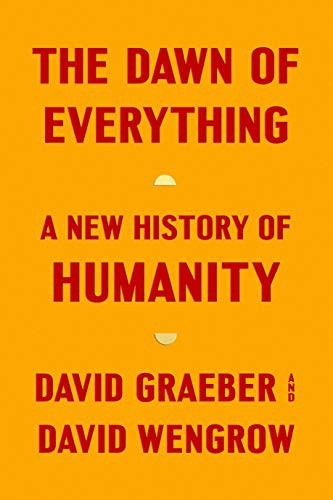
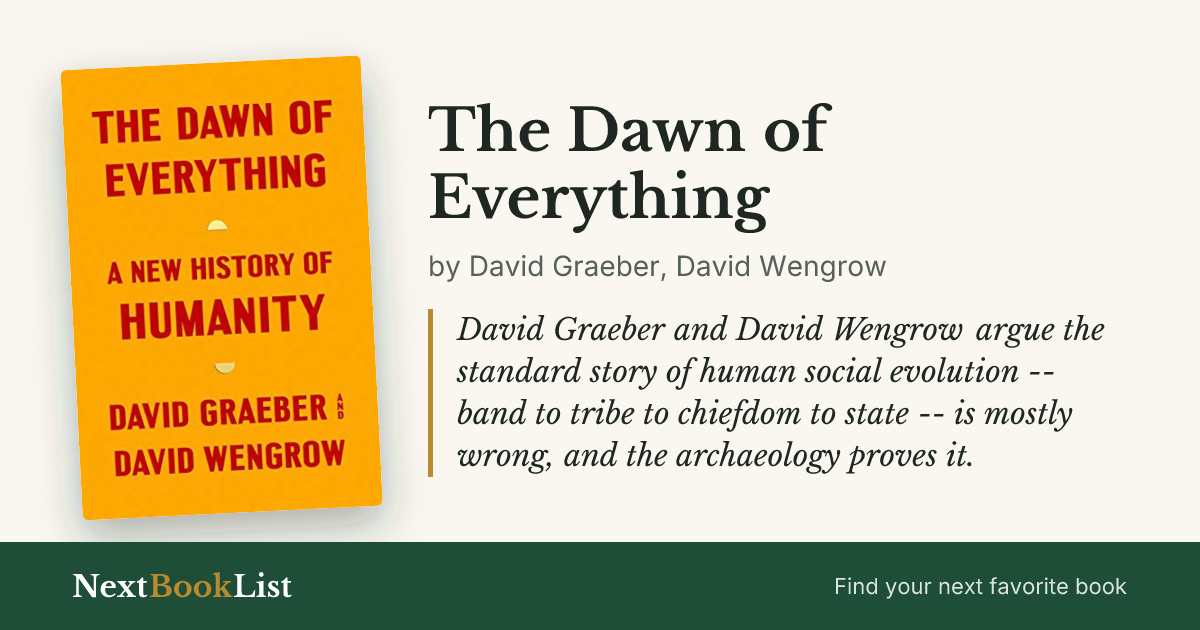
The Dawn of Everything
by David Graeber, David Wengrow · 2021
David Graeber and David Wengrow argue the standard story of human social evolution -- band to tribe to chiefdom to state -- is mostly wrong, and the archaeology proves it.
Worth reading? The Dawn of Everything is an argument book more than a synthesis book -- Graeber (an anthropologist) and Wengrow (an archaeologist) are directly challenging the popular progress narrative that Sapiens and Guns, Germs, and Steel both rely on, where societies march predictably from small egalitarian bands to large hierarchical states as they scale up. Their case, built on genuine archaeological evidence, is that early societies show far more seasonal flexibility, deliberate rejection of permanent hierarchy, and outright political experimentation than that narrative allows. It's dense, occasionally polemical, and specialists have pushed back on specific interpretations since publication -- but as a direct, evidence-based counter to the two most popular big-history books of the last decade, it's essential reading alongside them, not instead of them.
| Full Title | The Dawn of Everything: A New History of Humanity |
|---|---|
| Author | David Graeber, David Wengrow |
| Published | 2021 |
| Category | Sociology & Culture |
| Favorite quote | “Almost everything we have been taught about the history of human civilization is, at least in its broad outlines, wrong.” |
The Verdict
Graeber died unexpectedly just weeks before the book’s publication in 2021, after roughly a decade of collaboration with Wengrow, which gives the book’s closing chapters an unintended weight as his last major work. Wengrow has continued defending and extending its arguments in the anthropology community since.
you've read Sapiens or Guns, Germs, and Steel and want the direct, well-researched pushback -- Graeber and Wengrow argue early human societies were far more politically experimental and deliberately anti-hierarchical than the standard progress narrative allows
you want a tidy, linear story of human social development -- this book's entire point is that the tidy linear story is wrong, so it trades a clean narrative for a messier, more accurate (and more contested) one
Book Summary
The book's central target is what Graeber and Wengrow call the standard narrative of social evolution: that humans lived in small, relatively egalitarian bands for most of prehistory, then agriculture enabled larger settled populations, which in turn made hierarchy, private property, and eventually the state basically inevitable as societies scaled up. They marshal archaeological evidence -- from seasonal political structures that shifted between hierarchical and egalitarian modes throughout the year, to large early settlements that show no evidence of centralized rulers, to societies that appear to have deliberately experimented with and rejected specific forms of hierarchy -- to argue that scale didn't determine political structure nearly as tightly as the standard story claims.
Their deeper point is explicitly political: if hierarchy and inequality weren't an inevitable byproduct of agriculture and urbanization, but rather a series of specific, contingent choices various societies made (and others explicitly didn't), then the modern inequality we tend to treat as the unavoidable price of civilization is a choice too, not a law of history. That's the book's real argument with Diamond and Harari -- not just disputing individual facts, but rejecting the deterministic frame both authors build their books around.
Top 9 Lessons from The Dawn of Everything
- The standard 'band to tribe to chiefdom to state' progression of human social evolution isn't well-supported by the archaeological record Graeber and Wengrow survey.
- Some early societies show evidence of deliberately shifting between hierarchical and egalitarian political structures on a seasonal basis, rather than settling permanently into one mode.
- Large early settlements have been found with no clear evidence of centralized rulers or rigid hierarchy, contradicting the assumption that scale requires hierarchy.
- Agriculture's adoption wasn't a single decisive turning point that locked societies into hierarchy -- many agricultural societies show long periods without centralized political control.
- Graeber and Wengrow argue early humans had far more genuine political self-awareness and experimentation than the 'naive band society' framing usually credits them with.
- The book directly challenges Guns, Germs, and Steel's and Sapiens's shared assumption that increasing scale makes hierarchy essentially inevitable.
- Indigenous critiques of European society (documented contact-era dialogues, especially from North America) may have directly influenced Enlightenment political philosophy, a genealogy usually left out of standard intellectual history.
- If inequality and hierarchy were choices various societies made rather than an unavoidable consequence of scale, that reframes modern inequality as a choice too, not a historical inevitability.
- The authors are explicit that they're building an argument, not a neutral survey -- they want to expand what readers imagine is politically possible, not just correct historical facts.
Top 2 Quotes from The Dawn of Everything
"Almost everything we have been taught about the history of human civilization is, at least in its broad outlines, wrong."
David Graeber, David Wengrow, The Dawn of Everything
"Mutual aid — what contemporary European observers often referred to as 'communism' — was seen as the necessary condition for individual autonomy."
David Graeber, David Wengrow, The Dawn of Everything
Frequently Asked Questions
How does The Dawn of Everything challenge Sapiens and Guns, Germs, and Steel?
Both of those books treat increasing scale (population, agriculture, urbanization) as pushing societies toward hierarchy and centralized states in a roughly predictable way. Graeber and Wengrow use archaeological evidence to argue that link is much weaker than assumed -- many large, complex early societies show little or no centralized hierarchy.
Is The Dawn of Everything scientifically accepted?
It's a genuinely debated book within anthropology and archaeology -- some specialists praise its evidence and ambition, others have pushed back on specific interpretations and case studies. Read it as a serious, contested argument, not a settled consensus, the same way this site treats Sapiens and Guns, Germs, and Steel.
Do I need to read Sapiens or Guns, Germs, and Steel first?
It helps but isn't required -- Graeber and Wengrow explain the standard narrative they're challenging well enough to follow without prior reading, though the contrast lands harder if you've read at least one of the books they're responding to.
Is The Dawn of Everything difficult to read?
It's denser and more academic than Sapiens or Guns, Germs, and Steel, running past 700 pages with detailed archaeological case studies -- worth it for the argument, but budget more time than you would for a typical pop-history bestseller.
Ready to read it?
Get The Dawn of Everything on Amazon