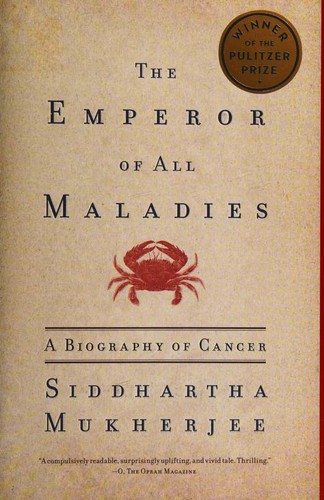
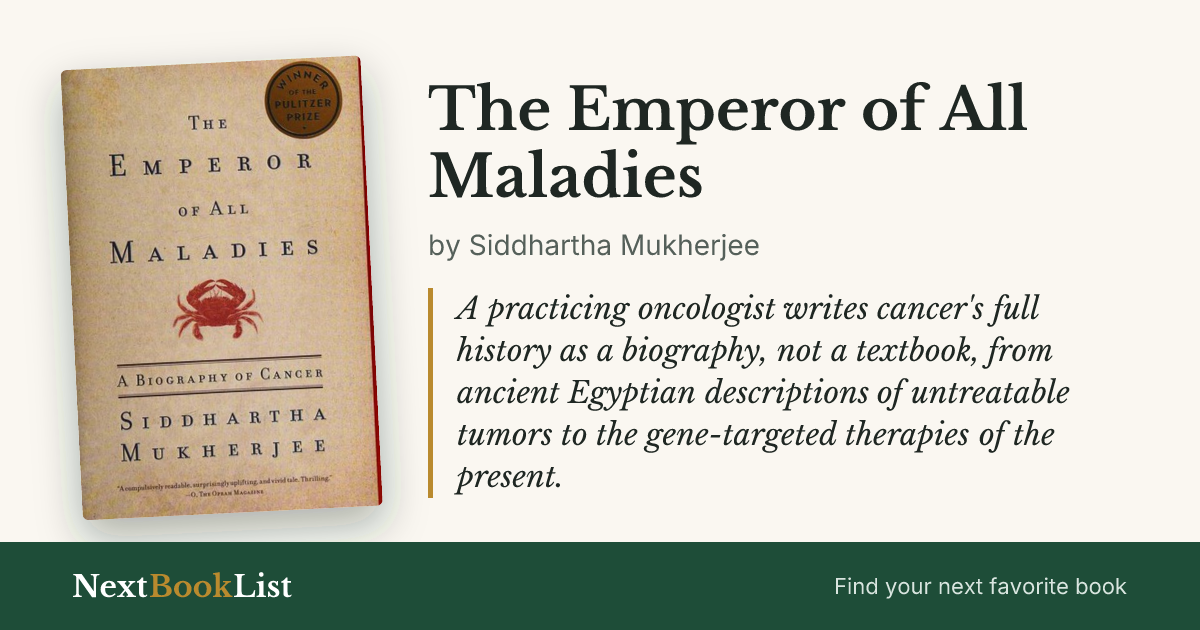
The Emperor of All Maladies
by Siddhartha Mukherjee · 2010
A practicing oncologist writes cancer's full history as a biography, not a textbook, from ancient Egyptian descriptions of untreatable tumors to the gene-targeted therapies of the present.
Worth reading? Mukherjee, a practicing oncologist at Columbia, treats cancer's history the way a biographer would treat a person -- tracing its earliest documented appearances in ancient medical texts, the brutal era of radical surgery and blunt chemotherapy, the slow, hard-won shift toward understanding cancer at the genetic and cellular level, and the beginning of targeted therapies that treat specific cancer types rather than attacking all fast-dividing cells indiscriminately. His clinical experience treating patients directly gives the science genuine human stakes throughout, which is likely why this became one of the rare science histories to win the Pulitzer Prize for general nonfiction.
| Full Title | The Emperor of All Maladies: A Biography of Cancer |
|---|---|
| Author | Siddhartha Mukherjee |
| Published | 2010 |
| Category | Science & Nature |
| Favorite quote | “Cancer is a flaw in our growth, but this flaw is deeply entrenched in ourselves.” |
The Verdict
Mukherjee’s clinical practice is what separates this from a purely academic medical history – he’s writing about patients he’s actually treated, decisions he’s actually had to make, which gives even the most distant historical chapters a sense of genuine stakes. It’s a long read that rewards patience.
you want the definitive, Pulitzer-winning history of cancer research and treatment, written by a physician who treats the disease directly
you want a quick, light read -- this is a genuinely substantial book covering thousands of years of medical history, best approached with real time to sit with it
Book Summary
Cancer research's history is one of gradually shifting from treating cancer as a single, unified disease (attacked with increasingly aggressive but non-specific tools -- radical surgery, broad chemotherapy) toward understanding it as thousands of genetically distinct diseases, each requiring different, more targeted treatment approaches -- a shift that took most of the 20th century and remains incomplete even now.
Mukherjee is candid about the field's real failures alongside its progress: decades of radical, disfiguring surgery performed on the theory that more aggressive intervention was always better, chemotherapy regimens that caused as much suffering as they prevented, and false starts that consumed research resources and patient lives before better science corrected course -- treating the field's mistakes as part of the story, not an embarrassment to omit.
Top 7 Lessons from The Emperor of All Maladies
- Cancer isn't a single disease but thousands of genetically distinct diseases, a shift in understanding that took most of the 20th century.
- Medical progress often includes decades of well-intentioned but genuinely harmful approaches (radical surgery, blunt chemotherapy) before better science corrects course.
- Treating a field's historical failures honestly, not just its successes, gives a more accurate and more useful picture of how progress actually happens.
- Targeted therapy (treating a cancer's specific genetic profile) represents a fundamentally different strategy than broadly attacking all fast-dividing cells.
- A practicing clinician's direct patient experience can add genuine stakes and specificity to what could otherwise be abstract scientific history.
- Major medical progress is rarely a single breakthrough -- it's typically the accumulation of many partial advances and corrected mistakes over decades.
- Understanding a disease's history helps contextualize current treatment limitations, not just celebrate current treatment capabilities.
Top 4 Quotes from The Emperor of All Maladies
"Cancer is a flaw in our growth, but this flaw is deeply entrenched in ourselves."
Siddhartha Mukherjee, The Emperor of All Maladies
"This is not a book about me, but my own life has informed this book."
Siddhartha Mukherjee, The Emperor of All Maladies
"Down to their innate molecular core, cancer cells are hyperactive, survival-endowed, scrappy, fecund, inventive copies of ourselves."
Siddhartha Mukherjee, The Emperor of All Maladies
"History repeats, but science reverberates."
Siddhartha Mukherjee, The Emperor of All Maladies
Frequently Asked Questions
Is The Emperor of All Maladies worth reading?
Yes -- it won the Pulitzer Prize for General Nonfiction and remains one of the most comprehensive, well-written histories of cancer research and treatment, written by a practicing oncologist.
What is The Emperor of All Maladies about?
Siddhartha Mukherjee's history of cancer, tracing its earliest documented appearances through the eras of radical surgery, chemotherapy, and modern targeted genetic therapy, treated as a biography of the disease itself.
Is The Emperor of All Maladies difficult to read as a non-scientist?
It's substantial (600-plus pages) but written for general readers, not specialists -- Mukherjee explains the science clearly, and his direct patient stories keep the material grounded rather than purely technical.
Who is Siddhartha Mukherjee?
A practicing oncologist and researcher at Columbia University, and the author of several other acclaimed science books including The Gene: An Intimate History, also covered on this site.
Ready to read it?
Get The Emperor of All Maladies on Amazon