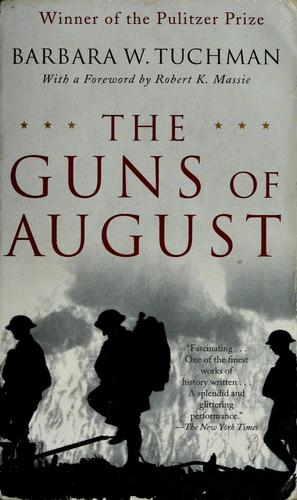
The Guns of August
by Barbara Tuchman · 1962
Barbara Tuchman's account of the diplomatic failures and first month of fighting that dragged Europe into World War I -- a war almost nobody wanted but nobody could stop once the mobilization plans started running.
Worth reading? The Guns of August earned its reputation the hard way: it's meticulously sourced, narratively gripping despite covering diplomatic cables and troop movements, and its central argument -- that rigid military timetables and alliance obligations outran the diplomats trying to stop the war -- has become a standard lens for thinking about how any large system can lock itself into disaster. President Kennedy reportedly had staff read it during the Cuban Missile Crisis specifically as a cautionary tale, which is about as strong an endorsement as a history book gets.
| Author | Barbara Tuchman |
|---|---|
| Published | 1962 |
| Category | History |
| Favorite quote | “Nothing so comforts the military mind as the maxim of a great but dead general.” |
The Verdict
The Kennedy connection isn’t folklore dressed up for the book jacket – it’s documented that he distributed copies to his cabinet during the missile crisis specifically to keep the room focused on how easily rigid plans and mutual distrust can escalate past the point anyone intended. That’s a rare thing for a 1962 history book: still functioning as an active policy reference decades later.
you want the classic account of how great powers can talk, plan, and alliance-build their way into a catastrophe nobody individually chose -- still assigned in military and diplomatic history courses over 60 years after publication
you want a full history of WWI -- this covers only the diplomatic buildup and the first month of fighting (through the Battle of the Marne), not the war's later years, trench stalemate, or its resolution
Book Summary
Tuchman's central argument is that WWI wasn't inevitable in the way it's often remembered -- it was the product of specific, compounding failures: rigid mobilization plans (Germany's Schlieffen Plan especially) that, once started, were nearly impossible to reverse or slow down without conceding a fatal head start to a rival power, and an alliance system that turned a regional crisis (the assassination of Archduke Franz Ferdinand) into a continental war within weeks.
A recurring theme is the gap between political intention and military machinery -- civilian leaders on multiple sides wanted to negotiate even as the war began, but the logistics of mobilization (railway timetables, troop deployment schedules) had already outrun their ability to actually stop it, illustrating how systems can develop momentum independent of anyone's actual decision to go to war.
Top 9 Lessons from The Guns of August
- Rigid military timetables, once activated, can remove the option to de-escalate even when political leaders still want to -- a system's momentum can outrun anyone's actual intent.
- Alliance obligations can convert a contained regional crisis into a continental catastrophe within weeks, especially when each power fears being the one left unprepared.
- Military planning built around a single best-case scenario (Germany's Schlieffen Plan assumed a fast victory over France before Russia mobilized) leaves no good options once reality diverges from the plan.
- Miscalculation, not malice, drove much of the July 1914 crisis -- multiple leaders believed the other side would back down, and none of them did.
- Once mobilization begins, reversing it is treated as more dangerous than continuing, even by leaders who privately doubt the war is necessary -- sunk-cost logic at a civilizational scale.
- Historical near-misses (the assassination could easily have not triggered a continental war) are worth studying precisely because the mechanism that turned crisis into catastrophe is repeatable.
- A single act, on its own, rarely justifies the scale of what follows -- the assassination of one archduke would never have warranted a continental war if the systems around it hadn't been primed to escalate.
- Modern industrial logistics (railway timetables, deployment schedules) can move faster than the slower, older rhythms of diplomacy they're meant to serve, leaving negotiators perpetually behind events.
- Even leaders acting cautiously and rationally in their own view can still produce catastrophe if the machinery they built has already removed caution as an option.
Top 2 Quotes from The Guns of August
"So gorgeous was the spectacle on the May morning of 1910 when nine kings rode in the funeral of Edward VII of England that the crowd, waiting under a hot sun for the procession, gasped when the first group of dignitaries came into view."
Barbara Tuchman, The Guns of August
"Nothing so comforts the military mind as the maxim of a great but dead general."
Barbara Tuchman, The Guns of August
Frequently Asked Questions
Is The Guns of August worth reading?
Yes, especially if you're interested in how great powers stumble into wars nobody fully wants. It won the Pulitzer Prize and remains a standard reference over 60 years after publication.
Does The Guns of August cover the entire First World War?
No -- it focuses on the diplomatic lead-up and the first month of fighting, ending around the Battle of the Marne in September 1914. It's not a full history of the war's later years.
Why did JFK read The Guns of August?
Kennedy reportedly had the book on hand during the 1962 Cuban Missile Crisis as a cautionary example of how rigid military planning and miscalculation can drag leaders into a war none of them actually want.
Is The Guns of August still accurate by modern historical standards?
It's held up remarkably well as a narrative account, though some specific interpretations have been revisited by later WWI historians. It's still widely assigned and cited as the classic entry point to the topic.
Ready to read it?
Get The Guns of August on Amazon