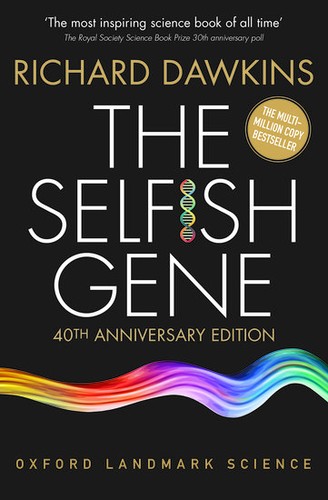
The Selfish Gene
by Richard Dawkins · 1976
Richard Dawkins reframes evolution around the gene, not the individual or the species -- and argues you're best understood as a survival machine your genes built to copy themselves.
Worth reading? The Selfish Gene changed how evolutionary biology gets explained to the public, and the reframe holds up: genes, not individuals or species, are the unit natural selection actually acts on, and organisms are best understood as vehicles genes build to replicate themselves. The 'selfish' in the title trips people up constantly -- Dawkins means it as a description of gene-level competition, not a claim that individual animals (or humans) are inherently selfish, and he says so directly in the book. Read the actual argument before you argue with the title.
| Author | Richard Dawkins |
|---|---|
| Published | 1976 |
| Category | Science & Nature |
| Favorite quote | “We are survival machines -- robot vehicles blindly programmed to preserve the selfish molecules known as genes.” |
The Verdict
Dawkins wrote this as a synthesizer of existing research (particularly W.D. Hamilton’s work on kin selection), not as the originator of gene-centered evolution – his real contribution was making a genuinely technical argument readable and durably popular. Nearly 50 years in print with no serious competitor for “best popular introduction to the topic” says the synthesis worked.
you want the book that popularized gene-centered evolution and coined the word 'meme' -- nearly 50 years old and still the standard popular introduction to how natural selection actually works at the genetic level
you're looking for a book about individual free will or moral philosophy -- Dawkins is making a narrow, technical argument about the unit of selection in evolutionary biology, and readers sometimes mistake his 'selfish gene' metaphor for a claim about human moral character, which he explicitly says it isn't
Book Summary
Dawkins's central claim is that the gene, not the individual organism or the species, is the fundamental unit of natural selection -- genes that are better at getting themselves copied into the next generation persist, and organisms (including humans) are essentially "survival machines" genes have built as vehicles for that replication. This reframe explains behaviors that look altruistic (parents sacrificing for offspring, worker bees sacrificing for a hive) as gene-level self-interest: a gene that helps copies of itself in relatives survive is still propagating itself, even if the individual carrying it doesn't personally reproduce.
In the book's final chapter, Dawkins extends the same logic beyond biology, coining the term "meme" for a unit of cultural information (a tune, an idea, a phrase) that spreads and competes for replication the same way genes do -- a concept that's since taken on a life of its own far beyond evolutionary biology, arguably outrunning the book's original argument in cultural reach.
Top 9 Lessons from The Selfish Gene
- Genes, not individuals or species, are the level at which natural selection actually operates -- individuals are better understood as vehicles genes build for replication.
- Apparently altruistic behavior in nature (parents sacrificing for offspring, alarm calls that put the caller at risk) is explainable as gene-level self-interest via kin selection.
- 'Selfish' in the title describes gene-level competition for replication, not a claim about individual or human moral character -- Dawkins explicitly rejects that reading.
- Reciprocal altruism (cooperation between unrelated individuals who each benefit) can evolve without conscious moral reasoning, driven purely by replication advantage.
- The book introduced the concept of the 'meme' -- a unit of cultural information that spreads and competes for replication analogously to genes.
- Evolutionary success is about a gene's copies persisting across generations, not about any individual organism's survival or happiness.
- Sexual reproduction and parental investment strategies can be modeled as competing genetic strategies rather than as conscious choices.
- Group selection (the idea that traits evolve 'for the good of the species') is largely rejected in favor of gene-level explanations that better fit observed behavior.
- Humans are unique among species in having the cultural capacity to consciously override gene-level 'selfish' programming, which Dawkins presents as a genuinely hopeful closing point.
Top 5 Quotes from The Selfish Gene
"We are survival machines -- robot vehicles blindly programmed to preserve the selfish molecules known as genes."
Richard Dawkins, The Selfish Gene
"Let us try to teach generosity and altruism, because we are born selfish."
Richard Dawkins, The Selfish Gene
"Nature red in tooth and claw sums up our modern understanding of natural selection admirably."
Richard Dawkins, The Selfish Gene
"They are in you and me; they created us, body and mind; and their preservation is the ultimate rationale for our existence."
Richard Dawkins, The Selfish Gene
"We are built as gene machines and cultured as meme machines, but we have the power to turn against our creators."
Richard Dawkins, The Selfish Gene
Frequently Asked Questions
What is the main idea of The Selfish Gene?
That natural selection operates primarily at the level of the gene, not the individual organism or the species -- organisms are best understood as vehicles genes build to replicate themselves.
Does The Selfish Gene argue that humans are inherently selfish?
No, and this is the book's most common misreading. Dawkins is describing gene-level competition, and explicitly argues in the closing chapter that humans are uniquely capable of consciously acting against 'selfish' genetic programming.
What is a 'meme' according to The Selfish Gene?
A unit of cultural information (an idea, tune, or phrase) that spreads and competes for replication the way genes do -- Dawkins coined the term here, decades before it took on its internet-culture meaning.
Is The Selfish Gene still considered accurate science?
The gene-centered view of evolution it popularized remains broadly accepted and influential in evolutionary biology, though some specific claims and framings have been refined or debated by biologists since 1976.
Ready to read it?
Get The Selfish Gene on Amazon