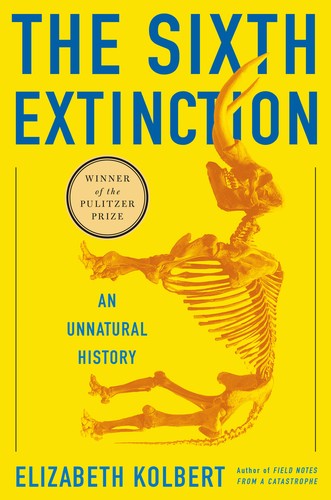
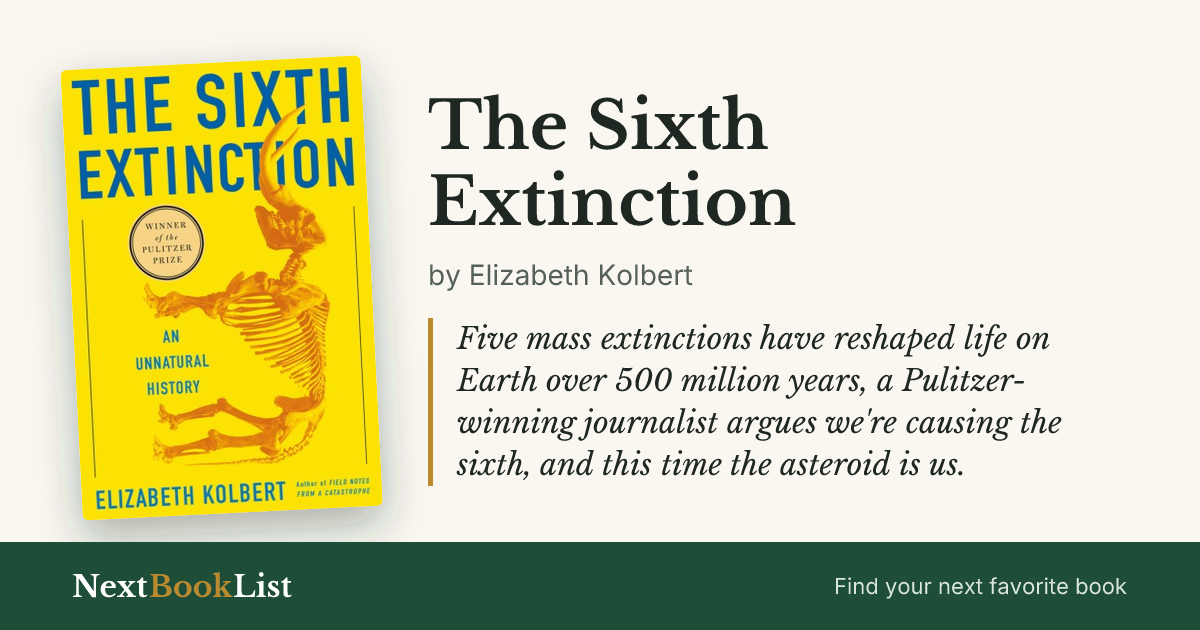
The Sixth Extinction
by Elizabeth Kolbert · 2014
Five mass extinctions have reshaped life on Earth over 500 million years, a Pulitzer-winning journalist argues we're causing the sixth, and this time the asteroid is us.
Worth reading? Kolbert traveled to Panama, Iceland, the Amazon, and the Great Barrier Reef to report this firsthand alongside the scientists tracking the current extinction event, and the reporting rigor is what separates it from typical environmental advocacy writing -- she's building the case through direct field observation and interviews with working researchers, not secondhand alarm. The comparison to the five previous mass extinctions (including the asteroid that ended the dinosaurs) gives the current crisis a scale most climate writing doesn't manage to convey, and the Pulitzer Prize it won reflects the journalism, not just the urgency of the subject.
| Full Title | The Sixth Extinction: An Unnatural History |
|---|---|
| Author | Elizabeth Kolbert |
| Published | 2014 |
| Category | Science & Nature |
| Favorite quote | “It is estimated that one-third of all reef-building corals, a third of all fresh-water mollusks, a third of sharks and rays, a quarter of all mammals, a fifth of all reptiles, and a sixth of all birds are headed toward extinction.” |
The Verdict
Kolbert’s willingness to actually travel to the field sites where extinction is happening, rather than synthesizing secondhand research from a desk, gives this a reporting credibility that most books on the topic don’t have. It’s not comfortable reading, and it isn’t trying to be – it’s trying to be accurate.
you want rigorous science journalism on the current extinction crisis, reported firsthand from the field rather than summarized secondhand
you want a purely optimistic or solutions-focused environmental book -- Kolbert's reporting is clear-eyed and doesn't soften the scale of what's already underway
Book Summary
Earth has experienced five mass extinction events over roughly 500 million years, each wiping out a large percentage of existing species -- the most famous being the asteroid impact that ended the dinosaurs -- and Kolbert's reporting builds the case, through direct field observation across multiple ecosystems, that human activity (habitat destruction, climate change, ocean acidification, invasive species) is driving a sixth extinction event comparable in scale to those previous five, but happening on a timescale of decades and centuries rather than geological time.
She's particularly attentive to how extinction risk compounds through interconnected ecosystems -- a single species' decline (coral, amphibians, specific insects) can cascade through food webs and ecological relationships in ways that are hard to predict in advance, meaning the current extinction event's true scope may not be fully visible until well after specific losses have already become irreversible.
Top 7 Lessons from The Sixth Extinction
- Earth has experienced five mass extinction events over roughly 500 million years, each dramatically reshaping which species survived.
- Current extinction rates, driven by human activity, are comparable in scale to those five previous mass extinctions, but compressed into a much shorter timescale.
- Extinction risk compounds through interconnected ecosystems -- a single species' decline can cascade unpredictably through food webs.
- Ocean acidification, a direct consequence of rising atmospheric CO2, poses a distinct threat to marine life beyond warming temperatures alone.
- The true scope of a mass extinction event may not be fully visible until well after specific, irreversible losses have already occurred.
- Firsthand field reporting alongside working scientists can build a more rigorous case than secondhand environmental advocacy writing.
- Human impact on biodiversity now operates at a geological scale, comparable to historical mass extinction events, not just a local environmental concern.
Top 2 Quotes from The Sixth Extinction
"It is estimated that one-third of all reef-building corals, a third of all fresh-water mollusks, a third of sharks and rays, a quarter of all mammals, a fifth of all reptiles, and a sixth of all birds are headed toward extinction."
Elizabeth Kolbert, The Sixth Extinction
"Right now, in the amazing moment that to us counts as the present, we are deciding, without quite meaning to, which evolutionary pathways will remain open and which will forever be closed."
Elizabeth Kolbert, The Sixth Extinction
Frequently Asked Questions
Is The Sixth Extinction worth reading?
Yes -- it's Pulitzer Prize-winning science journalism built from direct field reporting alongside working researchers, giving the current biodiversity crisis a rigorous, well-evidenced scale rather than secondhand alarm.
What is the main idea of The Sixth Extinction?
Earth has experienced five mass extinction events over roughly 500 million years, and human activity is currently driving a sixth, comparable in scale but compressed into a dramatically shorter timescale than previous extinctions.
Is The Sixth Extinction only about climate change?
No -- while climate change is a significant factor, Kolbert also covers habitat destruction, ocean acidification, and invasive species as distinct drivers of the current extinction event.
Did The Sixth Extinction win any awards?
Yes, it won the 2015 Pulitzer Prize for General Nonfiction, reflecting both the rigor of Kolbert's field reporting and the significance of the subject.
Ready to read it?
Get The Sixth Extinction on Amazon