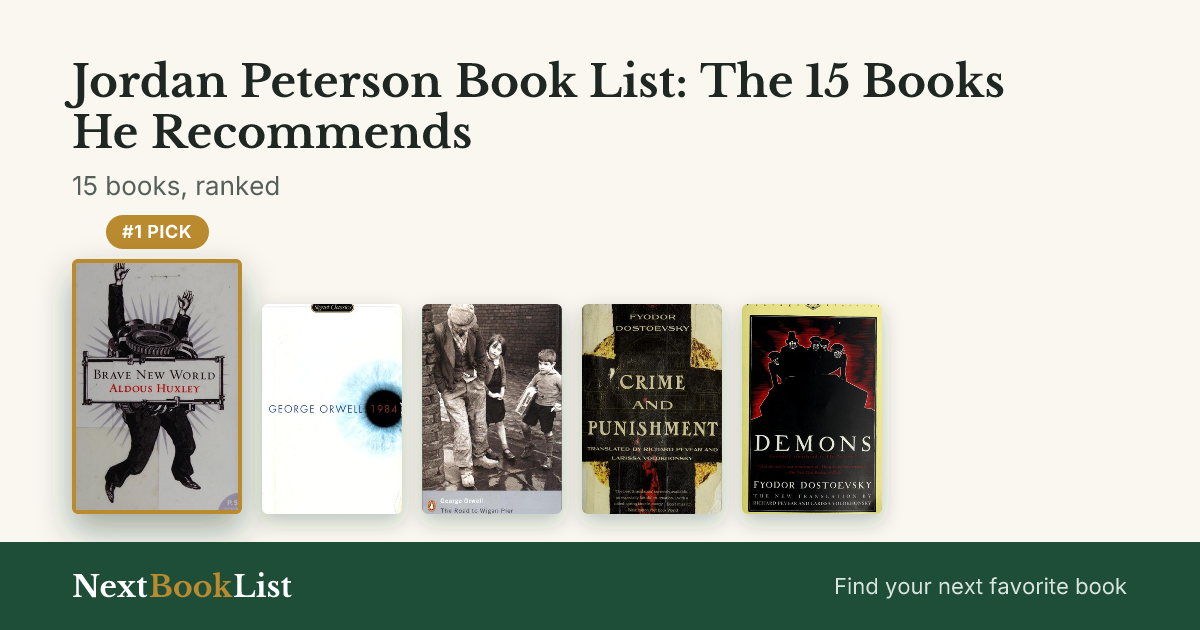
Jordan Peterson Book List: The 15 Books He Recommends

Updated July 20, 2026 · 15 books

Jordan Peterson Book List: The 15 Books He Recommends: ranked list of 15 books

Jordan Peterson has been naming the same core list of books for years, across interviews, his own bibliography, and his lectures, and the pattern is consistent: fiction and history that show what happens when ideology overrides individual conscience, paired with psychology that explains how meaning gets rebuilt afterward. Start with Man’s Search for Meaning or Brave New World if you’re new to this list, both are short and give you the throughline before the harder books.

The dystopian fiction, 1984, Brave New World, Demons, all dramatize the same warning from different angles: ideas detached from conscience don’t liberate people, they possess them. The history titles, The Gulag Archipelago, Ordinary Men, The Rape of Nanking, The Painted Bird, make the same case with documented, non-fictional weight, which is exactly why Peterson pairs them together rather than treating fiction and history as separate categories.

The psychology and religion titles close the list: Man’s Search for Meaning and Modern Man in Search of a Soul on how meaning gets rebuilt after suffering, Affective Neuroscience and A History of Religious Ideas on the biological and historical machinery underneath belief, and Maps of Meaning, Peterson’s own dense academic synthesis of all of it, saved for last on purpose.

One honesty note: this list reflects the fifteen-book bibliography Peterson has cited directly, not the much longer, sprawling reading lists published on his site covering hundreds of titles across a dozen categories. Treat this as his core, repeatedly-cited canon, not the exhaustive version.

Quick Comparison

#BookBest for
1Brave New WorldAldous Huxleyyou want the dystopia that predicted control through pleasure and distraction, not just fear -- which is arguably the more accurate warning for how things actually turned outAmazon
21984George Orwellyou want the foundational dystopia everything from Black Mirror to modern political rhetoric still borrows fromAmazon
3The Road to Wigan PierGeorge Orwellreaders who want firsthand economic reportage paired with an author willing to criticize his own sideAmazon
4Crime and PunishmentFyodor Dostoevskyyou want the foundational psychological novel, the one that basically invented the modern crime-and-guilt narrative before Freud had a name for any of itAmazon
5DemonsFyodor Dostoevskyreaders who want Dostoevsky's most explicitly political novel and a study of ideological extremism's human costAmazon
6Beyond Good and EvilFriedrich Nietzschereaders ready to have their assumptions about morality directly challenged, in short, quotable burstsAmazon
7Ordinary MenChristopher R. Browningreaders who want the most rigorous historical answer to how ordinary people commit atrocityAmazon
8The Painted BirdJerzy Kosinskireaders prepared for one of the most unflinchingly dark novels of the 20th centuryAmazon
9The Rape of NankingIris Changreaders who want a documented, harrowing account of an atrocity that's still underrepresented in most WWII educationAmazon
10The Gulag ArchipelagoAleksandr Solzhenitsynreaders who want the definitive firsthand account of the Soviet labor camp system, from someone who survived itAmazon
11Man's Search for MeaningViktor E. Franklanyone facing suffering they can't change, which is eventually everyoneAmazon
12Modern Man in Search of a SoulCarl Jungreaders who want Jung's core ideas without diving straight into his denser clinical worksAmazon
13Maps of MeaningJordan B. Petersonreaders who've read 12 Rules for Life and want the denser academic scaffolding underneath itAmazon
14A History of Religious Ideas, Volume 1Mircea Eliadereaders who want a serious, scholarly survey of how religious belief actually developed across the ancient worldAmazon
15Affective NeuroscienceJaak Pankseppreaders who want the rigorous neuroscience foundation under pop-psychology claims about emotionAmazon

The Books

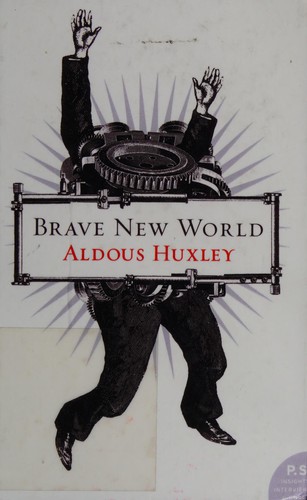
Brave New World by Aldous Huxley book cover

1. Brave New World

Aldous Huxley · 1932

A future where nobody needs to be oppressed into obedience because everyone's been engineered, drugged, and entertained into never wanting to rebel.

The genius of the premise is that nobody in the World State is lying to you – they really are happy, mostly. Huxley’s argument isn’t that the system is built on deception, it’s that contentment this total is itself the horror. That’s a harder, sadder point than “the government is bad,” and it’s why this one still lands.

Read it if: you want the dystopia that predicted control through pleasure and distraction, not just fear -- which is arguably the more accurate warning for how things actually turned out

Skip it if: you want a plot-driven thriller with a clear villain -- this is more idea-novel than page-turner, and the ending is deliberately unresolved rather than triumphant
Full verdict: Brave New World →

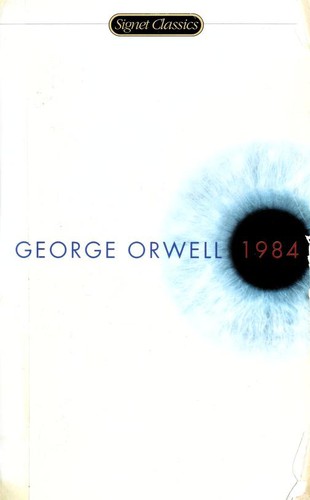
1984 by George Orwell book cover

2. 1984

George Orwell · 1949

The book that gave surveillance states, propaganda, and thought control their permanent vocabulary -- Big Brother, doublethink, thoughtcrime, Newspeak.

Orwell’s actual achievement isn’t the plot, which is fairly simple once you strip the political architecture away – it’s that he built a self-consistent totalitarian logic (doublethink, Newspeak, the mutability of the past) so complete that the vocabulary escaped the novel and became how we talk about real surveillance states.

The middle section, a long excerpt from a fictional book on the theory of the Party’s power structure, is where most readers stall out – it’s essay, not narrative. Push through it; the ending is worth it, and it’s the part of the book that explains why the Party wants belief, not just obedience.

Read it if: you want the foundational dystopia everything from Black Mirror to modern political rhetoric still borrows from

Skip it if: you want fast-paced plot -- the middle third is a long, dense excerpt from a fictional political treatise that tests patience even among fans

Full verdict: 1984 →

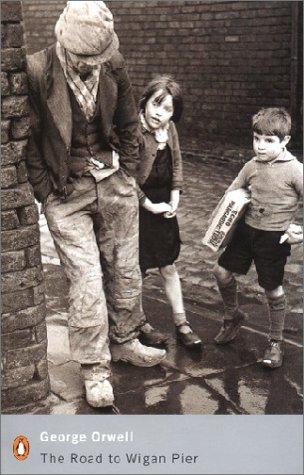
The Road to Wigan Pier by George Orwell book cover

3. The Road to Wigan Pier

George Orwell · 1937

Orwell goes underground into England's Depression-era coal towns, then turns the second half into a brutally honest essay on why socialism keeps failing to win over the working class it claims to speak for.

Orwell doesn’t let anyone off easy in this book, not the mine owners, not the government, and not his own socialist allies. The reportage half earns its reputation on documentary detail alone; the essay half is what makes people still argue about it nearly a century later.

Read it if: readers who want firsthand economic reportage paired with an author willing to criticize his own side

Skip it if: you want a tidy political argument, Orwell spends half the book attacking his own movement's failures

Full verdict: The Road to Wigan Pier →

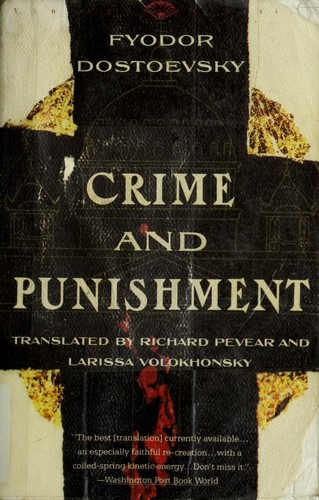
Crime and Punishment by Fyodor Dostoevsky book cover

4. Crime and Punishment

Fyodor Dostoevsky · 1866

A broke ex-student in St. Petersburg murders a pawnbroker to prove he's exempt from ordinary morality -- then spends 500 pages finding out he isn't.

What holds up best isn’t the murder plot – it’s Porfiry Petrovich, the detective who never needs to catch Raskolnikov in a lie because he understands his psychology better than Raskolnikov understands himself. That cat-and-mouse dynamic, built entirely on conversation rather than evidence, is the template a lot of modern psychological thrillers are still copying without crediting the source.

Read it if: you want the foundational psychological novel, the one that basically invented the modern crime-and-guilt narrative before Freud had a name for any of it

Skip it if: you're not ready for a genuine commitment -- this is a long, dense 19th-century Russian novel with a wall of patronymic names (Rodion Romanovich, Sofya Semyonovna) and a slow, interior first third; it rewards patience more than it grabs you

Full verdict: Crime and Punishment →

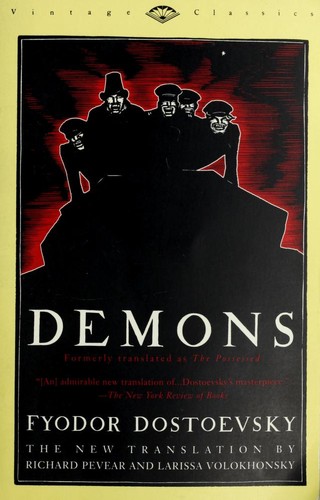
Demons by Fyodor Dostoevsky book cover

5. Demons

Fyodor Dostoevsky · 1872

Dostoevsky's darkest political novel, a small Russian town infiltrated by revolutionary nihilists, written as a warning about what happens when ideology replaces conscience.

This is the Dostoevsky novel written with real anger, at a real murder, by real revolutionaries he watched corrupt idealism into atrocity. It’s less famous than Crime and Punishment for a reason (it’s harder, sprawling, less tightly plotted), but its warning about ideology overriding conscience has aged into one of his most relevant books.

Read it if: readers who want Dostoevsky's most explicitly political novel and a study of ideological extremism's human cost

Skip it if: you want a shorter, gentler entry point to Dostoevsky, start with Crime and Punishment instead

Full verdict: Demons →

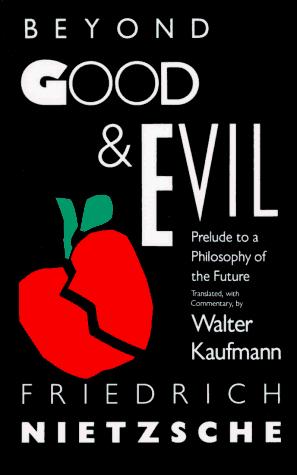
Beyond Good and Evil by Friedrich Nietzsche book cover

6. Beyond Good and Evil

Friedrich Nietzsche · 1886

Nietzsche's aphoristic attack on centuries of moral philosophy, arguing that 'good' and 'evil' are historical inventions, not eternal truths, written to unsettle you on purpose.

Nietzsche isn’t trying to win an argument here, he’s trying to dislodge assumptions you didn’t know you were making. Read slowly, expect discomfort, and don’t mistake the aphoristic style for looseness, every fragment is doing deliberate philosophical work.

Read it if: readers ready to have their assumptions about morality directly challenged, in short, quotable bursts

Skip it if: you want a systematic argument with a clear conclusion, Nietzsche writes in aphorisms designed to provoke, not a linear case

Full verdict: Beyond Good and Evil →

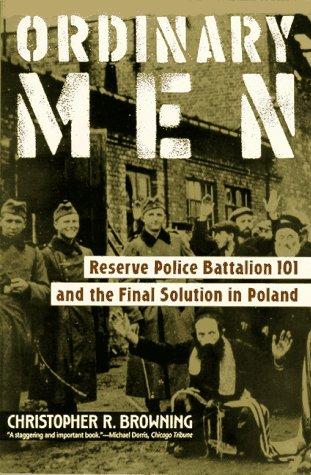
Ordinary Men by Christopher R. Browning book cover

7. Ordinary Men

Christopher R. Browning · 1992

A historian uses surviving trial testimony to show how a battalion of middle-aged German reservists, not fanatics, became mass murderers, and what that says about all of us.

This isn’t an easy book, and it shouldn’t be. Browning built his argument from actual postwar testimony, not theory, and the uncomfortable finding, that permission to refuse didn’t stop most men from participating, is exactly why the book still gets assigned in psychology and history courses decades later.

Read it if: readers who want the most rigorous historical answer to how ordinary people commit atrocity

Skip it if: the subject matter, sustained detail on mass killing, is genuinely difficult reading

Full verdict: Ordinary Men →

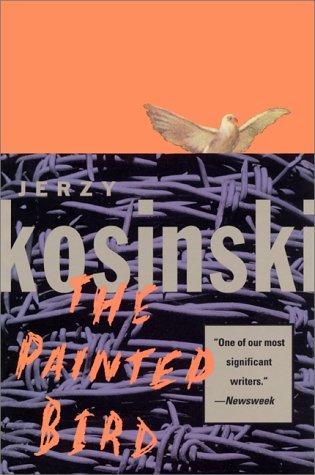
The Painted Bird by Jerzy Kosinski book cover

8. The Painted Bird

Jerzy Kosinski · 1965

A boy wanders alone through Nazi-occupied Eastern European villages in this brutal, controversial novel about what unsupervised cruelty does to a child.

This is not an easy recommendation, and it isn’t meant to be. Kosinski’s novel earns its reputation as one of the darkest books on any reading list by refusing every comfort, every redemption arc, every institutional safety net a reader might expect. Approach it knowing exactly what you’re signing up for.

Read it if: readers prepared for one of the most unflinchingly dark novels of the 20th century

Skip it if: you're not in a place to read sustained, graphic depictions of cruelty toward a child

Full verdict: The Painted Bird →

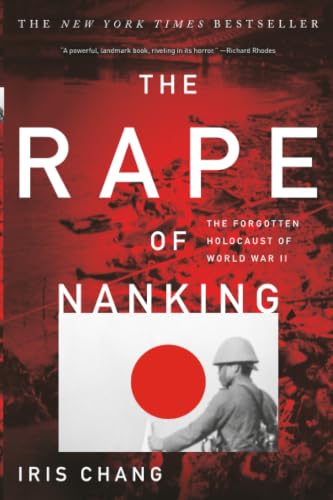
The Rape of Nanking by Iris Chang book cover

9. The Rape of Nanking

Iris Chang · 1997

The book that forced a largely Western audience to confront a 1937 atrocity in China that had been left out of most WWII histories entirely.

Chang wrote this in her twenties and it became the book that put the Nanking Massacre on the map for readers who had never encountered it in a WWII history course. It’s harrowing by necessity, not for effect, and it belongs on any serious 20th-century history shelf.

Read it if: readers who want a documented, harrowing account of an atrocity that's still underrepresented in most WWII education

Skip it if: you're not prepared for sustained, graphic historical detail about mass killing and sexual violence

Full verdict: The Rape of Nanking →

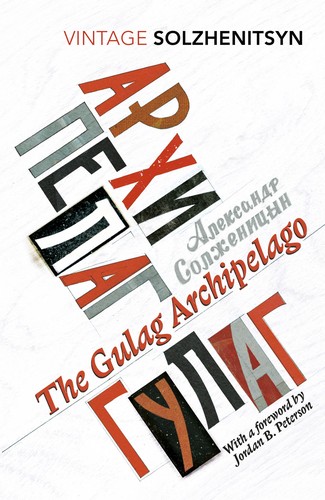
The Gulag Archipelago by Aleksandr Solzhenitsyn book cover

10. The Gulag Archipelago

Aleksandr Solzhenitsyn · 1973

Solzhenitsyn's own eight years in Soviet labor camps became the foundation for the book that exposed the gulag system to the world, and later got a foreword from Jordan Peterson himself.

Solzhenitsyn didn’t write this for comfort, he wrote it because he’d lived through the system he was documenting and wanted a record no propaganda could erase. Even in abridged form it’s long and deliberately unrelenting, and it’s exactly that refusal to soften the material that made it the book that changed how the West understood Soviet communism.

Read it if: readers who want the definitive firsthand account of the Soviet labor camp system, from someone who survived it

Skip it if: you want a light read, this is long, dense, and deliberately unrelenting, even in the abridged edition

Full verdict: The Gulag Archipelago →

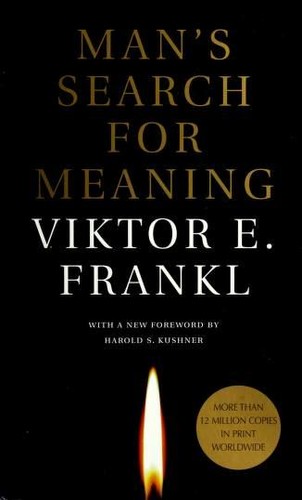
Man's Search for Meaning by Viktor E. Frankl book cover

11. Man's Search for Meaning

Viktor E. Frankl · 1946

A psychiatrist survives the camps and emerges with one claim: meaning, not happiness, keeps people alive.

Half memoir of Auschwitz, half introduction to logotherapy. Frankl’s observation (those who had a why survived the how) has carried this book through nearly eighty years and dozens of languages. Between stimulus and response there is a space, and in that space is your freedom. Short enough to read in two sittings. Stays with you for decades.

Read it if: anyone facing suffering they can't change, which is eventually everyone

Skip it if: nobody. If one book on this site is unskippable, it's this one.

Full verdict: Man's Search for Meaning →

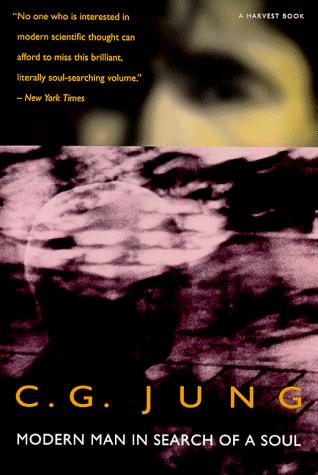
Modern Man in Search of a Soul by Carl Jung book cover

12. Modern Man in Search of a Soul

Carl Jung · 1933

The most accessible entry point into Jung's thinking, a collection of essays on dreams, the unconscious, and why modern life leaves people spiritually unmoored.

This is the Jung book people actually recommend to beginners, and for good reason: it collects his more accessible lectures on dreams, religion, and modern meaning-making without requiring you to already know his clinical vocabulary. Start here before his denser works.

Read it if: readers who want Jung's core ideas without diving straight into his denser clinical works

Skip it if: you want a single sustained argument, this is a curated essay collection, not one continuous book

Full verdict: Modern Man in Search of a Soul →

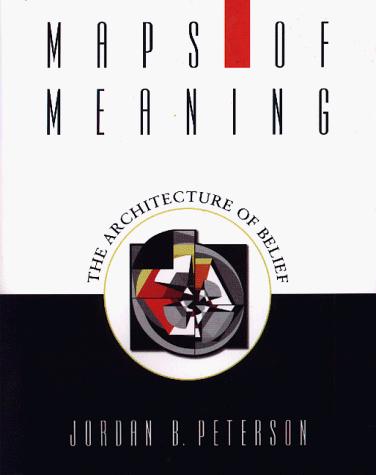
Maps of Meaning by Jordan B. Peterson book cover

13. Maps of Meaning

Jordan B. Peterson · 1999

Peterson's dense, foundational academic work, twenty years before 12 Rules for Life, arguing that ancient myths encode psychological survival knowledge modern rationalism dismisses too quickly.

This is Peterson before the public persona, writing a genuinely difficult academic book that took him over a decade to complete. Every idea he later popularized traces back here. Read 12 Rules for Life first if you’re new to him; come back to this once you want the theory underneath the rules.

Read it if: readers who've read 12 Rules for Life and want the denser academic scaffolding underneath it

Skip it if: you want Peterson's accessible, popular writing, start with 12 Rules for Life instead

Full verdict: Maps of Meaning →

A History of Religious Ideas, Volume 1 by Mircea Eliade book cover

14. A History of Religious Ideas, Volume 1

Mircea Eliade · 1978

A landmark scholar of comparative religion traces spiritual belief from Paleolithic burial rites through ancient Egypt, Mesopotamia, and Greek mystery religions, the first of a three-volume survey.

This is a genuine scholarly undertaking, not a popular history, and it rewards patient readers with one of the most comprehensive comparative surveys of ancient religious thought available. Volume 1 alone covers enormous ground, from Paleolithic burial sites to Greek mystery cults, treating each with the same rigor.

Read it if: readers who want a serious, scholarly survey of how religious belief actually developed across the ancient world

Skip it if: you want a light overview, this is a dense academic reference work, not a casual read

Full verdict: A History of Religious Ideas, Volume 1 →

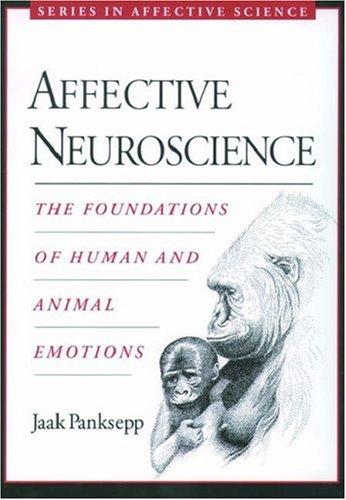
Affective Neuroscience by Jaak Panksepp book cover

15. Affective Neuroscience

Jaak Panksepp · 1998

The textbook that established emotion as a legitimate neuroscience research subject, mapping the actual brain circuits behind rage, fear, play, and seeking.

This is the primary source, not a summary of it. Panksepp built the actual field of affective neuroscience with this book, and its seven-system framework for basic emotion still underlies a huge amount of later, more accessible psychology writing. Dense, but foundational.

Read it if: readers who want the rigorous neuroscience foundation under pop-psychology claims about emotion

Skip it if: you want an accessible pop-science book, this is a graduate-level neuroscience textbook

Full verdict: Affective Neuroscience →

Frequently Asked Questions

What book does Jordan Peterson recommend most?

He most often points to The Gulag Archipelago and Man's Search for Meaning as the books that most shaped his thinking on ideology, suffering, and individual responsibility. He wrote the foreword to the Vintage Classics abridged edition of the Gulag Archipelago.

Which Jordan Peterson-recommended book should I read first?

Man's Search for Meaning or Brave New World. Both are short, accessible, and give you the throughline (finding meaning under constraint) that runs through the harder, longer books later on this list.

Why do so many dystopian novels appear on this list?

Peterson treats 1984, Brave New World, and Demons as case studies in what happens when ideology overrides individual conscience, the same theme that runs through the nonfiction history titles like The Gulag Archipelago and Ordinary Men.

Is Maps of Meaning a good starting point for Jordan Peterson's own books?

No. It's his dense academic foundation text, most readers should start with his more accessible public writing and treat Maps of Meaning as the theory underneath it, read once you already want the deeper scaffolding.

Keep Reading