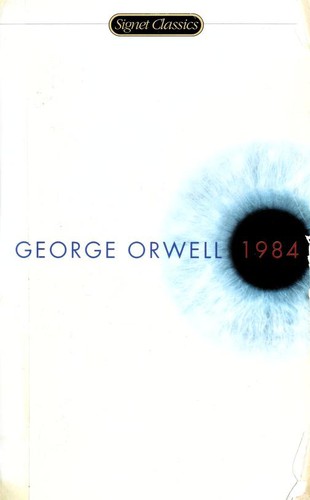
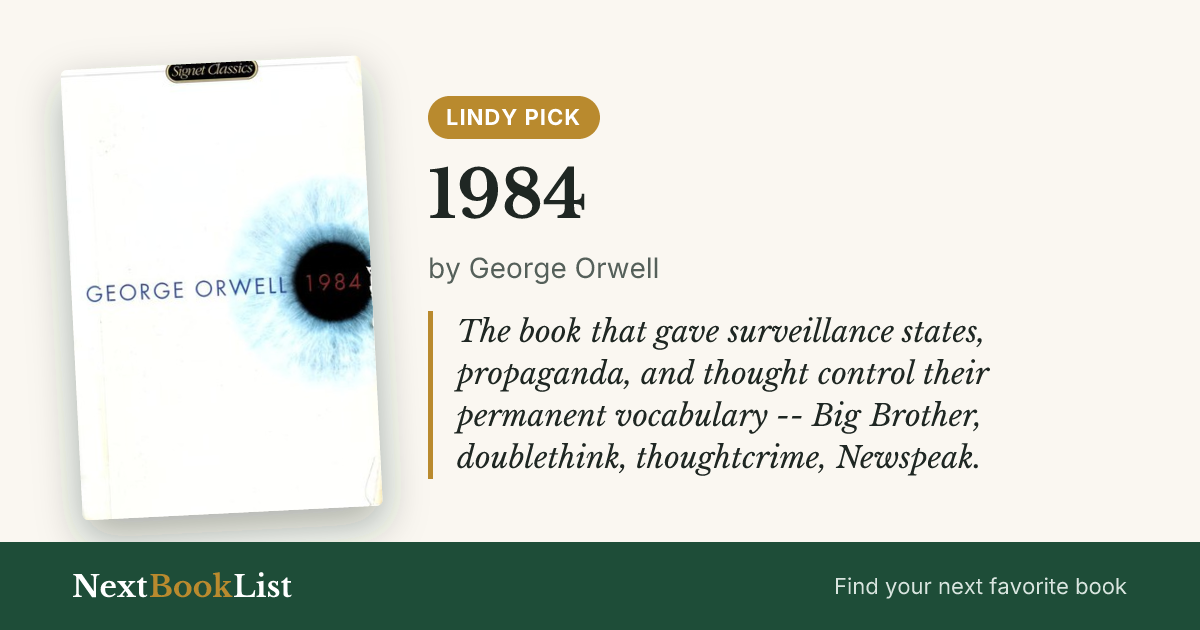
1984
by George Orwell · 1949
The book that gave surveillance states, propaganda, and thought control their permanent vocabulary -- Big Brother, doublethink, thoughtcrime, Newspeak.
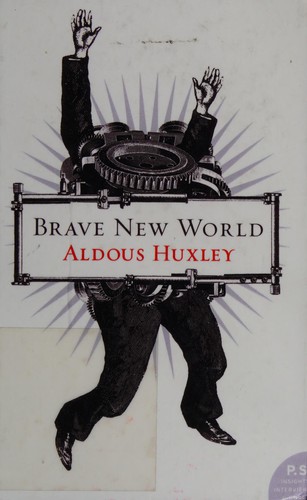
Worth reading? 1984 is the most influential dystopian novel ever written, more politically load-bearing than Brave New World and bleaker by design -- Huxley warned we'd be controlled by pleasure, Orwell warned we'd be controlled by pain and lies, and Orwell's vocabulary is the one that stuck. Read it once as an adult, not just in high school, because the political point lands differently once you've watched actual propaganda work.
| Full Title | Nineteen Eighty-Four |
|---|---|
| Author | George Orwell |
| Published | 1949 |
| Publisher | Signet Classics |
| Category | Fiction |
| Favorite quote | “Big Brother is watching you.” |
The Verdict
Orwell’s actual achievement isn’t the plot, which is fairly simple once you strip the political architecture away – it’s that he built a self-consistent totalitarian logic (doublethink, Newspeak, the mutability of the past) so complete that the vocabulary escaped the novel and became how we talk about real surveillance states.
The middle section, a long excerpt from a fictional book on the theory of the Party’s power structure, is where most readers stall out – it’s essay, not narrative. Push through it; the ending is worth it, and it’s the part of the book that explains why the Party wants belief, not just obedience.
you want the foundational dystopia everything from Black Mirror to modern political rhetoric still borrows from
you want fast-paced plot -- the middle third is a long, dense excerpt from a fictional political treatise that tests patience even among fans
Book Summary
Winston Smith works at the Ministry of Truth rewriting history to match whatever the Party currently claims, in a totalitarian state that maintains power not just through violence but through controlling language and memory itself -- if a fact isn't recorded and nobody remembers it happening differently, it didn't happen.
The novel's key mechanism is doublethink: the ability to hold two contradictory beliefs simultaneously and accept both, which the Party requires of its citizens as the real foundation of control, more than fear of the telescreens. Newspeak, the Party's shrinking official language, is designed to make certain rebellious thoughts literally unthinkable by removing the words for them.
Winston's affair with Julia and his secret diary are acts of rebellion that the novel ultimately crushes completely. Room 101 doesn't just punish Winston, it reprograms him to genuinely love Big Brother, which is the point: the Party doesn't want obedience, it wants belief.
Top 10 Lessons from 1984
- Controlling the historical record -- rewriting old newspapers, erasing people -- is as powerful a tool as controlling the present.
- Doublethink, holding two contradictory beliefs and accepting both, is the real mechanism of control, not just fear.
- Newspeak shrinks the language deliberately, on the theory that you can't think a thought you have no words for.
- Surveillance (telescreens, the Thought Police) works less through catching everyone and more through making everyone assume they might be watched.
- Private love and personal loyalty are treated by the Party as the last refuge of independent thought, which is why it targets them specifically.
- The Party's ultimate goal in Room 101 isn't obedience, it's genuine belief -- breaking Winston means making him actually love Big Brother.
- War in the novel is perpetual and rotates enemies by design, which keeps the population unified against a threat that never resolves.
- The proles are left mostly unsurveilled because the Party judges them powerless enough not to matter -- ignorance, not force, keeps them controlled.
- Objective truth is the real casualty of the novel -- 'two plus two makes five' is the endpoint of successful doublethink.
- The novel's bleakness is a deliberate rebuttal to utopian science fiction of its era -- Orwell wanted a warning, not a cautionary tale with a safety net.
Top 7 Quotes from 1984
"War is peace. Freedom is slavery. Ignorance is strength."
George Orwell, 1984
"Big Brother is watching you."
George Orwell, 1984
"If you want a picture of the future, imagine a boot stamping on a human face -- forever."
George Orwell, 1984
"Who controls the past controls the future. Who controls the present controls the past."
George Orwell, 1984
"Freedom is the freedom to say that two plus two make four. If that is granted, all else follows."
George Orwell, 1984
"It was a bright cold day in April, and the clocks were striking thirteen."
George Orwell, 1984
"Doublethink means the power of holding two contradictory beliefs in one's mind simultaneously, and accepting both of them."
George Orwell, 1984
Frequently Asked Questions
Is 1984 worth reading?
Yes -- it's the foundational dystopian novel and the source of the vocabulary (Big Brother, doublethink, thoughtcrime) still used to describe real surveillance and propaganda today.
Is 1984 hard to read?
The prose itself is clear and readable, but the middle section (a long excerpt from a fictional political treatise) is dense and stalls out some readers. Push through it.
What is the main theme of 1984?
That total control requires controlling truth, memory, and language itself, and that the goal of totalitarian power is genuine belief, not mere obedience.
Who should read 1984?
Anyone who wants the foundational dystopia everything since has borrowed from. Reread it as an adult even if you read it in school -- the political point lands differently.
Ready to read it?
Get 1984 on Amazon